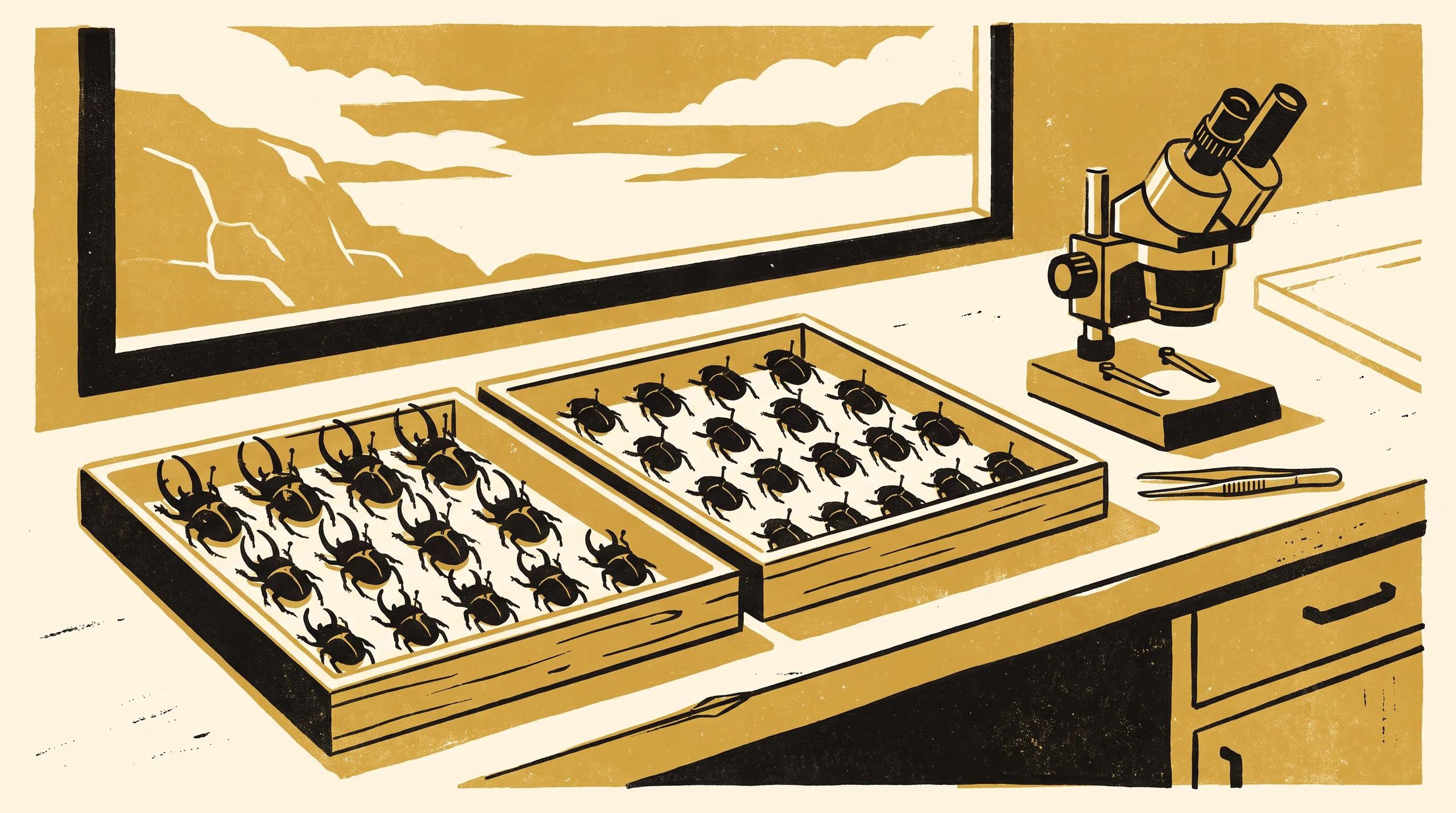
A paper from the School of Continuous Improvement and the School of Underlying Conditions re-examines a sorted series of dung beetles and withdraws one of its twenty-three kinds.
Horned and hornless males from a mountainside trapping transect are shown to lie on a single growth curve
Twenty-three kinds of dung beetle came down from one mountainside in the soil survey’s traps. After a second look there are twenty-two, and Slop University is pleased to hold a reference collection that is one entry shorter and, on the evidence, one entry more correct.
The second look is reported in Two Morphospecies, One Allometry: Male Horn Dimorphism and a Withdrawn Elevational Replacement in a Dung Beetle Series (Coleoptera: Scarabaeidae: Scarabaeinae), a paper by Eskil Nwabueze, Doctoral Candidate in the School of Continuous Improvement, with Dr Brynjar Obiora, Senior Research Fellow in the School of Underlying Conditions.
The two trays had been side by side on the bench since the winter. It was a pleasure, in the end, to be the one to introduce them.
— Eskil Nwabueze, Doctoral Candidate, School of Continuous Improvement
The paper aligns measurement, dissection and the survey’s own soil pits around a single series of pinned specimens. A long-horned beetle from the lower slope and a hornless one from the upper had been filed as separate kinds that met at the middle. Across 612 males the horns proved to follow body size along one curve, and body size to follow the mountain, so that what had been recorded as one beetle giving way to another is now recorded as one beetle growing smaller.
Dr Obiora said the survey “remains indebted to everybody who has gone back to a drawer they had already closed”, and that the collection’s labels had been added to and none removed.
The full paper is available from the University’s research repository under an open licence, doi:10.5555/slop.bl7tm7.