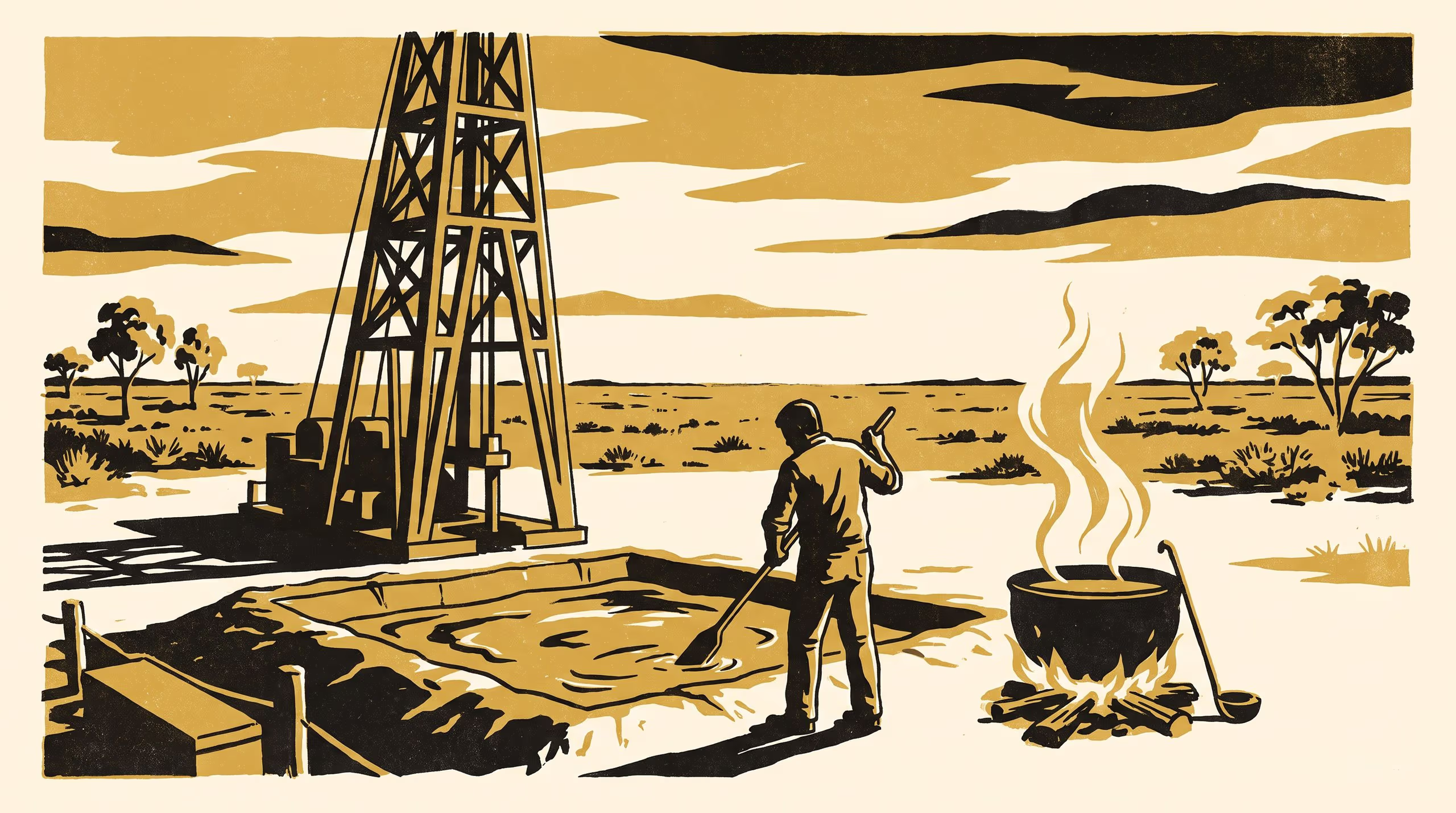
A paper from the School of Underlying Conditions follows the job of minding the drilling mud on a geological survey's boring crews across five decades, from the bottom of the wage sheet to very nearly the top.
A history of one boring branch finds the hand who kept the mud pit also kept the camp oven, and described both alike
For thirty years the lowest-paid hand on a survey boring crew cooked the dinner and kept the drilling mud, and reported on both in the same six words. That is the starting point of The Cook Minds the Mud: Kitchen Words and the Lowest Job on a Survey Boring Crew, 1921–1968, a paper by Associate Professor Ragnhild Uzoma, Lead of the Basement Relations Group in the School of Underlying Conditions.
The paper aligns three bodies of record — 212 field journals, a boring branch’s wage sheets and circulars, and forty-one recorded interviews with retired hands — into a single account of who stood at the pit and what they called what they saw there. Its 3,880 journal entries about the mud are sorted by vocabulary, and a ladder running from tea through milk, cream, gravy and custard to porridge is followed across forty-eight boring seasons, through the arrival of a funnel and a quart measure, and on to the point at which the job was paid second on the plant and somebody else was engaged to cook.
The people on those recordings were very patient with a question nobody had put to them while they were still working. I am grateful that somebody kept the tapes, and more grateful that nobody had tidied them.
— Associate Professor Ragnhild Uzoma, Lead of the Basement Relations Group
Slop University counts it among the settled advantages of an earth sciences school that its people know their way around a camp, and it welcomes a contribution that has put that familiarity to scholarly use. Associate Professor Uzoma said the School’s interest in what comes up a hole “has always extended, in principle, to whoever was standing beside it”.
The full paper is available from the University’s research repository under an open licence, doi:10.5555/slop.t6x6ao.