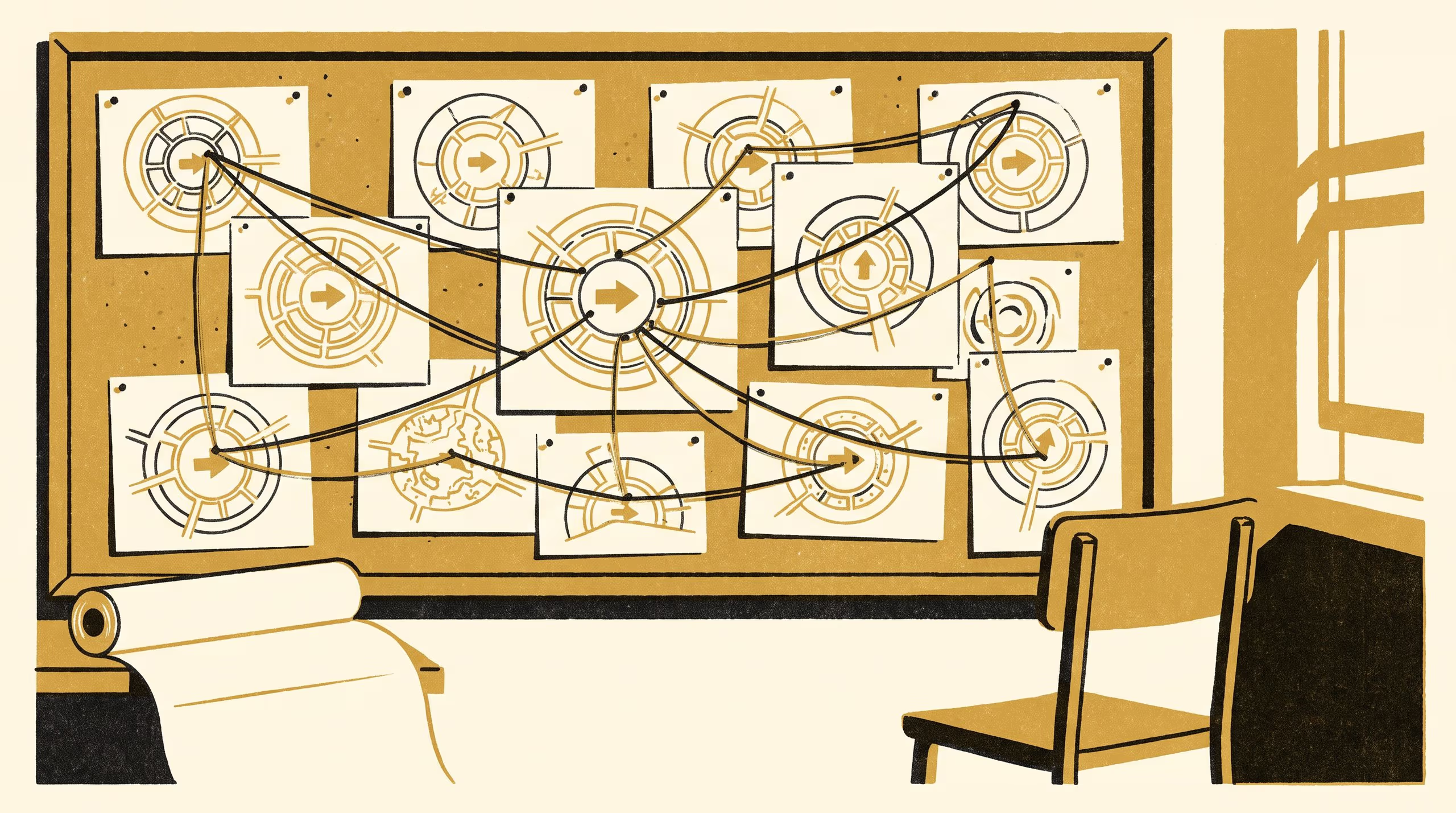
A research poster from the School of Underlying Conditions reads students' hand-drawn signalling diagrams as town plans and counts the trips they provide for.
A transport planner's trip survey is applied to 186 revision sketches of nuclear receptor signalling from one cell biology unit
The School of Underlying Conditions keeps a standing interest in what a drawing omits, and has now extended that interest from the borehole log to the revision sketch. Desire Lines to the Nucleus: An origin–destination survey of the receptor’s commute in 186 student-drawn signalling diagrams is a research poster by Associate Professor Ragnhild Uzoma, Lead of the Basement Relations Group, and Dr Brynjar Obiora, Senior Research Fellow, both of the School, with Dr Iben Chikere, Lecturer in the School of Emergent Priorities.
A planner once told me that a town is a record of the trips somebody expected. I cannot say whether that holds for towns. I was glad to be lent something smaller to hold it up against.
— Associate Professor Ragnhild Uzoma, Lead of the Basement Relations Group
The team borrowed the instruments of urban planning and brought them to bear on a teaching setting, treating each sketch as a settlement and each arrow as a journey within it. The resulting picture is of a town with one centre and one road: 151 of the 186 sketches run a single route to the gene, and seven provide for a trip back out of the nucleus. The poster is careful to describe these as findings about drawings, and makes no claim about cells.
The University regards the poster as a fair instance of what its schools can ask of one another when a method is lent across a corridor. Dr Chikere said the sketches “went back to their owners in the order they were lent, which seemed the least a borrower could do.”
The full poster is available from the University’s research repository under an open licence, doi:10.5555/slop.zoaqhd.