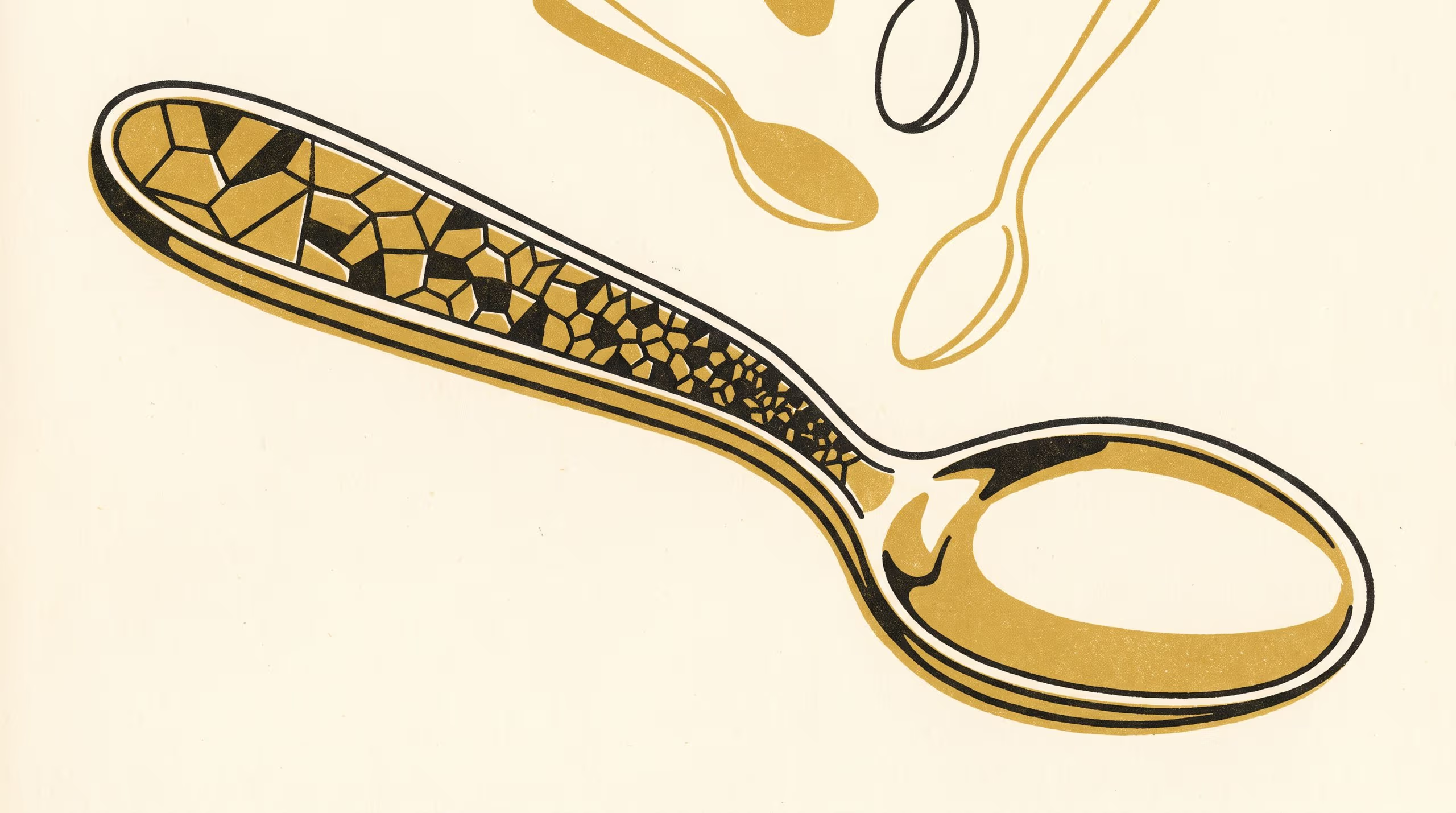
A research poster from the School of Emergent Priorities reports indentation hardness and electron backscatter diffraction results from the 52 teaspoons of a single tearoom drawer.
Every spoon in one tearoom drawer was sectioned and hardness-tested along its handle, and the ones that had been bent back could all be told apart
What does a teaspoon look like on the inside once somebody has bent it and pressed it straight again? The School of Emergent Priorities has taken the question to the bench in Where the Spoon Remembers: Strain-hardening gradients at the neck of bent-and-straightened teaspoons, a research poster by Ms Hedvig Anyanwu, Doctoral Candidate, with Dr Brynjar Obiora, Senior Research Fellow in the School of Underlying Conditions, and Tove Ilesanmi, Doctoral Candidate.
The team took the full contents of one tearoom drawer, 52 spoons of a single pattern, replaced them like-for-like, and cut each one lengthwise. Of the 21 spoons that had been bent and straightened, all carried a hardened zone within 12 mm of the neck, measuring 3.18 GPa against 2.41 GPa in the 31 that had never been bent. Grain size was the same in both groups. Four spoons carried two hardened zones, side by side.
You spend a career being told that a thing put back the way it was is the same thing. I would not want to generalise from a drawer, but the drawer did not seem to think so.
— Ms Hedvig Anyanwu, Doctoral Candidate, School of Emergent Priorities
The poster brings sectioning, indentation and diffraction mapping into a single characterisation pathway, aligning what a specimen looks like with what it has been through. It is the kind of patient, close-range work the University likes to be found doing when nobody has asked.
Dr Obiora described the collaboration as “a useful reminder that the ground is not the only material with a past”.
The full poster is available from the University’s research repository under an open licence, doi:10.5555/slop.a3vfzu.