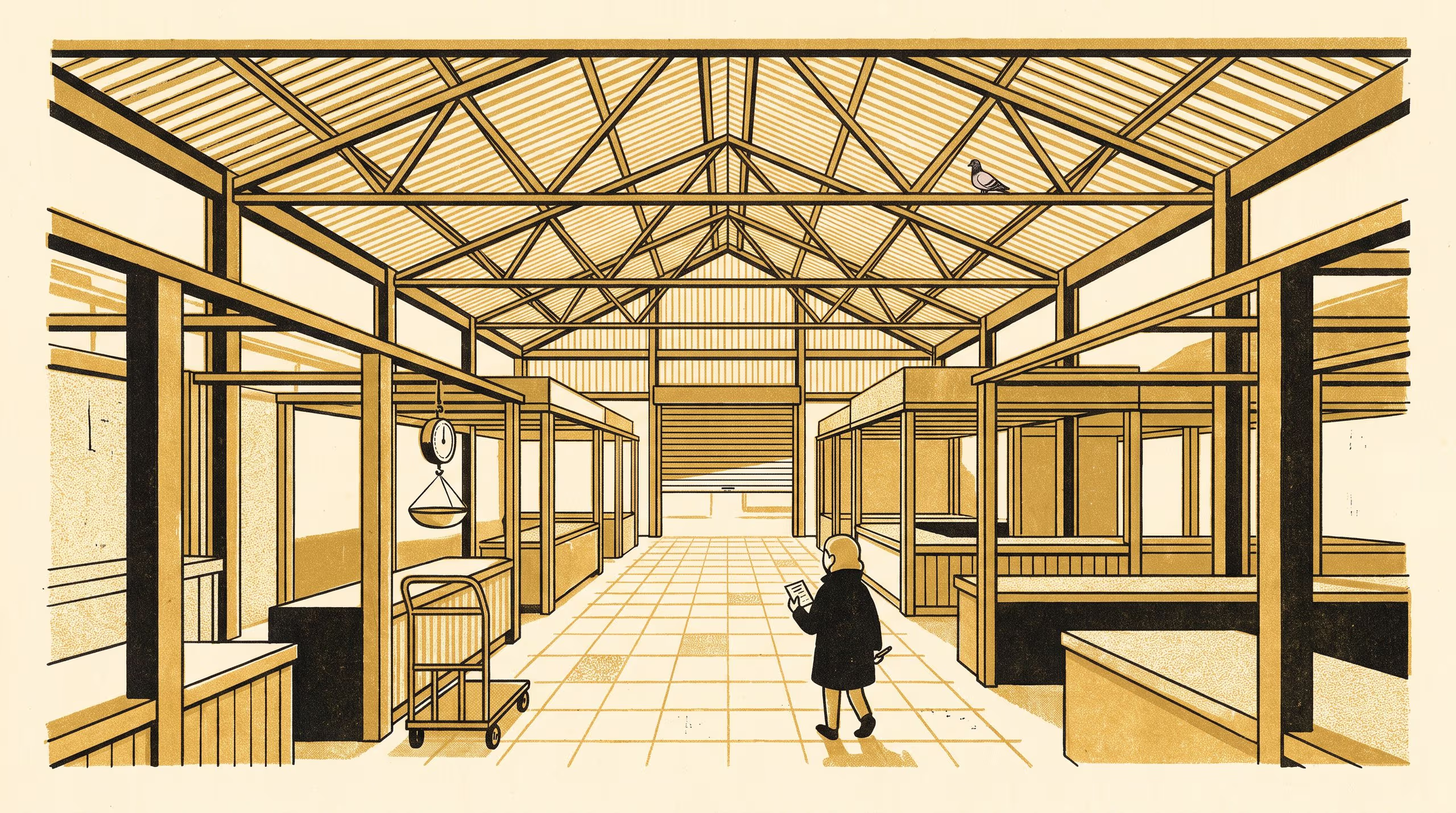
A paper from the School of Underlying Conditions applies the statistics of unseen species to the lists of sounds that listeners write down on a walk through a covered market.
Twenty-four cards from one market hall are read for what none of them contains
“Write down each different sound you notice, and what is making it, once only.” That was the whole of the instruction handed to twenty-four people at the door of a covered market hall, and the cards they returned are the subject of Heard Once: Sample Coverage and the Number of Unheard Sound Sources in a Soundwalk Inventory, a paper by Associate Professor Ragnhild Uzoma, Associate Professor and Lead, Basement Relations Group, and Dr Vigdis Emenike, Senior Lecturer, both of the School of Underlying Conditions.
The paper carries an established body of sampling theory across to the practice of listening, aligning the inventory, the listener and the coding of the cards within a single completeness framework. Its cards hold 118 kinds of sound, 24 of them written down by one listener alone, and from that pattern the authors arrive at an estimate of at least sixteen further kinds that were there to be heard and appear on no card at all.
A list is a modest thing to hand back to a place. We have tried to say how modest, and we rather think the place would want to be told.
— Associate Professor Ragnhild Uzoma, Associate Professor and Lead, Basement Relations Group
It falls to a university, from time to time, to be exact about an absence, and the University is glad to see the task taken up by a school whose ordinary business lies some distance below the floor of any market. Dr Emenike said the cards had been kept, “and the hall, so far as either of us is aware, is still making most of the same noises, which leaves the matter pleasantly open.”
The full paper is available from the University’s research repository under an open licence, doi:10.5555/slop.rwfe7f.