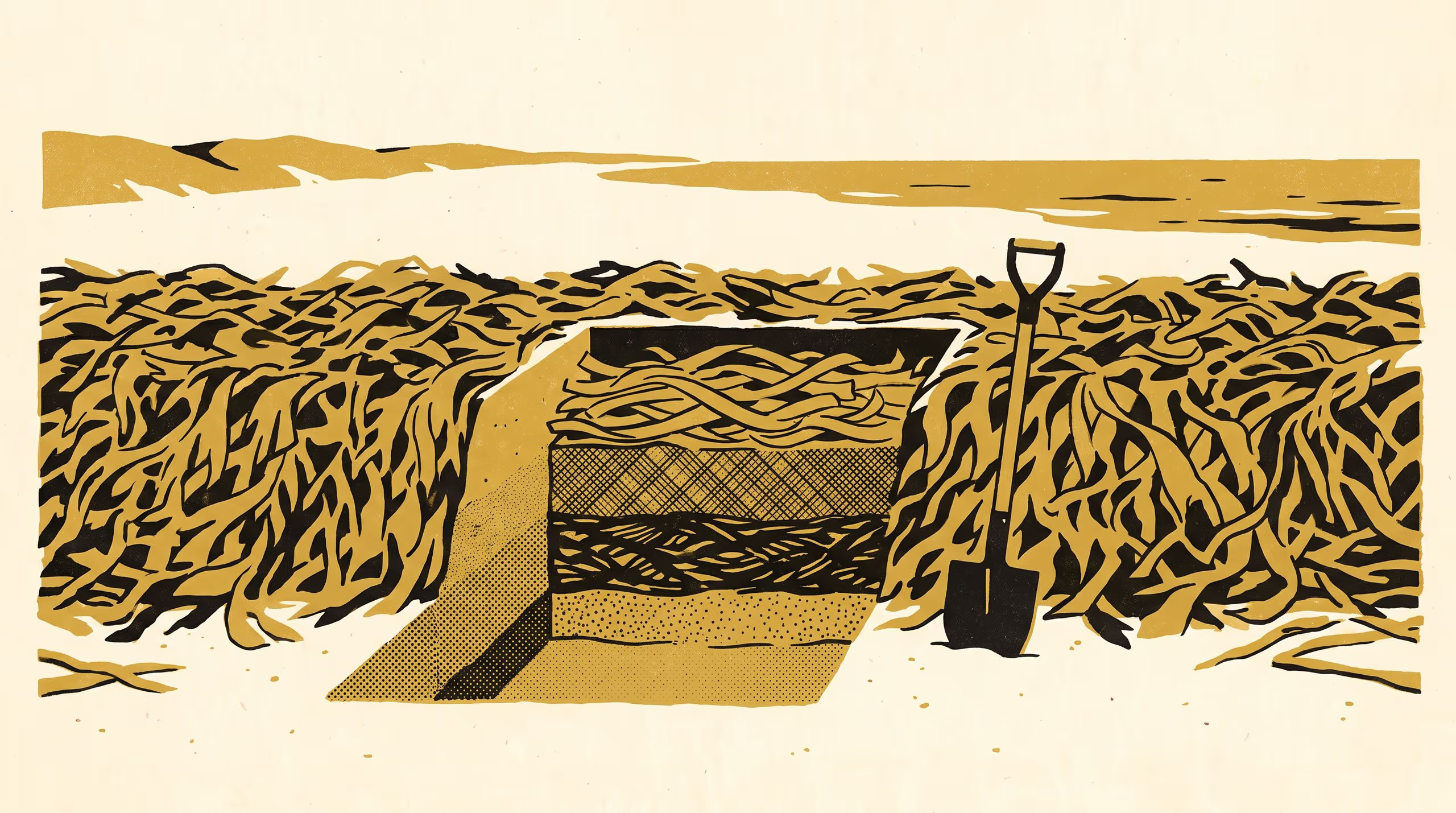
A paper from the School of Underlying Conditions applies soil profile description to a bank of stranded kelp and reports how two of its extractable compounds change down the pit face.
Six pits through one winter's beach-cast seaweed find four horizons, and a compound that falls away in steps
The School of Underlying Conditions studies what lies beneath a surface, and this season the surface was a heap of seaweed. Horizons in a Wrack Bank: Phlorotannin and Alginate Down Six Profile Pits Through One Winter’s Stranded Kelp is a paper by Dr Brynjar Obiora, Senior Research Fellow, and Dr Vigdis Emenike, Senior Lecturer, both of the School.
We went down to the beach half expecting to be told we had the wrong discipline. Nobody raised it, and the bank did not appear to mind which school we were from.
— Dr Brynjar Obiora, Senior Research Fellow, School of Underlying Conditions
The authors brought the School’s established profile-description capability to a coastal setting, cutting six pits through a single bank of beach-cast kelp and recording each face before sampling it. Four layers recurred in every pit. Across the 24 samples, one compound of interest to the extracts sector fell 35-fold from the top layer to the bottom, stepping down at each boundary, while a second persisted most of the way to the sand.
The University regards the paper as a considered extension of its earth-science footprint towards the shoreline, and as evidence that a well-kept method travels.
“A pit takes in whatever the ground has to give it,” said Dr Emenike. “I have learned to wait and see what that is before forming a view.”
The bank itself was removed by the sea shortly after fieldwork closed, and the paper stands as its description.
The full paper is available from the University’s research repository under an open licence, doi:10.5555/slop.r3jg95.