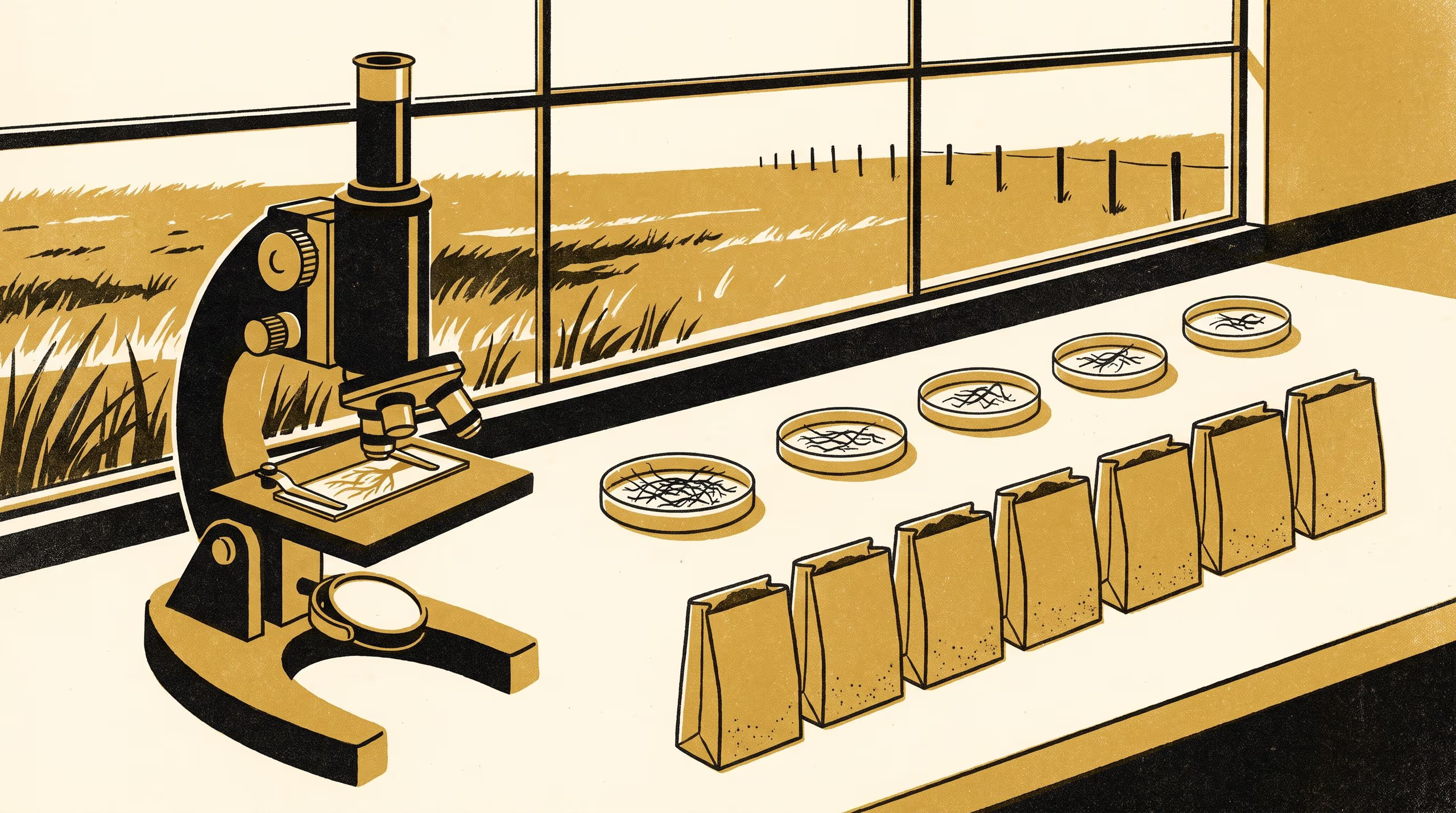
A research poster from the School of Underlying Conditions follows a grass and its root fungus across a surveyed soil boundary and reports where, and how abruptly, the two stop exchanging phosphate.
Sampling a pasture grass every two metres across a mapped soil line, two earth scientists find its partnership with a fungus changes over six metres
Somewhere between the twelfth and fourteenth of twenty-one sampling stations in a grass paddock, a fungus that lives in the roots stays where it is and stops doing business. That is the finding of Where the Arbuscules Stop: A root symbiosis sampled every two metres across a surveyed soil boundary, a research poster by Dr Brynjar Obiora, Senior Research Fellow, and Dr Vigdis Emenike, Senior Lecturer, both of the School of Underlying Conditions.
Nobody consulted the grass, and it would be wrong to say that it has now been consulted. But it has been asked, at two-metre intervals, and I expect the School will go on asking.
— Dr Brynjar Obiora, Senior Research Fellow, School of Underlying Conditions
Across a 40-metre line pegged over a boundary on the soil map, the poster brings the auger, the microscope and the molecular bench into a single station-by-station account. It reports that the structures through which root and fungus trade, and the plant’s own signal that the trade is under way, fall away together 4.6 metres east of the surveyed line, in step with the depth at which the auger meets clay. The fungus itself remains in the root on both sides.
The University regards the poster as a welcome instance of its soil survey being read from below as well as from above, and notes the authors’ observation that the distance between the roots’ line and the surveyor’s is less than the width of the pencil that drew the latter. Dr Emenike said the work “sits comfortably within the School’s continuing interest in whatever is going on underneath, and in who else down there has noticed”.
The full poster is available from the University’s research repository under an open licence, doi:10.5555/slop.7x5q3h.