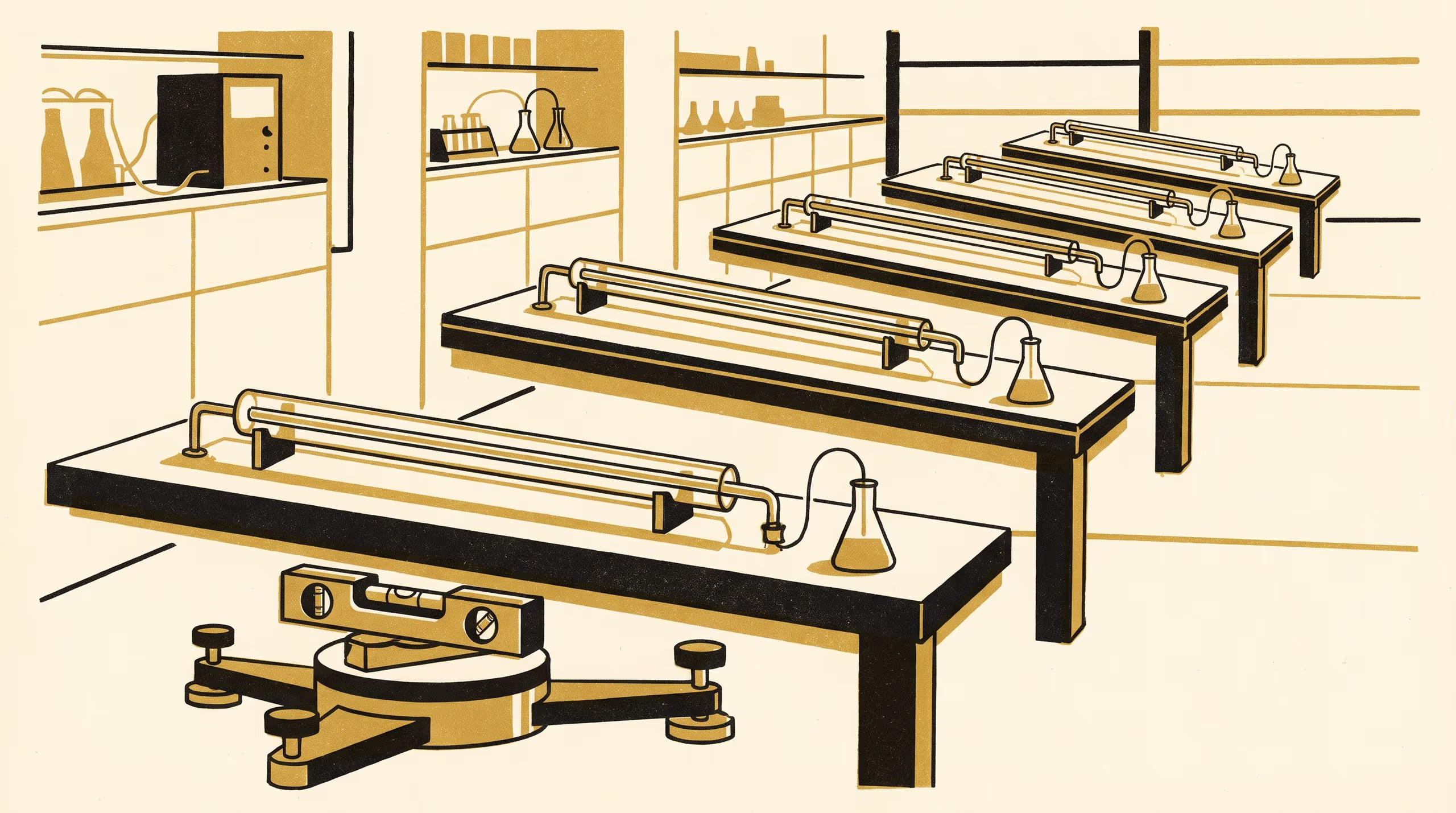
A new Slop University display advertisement introduces the School of Underlying Conditions' work on flow in very thin channels, and on the benches those channels stand on.
A portrait display advertisement from the School of Underlying Conditions presents its microfluidic bench work by way of a spirit level.
The portrait panels in the University’s corridors now carry Small Channels. Level Benches., a display advertisement for the small-scale flow research of the School of Underlying Conditions. It was prepared by Dr Vigdis Emenike, Senior Lecturer, with Associate Professor Ragnhild Uzoma, Associate Professor and Lead, Basement Relations Group.
The advertisement shows a single glass channel, a flask, a levelling mount and a spirit level, and says very little else. It directs the reader to a School study in which one channel gave results minutes apart across six laboratory benches until the benches were made level, and it positions the School’s microfluidic and catalytic bench capability on that footing: attention to the apparatus, and then to the surface beneath the apparatus.
A school like ours is used to looking down. It turns out the habit travels perfectly well indoors, and that most rooms have been waiting for somebody to try it.
— Dr Vigdis Emenike, Senior Lecturer, School of Underlying Conditions
The University sees in the campaign a school comfortable enough with its instruments to advertise the furniture, and regards that composure as an asset to its wider research posture. Associate Professor Uzoma said the advertisement “asks nothing of the viewer that a patient person with a thumbscrew could not supply, and we have always thought well of such people”.
The campaign anchors a broader conversation within the School about precision at small scales, and is expected to remain in rotation across the University’s signage through the teaching period.
The full poster is available from the University’s research repository under an open licence, doi:10.5555/slop.ffcndh.