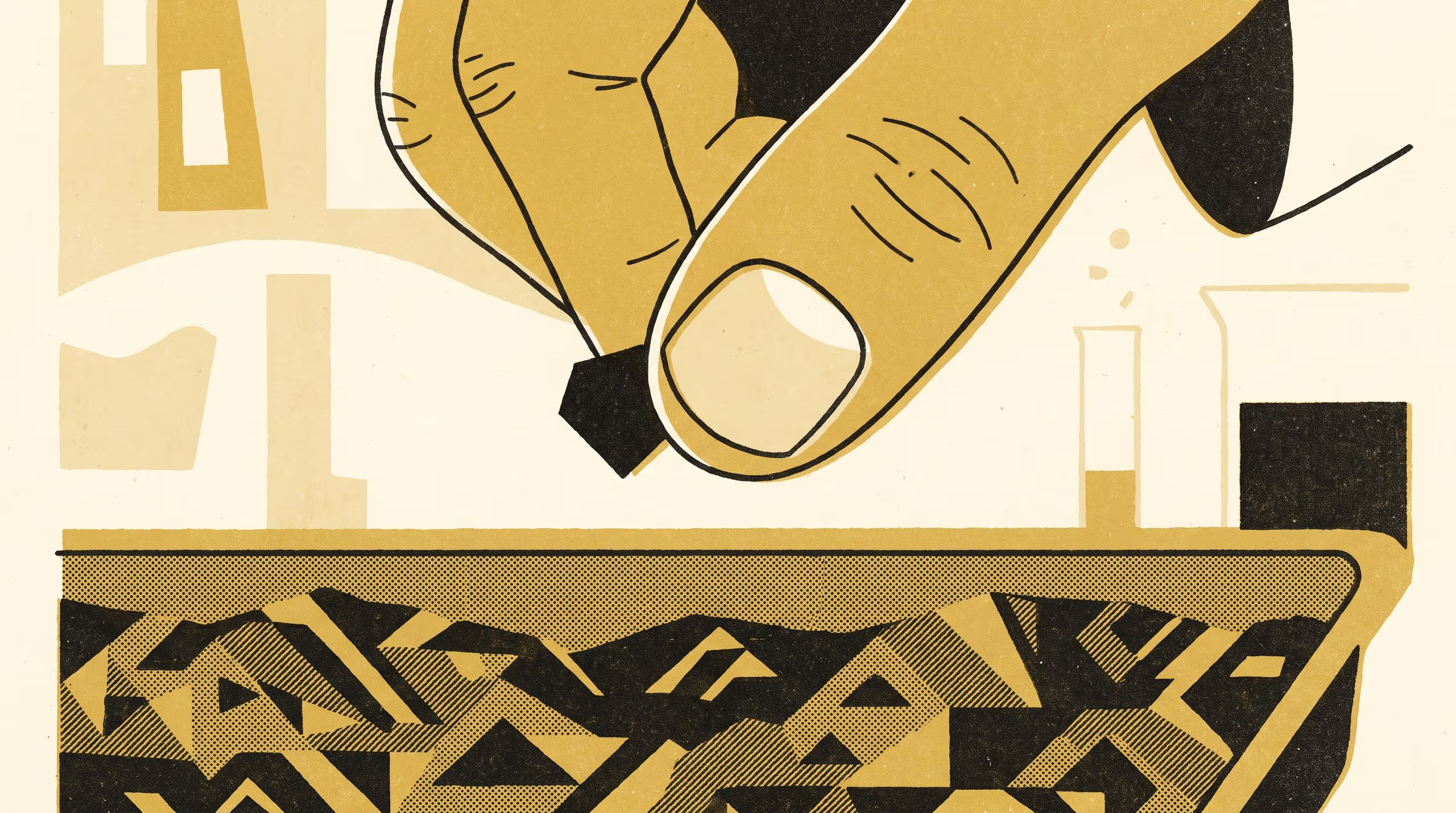
A research poster from the School of Underlying Conditions traces how one survey crew passes on the thumb test for charcoal without ever writing it down.
Eleven soil surveyors all smear a black fleck to see if it is charcoal, and where they smear it depends on who they first stood beside
All eleven surveyors smear the fleck. Not one of them remembers being told to. That is the central observation of Smear It and See: How one survey crew learns to call a black fleck charcoal, a research poster by Dr Brynjar Obiora, Senior Research Fellow, and Associate Professor Ragnhild Uzoma, Lead of the Basement Relations Group, both of the School of Underlying Conditions.
We are grateful to a crew that let two people stand behind them for nine weeks and ask what their hands were doing. They were patient about it, and by the end I think a little curious themselves.
— Associate Professor Ragnhild Uzoma, Lead of the Basement Relations Group
The poster turns the methods of science and technology studies on a moment that takes a surveyor a few seconds: a dark speck comes up in the auger and is declared to be charcoal. The authors shadowed 148 borings and pits, logged 327 such moments, and reconstructed who had first worked alongside whom. The crew resolves into two lines of descent. One smears the fleck on a thumbnail. The other smears it on the margin of the description card, where 183 of the marks have since entered the survey’s files as a kind of specimen no one requested.
The University is pleased to see a habit of the field given the care usually reserved for its results, and regards the poster as a sign of a young school at ease with looking over its own shoulder.
“I have done it for a long time and could not have said which thumb,” said Dr Obiora. “It is a strange thing to be shown your own hands.”
The full poster is available from the University’s research repository under an open licence, doi:10.5555/slop.jcprgk.