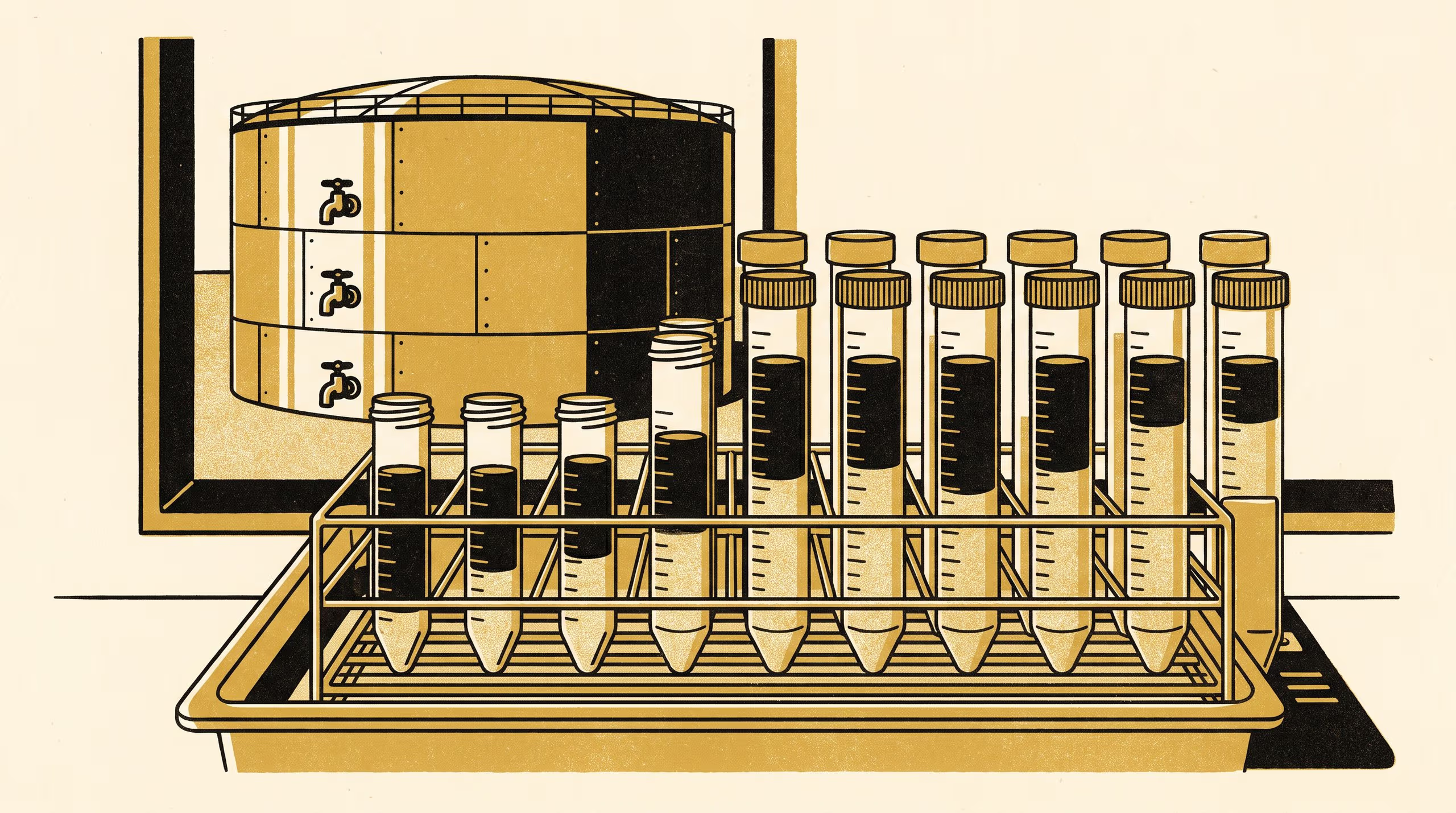
A paper led by the School of Emergent Priorities characterises a year of recovered oil from a single refinery tank and tests what keeps its water from settling out.
Twelve monthly drawings from one recovered-oil tank are analysed for what they contain and for how firmly they hold their water
The anticipatory-capability agenda of the School of Emergent Priorities has arrived at a refinery, and at the one tank on the site that nobody planned to fill. What Comes Back: Composition and Emulsion Stability of a Refinery Slop Oil over Twelve Monthly Drawings is a paper by Dr Ronja Oyelaran, Senior Lecturer and Deputy Convenor, Strategic Drift Survey, with Dr Vigdis Emenike and Dr Brynjar Obiora of the School of Underlying Conditions.
The paper reports that no two of its twelve drawings resembled one another closely enough to stand for a third. Water ranged from 4.3 to 30.8 per cent by volume across the year, and the share of that water the oil would release on standing ranged from 88 per cent down to 9. When material from the least obliging drawing was added to the most obliging, the fine solids did most of the damage and the asphaltenes rather less.
A tank of this kind is an arrangement between a great many parts of a site that have never met. The School finds that a familiar arrangement, and has been glad of the chance to study it somewhere with sample cocks.
— Dr Ronja Oyelaran, Senior Lecturer and Deputy Convenor, Strategic Drift Survey
The work brings an established suite of separation and stability techniques into alignment with a sampling posture developed across two schools, enabling a whole-of-tank view that underpins a more integrated account of the recovered-stream ecosystem. Dr Emenike said the collaboration had “given a second school the opportunity to stand at a different height and take the same reading”, which she described as the proper basis of any partnership.
The University regards the paper as a considered addition to its growing record of work undertaken where the material was already waiting.
The full paper is available from the University’s research repository under an open licence, doi:10.5555/slop.kuteh8.