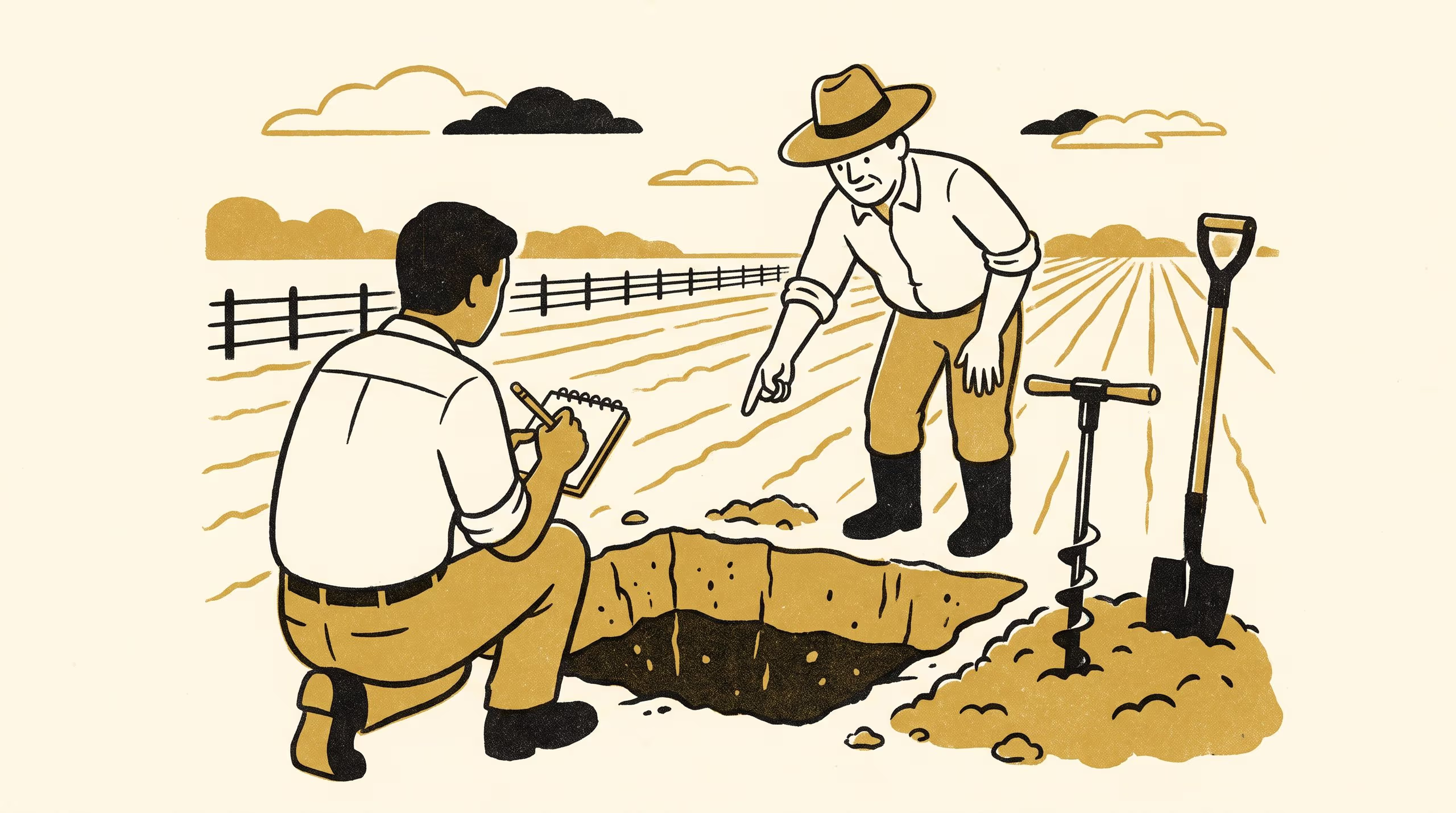
A research poster from the School of Underlying Conditions dates 143 soil words that landholders gave to visiting surveyors, and follows each to its last appearance on the page.
Six decades of margin notes in one district's soil survey notebooks are read for the words that lasted and the words that did not
A slip drawer is a patient thing. It was there before the question was, and it has room for the next one.
— Sunniva Balogun, Doctoral Candidate, School of Emergent Priorities
The drawer in question now holds 1,946 slips, each one a word for soil that a landholder said aloud to a surveyor and the surveyor thought to write in the margin. They are the working material of What the Farmer Called It: A Historical Lexicon of Soil Words from the Margins of One District’s Survey Notebooks, a research poster by Dr Brynjar Obiora, Senior Research Fellow, and Dr Vigdis Emenike, Senior Lecturer, both of the School of Underlying Conditions, with Ms Balogun.
The poster brings the methods of the dictionary to the holdings of the soil survey. It reads 212 field notebooks across six decades, resolves the margin notes into 143 headwords, and follows each from its first appearance to its last. Words for how the ground behaved under a plough are found to leave the notebooks with the horse team. Words for colour, for gravel and for a particular corner of a farm stay. The authors also record the point at which a surveyor stopped placing a farmer’s word in inverted commas and began using it as their own, which happened to 38 of them.
The University regards the lexicon as a fitting use of a collection it has kept for other reasons, and as evidence of what its earth sciences school can offer the study of language.
“The notebooks were always going to be read twice,” said Dr Obiora. “It has taken until now to settle on what the second reading was for.”
The full poster is available from the University’s research repository under an open licence, doi:10.5555/slop.z99naw.