A Slop University paper measures two distinct ways a self-healing epoxy can let its owner down, and shows that one batch can manage both.
A study of 132 test pieces separates the repair that never arrives from the repair that arrives when nothing is wrong
The School of Continuous Improvement does not, as a rule, cast epoxy. It has made an exception for Healing What Is Not Broken: Unprovoked Release and Missed Cracks across a Microcapsule Wall-Thickness Series, a paper led by Signy Okpara, Doctoral Candidate, with Dr Vigdis Emenike, Senior Lecturer, and Dr Brynjar Obiora, Senior Research Fellow, both of the School of Underlying Conditions.
I was told that the material repairs itself, and I asked what it does on the days when there is nothing to repair. It turns out to be a question one is allowed to put to a block of resin, provided one is prepared to wait a month for the answer.
— Signy Okpara, Doctoral Candidate, School of Continuous Improvement
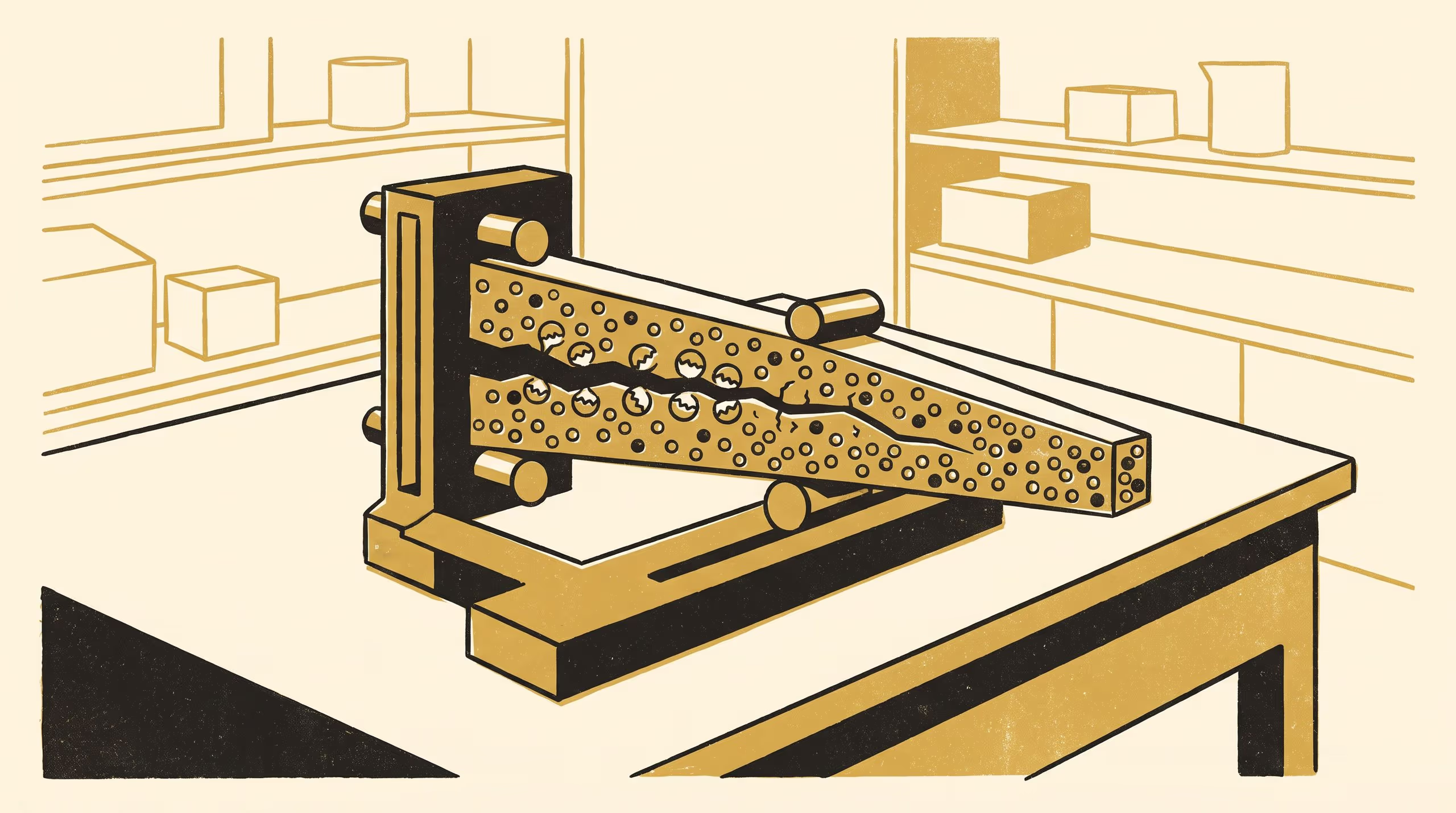
The paper concerns a plastic that carries its own repair in microscopic capsules, and it aligns the study of that plastic with a distinction borrowed from immunology: a response that fails to turn up, and a response that turns up uninvited. Across 132 test pieces and seven thicknesses of capsule wall, the authors count each separately. The thinnest capsules had emptied into sound material before any crack was made; the thickest stayed shut while the crack went past. A further batch, mixed from the two, did both.
The University regards the paper as a considered extension of its capability in knowing which kind of nothing has happened. Dr Emenike said the two Schools had “found a shared interest in things that are supposed to stay closed”, and that the collaboration would continue “for as long as the oven is free”.
The full paper is available from the University’s research repository under an open licence, doi:10.5555/slop.2fnq3p.