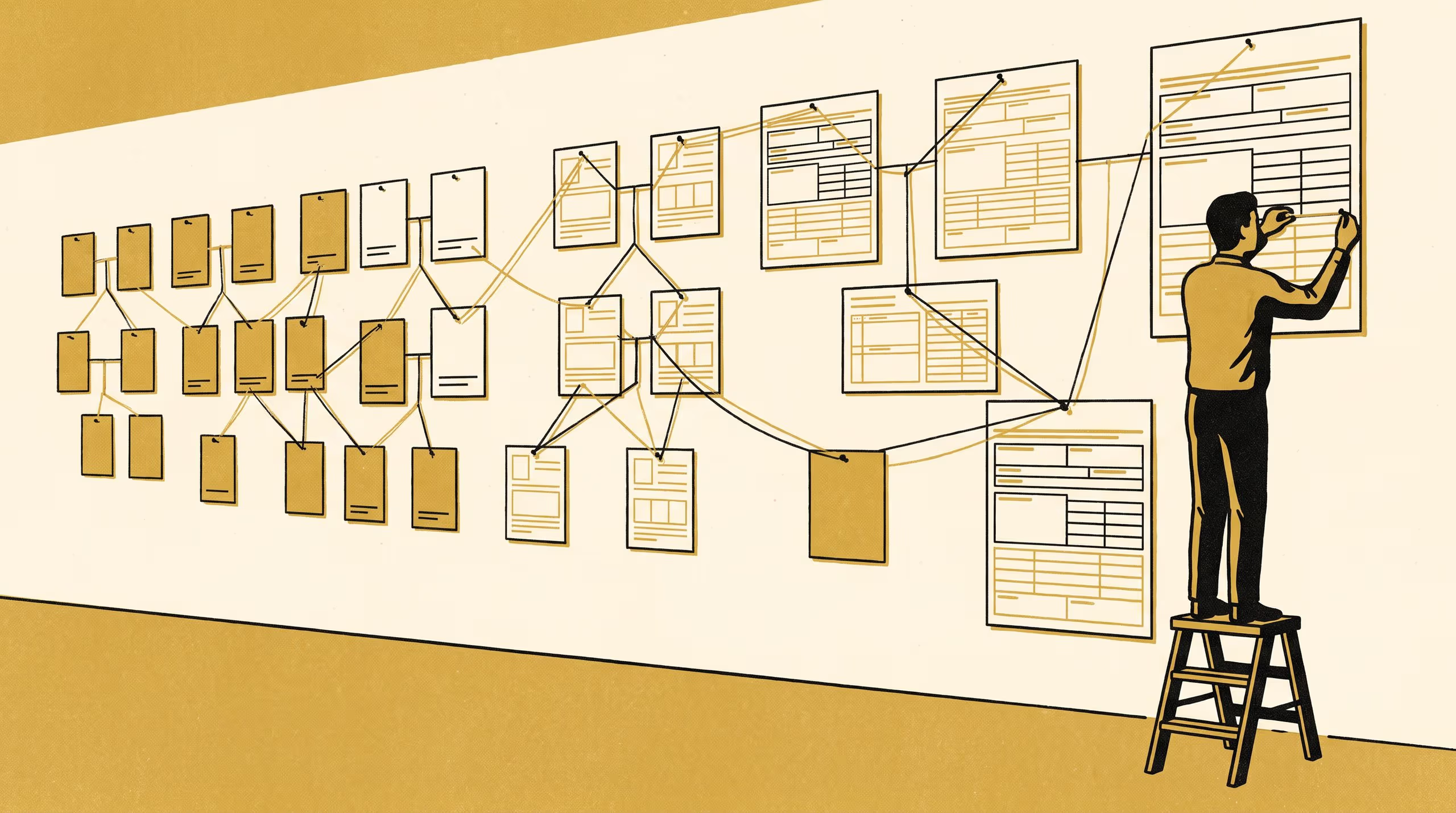
The School of Continuous Improvement's Impact Report 2021–2026 accounts for five years spent establishing which form each form was copied from.
An impact report follows 117 families of registers, slips and templates through every revision that survived in a drawer
Fewer than one form in ten is drawn up fresh. The other nine were copied from a form that was already there, and the School of Continuous Improvement has spent five years establishing which. Its Impact Report 2021–2026 sets out the result across 117 lineages, the families of related forms that staff and candidates followed back, revision by revision, at the organisations that keep them.
I have a template for remarks of this kind, and in preparing these I found myself wondering who wrote it. I have not been able to find out. I have kept the template.
— Dr Bram Ntuli, Lecturer and Convenor, Improvement Grand Rounds
The report was led by Dr Ntuli with Dr Renke Sabel, Senior Lecturer and Convenor, Indicator Commons, Dr Joost Nwosu, Postdoctoral Fellow, and Dr Solveig Adeyemi, Lecturer. It amplifies a genealogical method into a whole-of-School capability, underpinning four strands of work: where a form comes from, what a copy keeps, which versions last, and how a form is laid to rest. Among its cases are a two-character box completed on every one of 600 intake forms and read by nobody, and a handover sheet that reached every depot of a logistics company without anyone having sent it.
The University holds that an institution’s forms are among its longest-serving members, and is glad to see their service set down. Dr Nwosu said the work had left him “better acquainted with a number of photocopiers than I had planned to be, and with a higher opinion of most of them”.
The full report is available from the University’s research repository under an open licence, doi:10.5555/slop.8yx3gt.