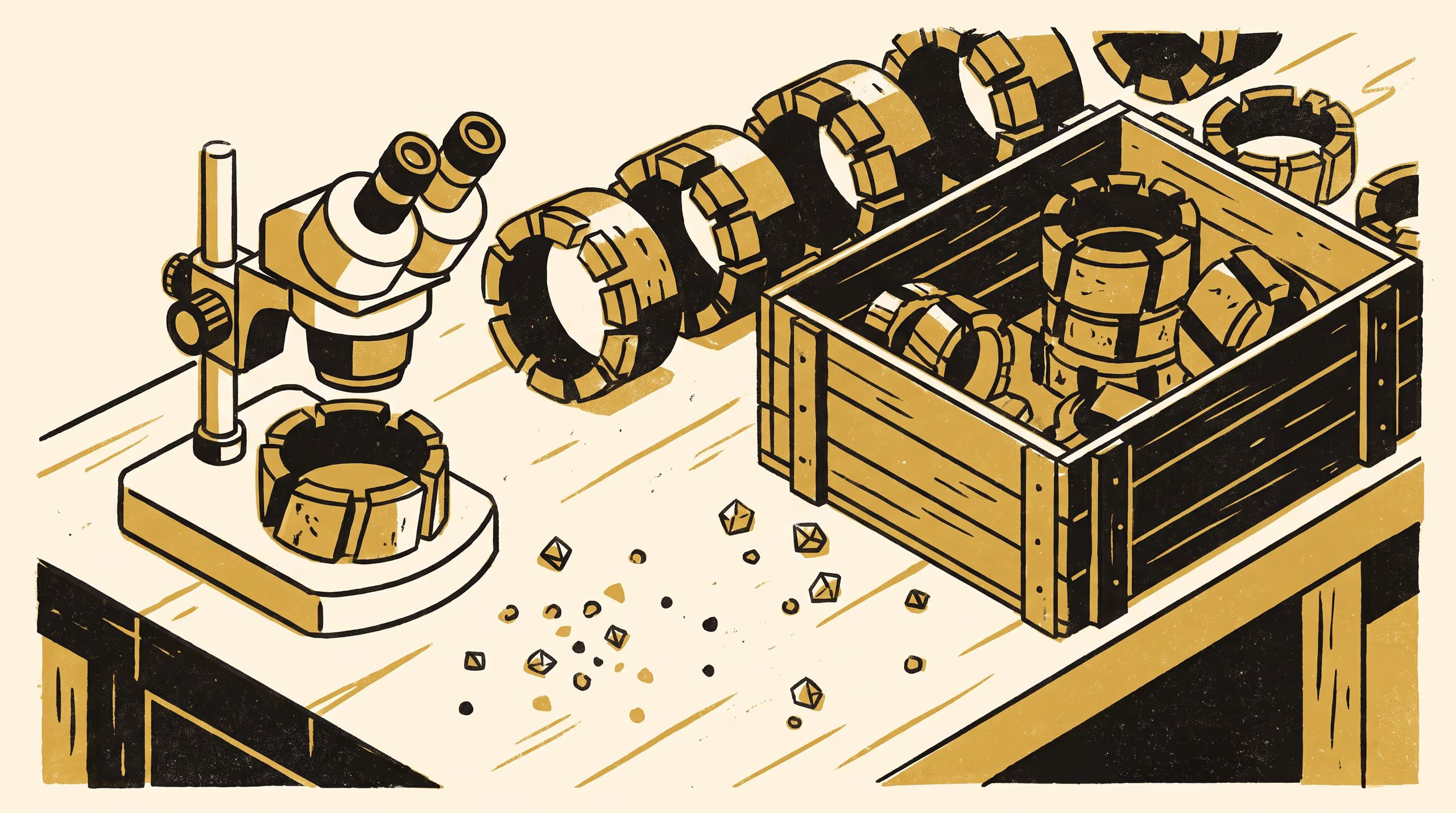
A paper from the School of Underlying Conditions counts every diamond site on the faces of thirty-eight retired core bits and finds that most of the diamonds were not worn out.
A census of 5,514 grit sites on thirty-eight spent core-bit crowns records how each diamond finished its working life
More than a third of the diamonds had already gone. That is the first result of Lost Before They Were Blunt: A Grit-by-Grit Census of Diamond End States in Thirty-Eight Retired Impregnated Core-Bit Crowns, a paper by Associate Professor Ragnhild Uzoma, Associate Professor and Lead, Basement Relations Group, and Dr Vigdis Emenike, Senior Lecturer, both of the School of Underlying Conditions.
The paper takes a crate of core bits written off at the end of a coring programme and examines the cutting face of each one, site by site. Of 5,514 places where a diamond had been, 34.5% were empty sockets. On the softer crowns the diamonds had left early and largely unused; on the harder ones they had stayed, and been polished flat where they stood.
The School has spent a long time looking at what comes up the hole. It seemed only fair to look for once at what went down it, and I expect we will be looking for a while yet.
— Associate Professor Ragnhild Uzoma, Associate Professor and Lead, Basement Relations Group
The study aligns microscopy, surface profiling and spectroscopy into a single end-of-life record for each crown, anchoring a materials question in the School’s established coring capability and extending its attention from the recovered sample to the instrument of recovery.
The University counts the paper among the dividends of keeping things after they have stopped being useful. Dr Emenike said the crate “has been returned to the shelf it came from, which is the outcome we would wish for any piece of research”.
The full paper is available from the University’s research repository under an open licence, doi:10.5555/slop.tqgxe4.