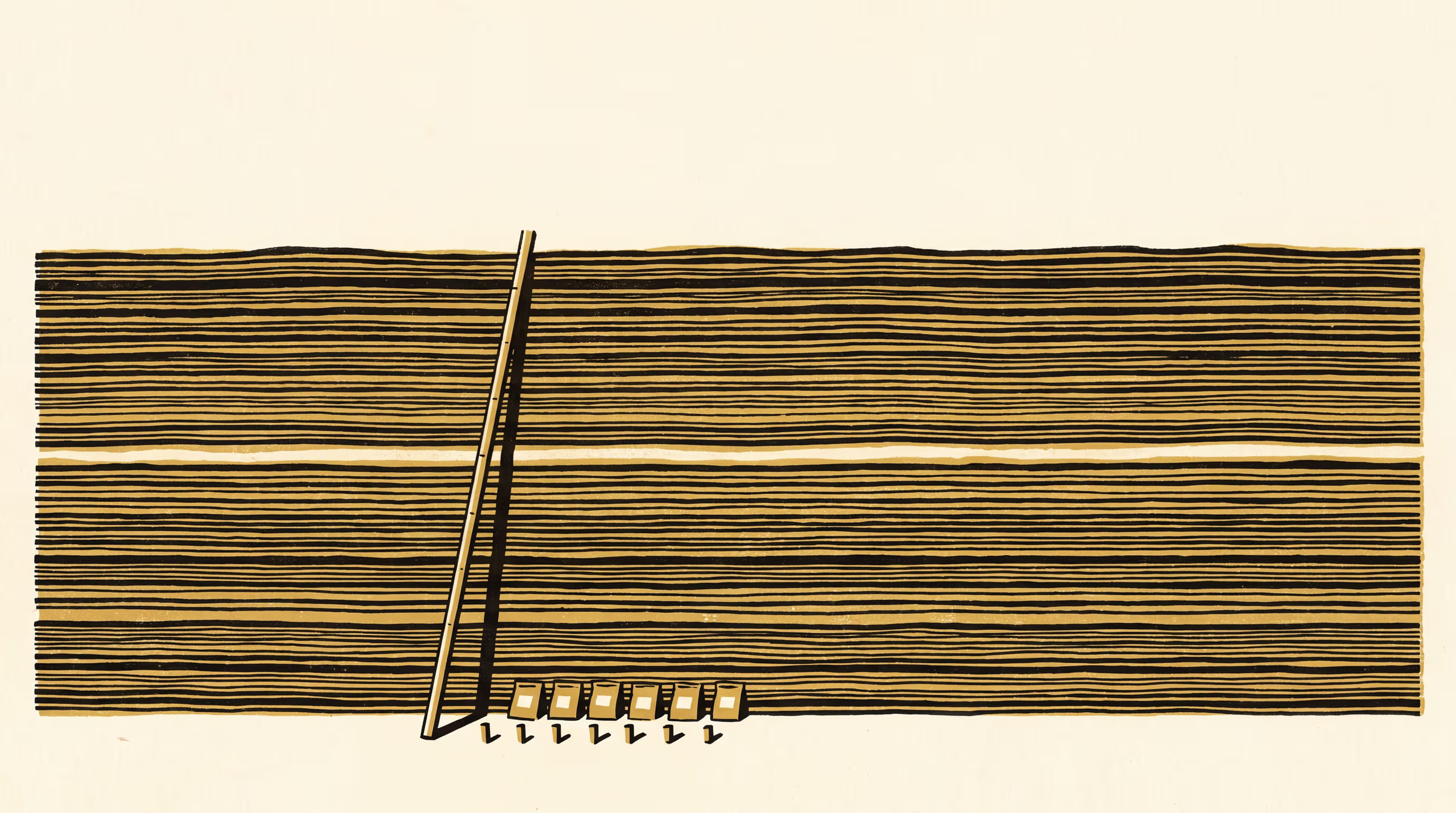
A research poster from the School of Underlying Conditions reads the gradual disappearance of fossils below one ash bed as an effect of how hard anyone looked.
A soil surveyor borrows the physics of small systems to ask where 25 fossil forms were really last alive
We picked forty-eight thousand shells in order to learn that we should have stood closer together. I am told this is how most fields proceed, and I see no reason for ours to be the exception.
— Dr Brynjar Obiora, Senior Research Fellow, School of Underlying Conditions
The shells in question came out of sixty samples taken down a disused quarry face, and they are the subject of Last Seen Below the Ash: Finite-size scaling of fossil range terminations in one measured mudstone section, a research poster by Dr Obiora with Associate Professor Ragnhild Uzoma, Associate Professor and Lead, Basement Relations Group, and Dr Vigdis Emenike, Senior Lecturer.
Below a single thin ash bed the section’s fossil forms appear to drop out one by one over several metres. The poster aligns that pattern with a result from theoretical physics about sharp changes in small systems, treating the number of specimens picked from each sample as the size of the system. As the picking is thinned and restored, the apparent extinction slides toward the ash in an orderly way, and at unlimited effort it arrives there. Nine of the rarer forms declined to take part.
The University takes some satisfaction in a result whose principal recommendation is a shorter step between samples. Associate Professor Uzoma said the School had “spent a good many years on what the ground withholds, and it is agreeable to find some of it was only waiting to be counted more slowly”.
The full poster is available from the University’s research repository under an open licence, doi:10.5555/slop.91zmdy.