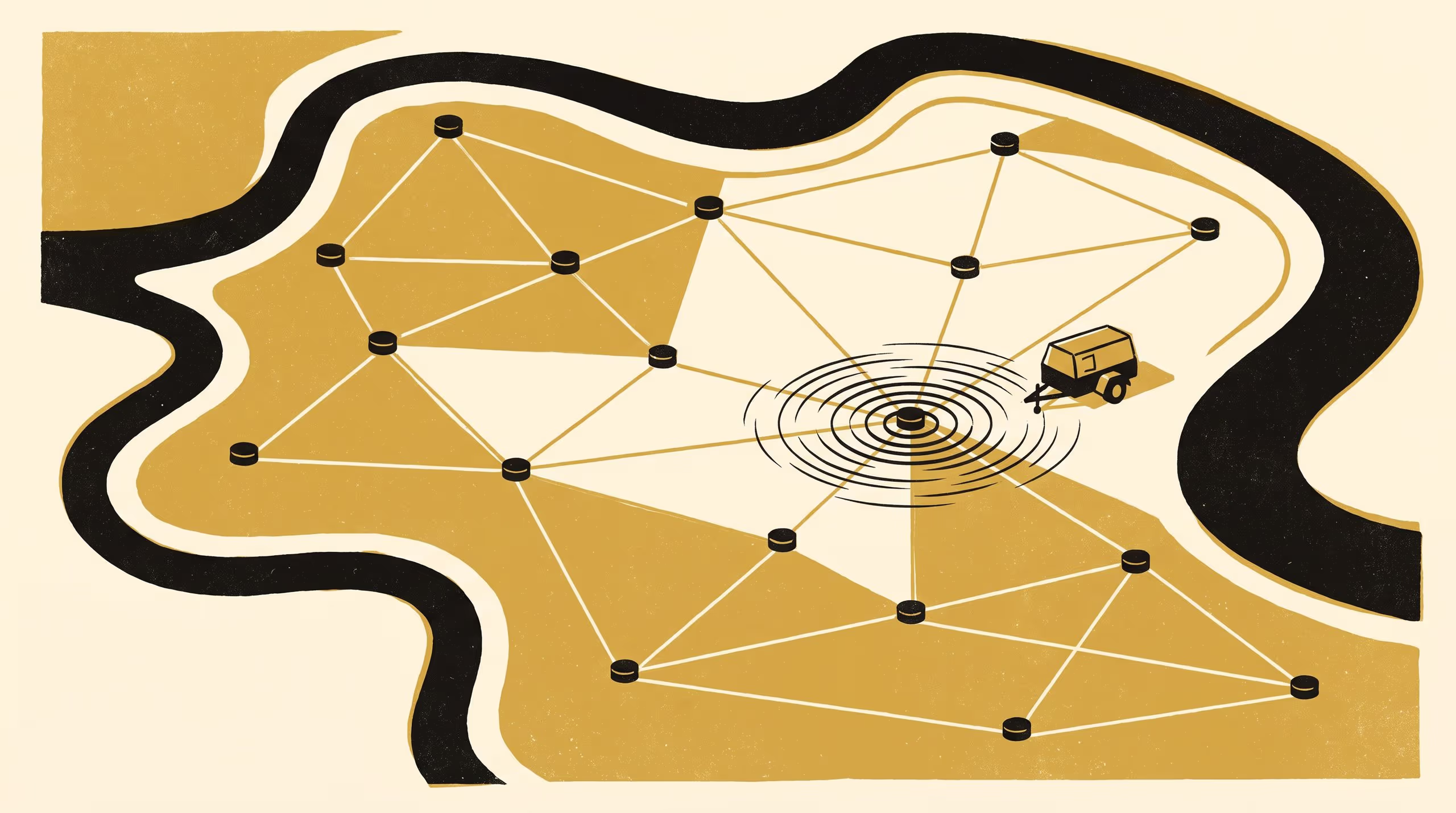
A research poster from the School of Underlying Conditions pumps a field of monitoring bores one at a time to check a statistical model of how they are joined, and works out the shortest order in which to do it.
Seven tests on sixteen monitoring bores separate the links water travels from the links the weather supplied
People ask whether we minded pumping bores a computer had already drawn lines between. We did not mind. A line is a fine thing to be handed, and a pump is a fine thing to bring to it.
— Dr Vigdis Emenike, Senior Lecturer, School of Underlying Conditions
So begins the School of Underlying Conditions’ account of A Pumping Test Is a Do-Operator: Telling connection from shared weather in a network learned over sixteen bores, a research poster by Dr Emenike and Dr Brynjar Obiora, Senior Research Fellow.
The poster brings statistical learning, field hydrology and a long-standing problem in the theory of computation into a single working arrangement. A model built from three years of logged water levels proposed 27 links between the bores of one riverside field. The authors then pumped the bores in turn and watched which neighbours answered. Seventeen links held; ten turned out to join bores that had only been listening to the same river. A rule for choosing the next bore finished the campaign in seven tests, where the field crew’s customary circuit would have taken thirteen.
The University counts it a mark of a settled research culture when a school checks a result by going outside and running a hose. Dr Obiora said the two authors had “kept to the order the arithmetic gave us, including on the morning it sent us to the far corner first”.
The full poster is available from the University’s research repository under an open licence, doi:10.5555/slop.xd29pb.