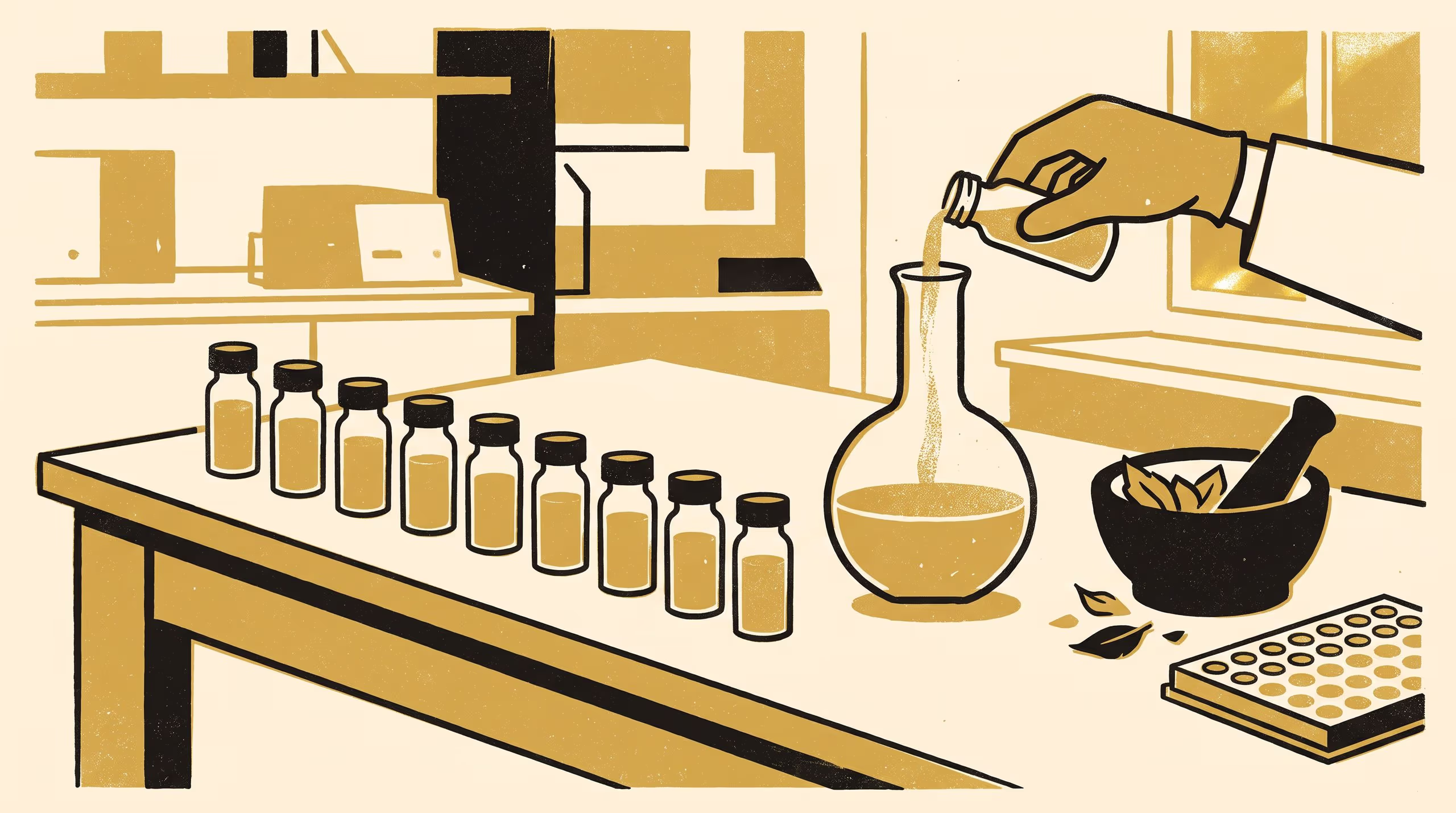
A Slop University poster reports an active plant extract whose activity could not be found in any of its nine parts, and was recovered by returning them to one flask.
Nine fractions of one shade-house shrub's extract were each close to inactive alone, and close to the original when recombined
Separation is how a laboratory finds out which part of a plant extract is doing the work: the extract is passed down a column, collected in portions, and each portion is tested until the active one declares itself. A team in the School of Emergent Priorities has followed that procedure to its end and reports that, on this occasion, none did.
Nine Inactive Fractions: Loss and Recovery of Enzyme Inhibition on Fractionating a Leaf Extract from an Undetermined Accession is a research poster by Ylva Ogunbanjo and Halvard Nnamani, Doctoral Candidates in the School, with Dr Runa Adegoke, Senior Lecturer and Convenor of the Strategic Drift Survey. The crude extract inhibited the team’s screening enzyme by 78 per cent. The best of its nine fractions managed 14. Returned to a single flask in their original proportions, the nine together reached 71, and two of them, collected some forty tubes apart, accounted for most of that between them.
I would like to thank whoever has been watering accession 17. Nobody could tell us what it is, and it was in very good condition.
— Ylva Ogunbanjo, Doctoral Candidate, School of Emergent Priorities
The University regards a result of this kind as a fair return on a column, a plate reader and a shrub it already had. The poster is careful about its reach: the work is a bench screen against one enzyme, it makes no claim about any living system, and the plant, which has not flowered in the period of record, remains identified to family only. Dr Adegoke said the School was “content to know what the extract does before it knows what the extract is, and would not want the order of those two discoveries read as a preference”.
The full poster is available from the University’s research repository under an open licence, doi:10.5555/slop.6gr9nk.