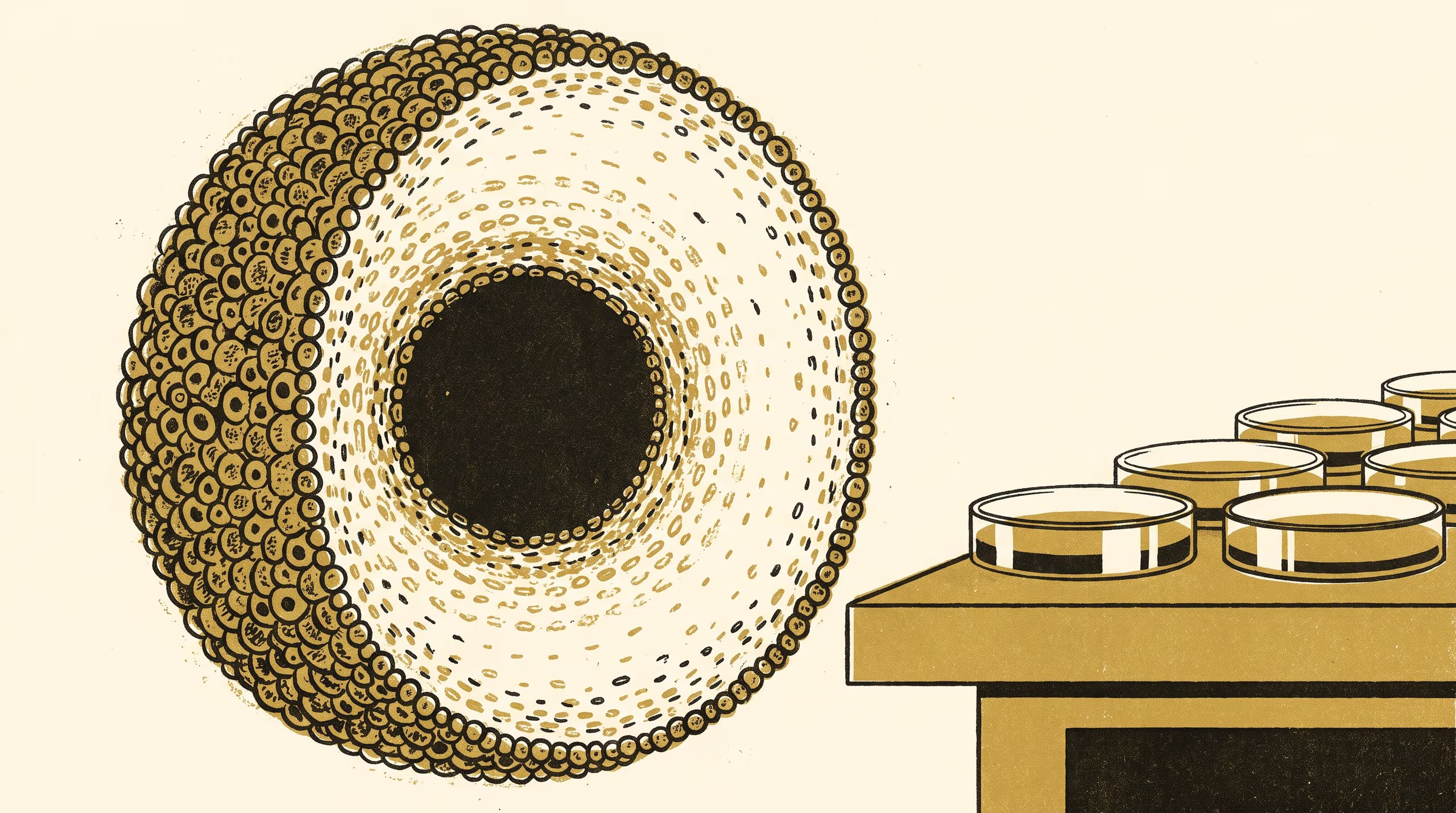
Confocal profiling of 212 cultured spheroids puts the arrest front at a median 38 micrometres, flat across spheroid size and more than twice as deep under competition.
A research poster reads the arrest depth as sorbing-solute transport and finds that competing the binding sites away moves the front twice as deep
A molecule sent to find something will not travel far through a tissue that is full of it. Slop University has put a figure on how far, in cultures of its own.
The Front Stops Short of the Core: Depth-Resolved Arrest of a Labelled Galectin-3 Construct in a Tumour-Spheroid Line, Read as Sorbing-Solute Transport is a research poster by Dr Vigdis Emenike, Senior Lecturer in the School of Underlying Conditions, with Dr Brynjar Obiora, Senior Research Fellow, and Tove Ilesanmi, Doctoral Candidate in the School of Emergent Priorities.
We spend a good deal of our time asking how far something gets before something stops it, and what the stopping is made of. It has been a pleasure to find that the question travels as well as it does.
— Dr Vigdis Emenike, Senior Lecturer, School of Underlying Conditions
The work mobilises confocal imaging and a paired competition arm across 212 cultured spheroids, translating each radial profile into a single front measure and reading that measure against the density of binding sites available to it. Where the probe’s own targets are competed away, the front moves inward and the profile flattens.
Dr Brynjar Obiora said the study “sits very comfortably” alongside the School’s other work on what a single reading can be asked to stand for, and that the group would be glad to run the same protocol on material from other benches.
The University regards the poster as a worthwhile addition to the record of what its instruments are in a position to see, and as an indication of the breadth its schools are willing to carry. The full poster is available from the University’s research repository under an open licence, doi:10.5555/slop.qm08vl.