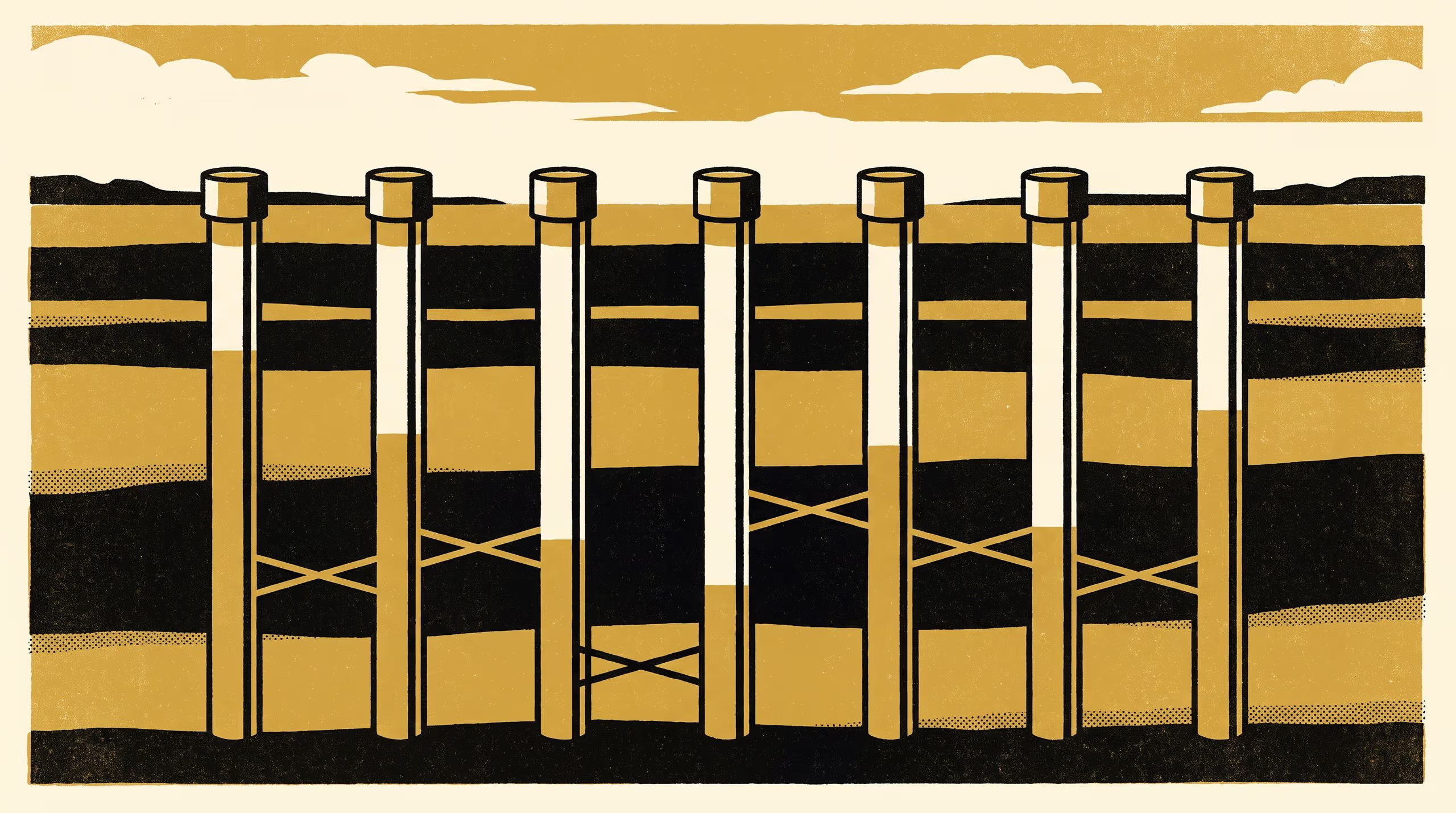
A new paper by Dr Vigdis Emenike treats a row of monitoring bores as an algebraic structure and establishes exactly when one bore's reading is really another's.
A mathematics paper from the earth sciences school finds how few failures it takes for every bore in a row to show the same level
A proof is the only fieldwork I have done where nothing needed to be carried back to the vehicle. I would like to thank the line of bores for holding still.
— Dr Vigdis Emenike, Senior Lecturer, School of Underlying Conditions
That is how the author of There and Back: Cross-Connected Monitoring Bores and the Double Catalan Monoid describes a paper that contains no water. It is the first work of pure mathematics to come out of the School of Underlying Conditions, and the University regards its arrival from that direction with considered equanimity.
The paper anchors a bore-to-joint-to-history framing in a deliberately plain model, in which neighbouring bores that become connected both settle at the higher of their two levels. It aligns that model with an algebraic object already known to specialists, and then asks of it the questions a person holding a dip tape would ask. For a row of n bores, it establishes that 2n - 3 connections, made in one pass along the row and one pass back, are enough to leave every bore showing the same level, and that no shorter sequence will do. It also shows that a reading can be a faithful record of a level belonging to a different bore, one that no longer shows it.
The University counts it among the quieter satisfactions of the year that a question about whose water is in a pipe has been answered in a form that will not need to be measured again. Dr Emenike said the result “asks nothing of anyone who looks after an actual bore, which is as much as a theorem can decently offer them”.
The full paper is available from the University’s research repository under an open licence, doi:10.5555/slop.3wrth4.