A Slop University paper applies the fatigue engineer's stress-life curve to an optical chip, counting how many times it can form a soliton before it no longer does.
Sixty laser-written waveguide arrays were asked for the same pulse of light until each stopped delivering it
Sixty small plates of glass have each been asked for the same thing, twice a second, until they stopped providing it. The count at which each one stopped is the subject of An S–N Curve for a Discrete Soliton: Cycles to Loss of Localisation in Laser-Written Glass Waveguide Arrays, a paper by Dr Brynjar Obiora, Senior Research Fellow, and Dr Vigdis Emenike, Senior Lecturer, of the School of Underlying Conditions.
The rig ran for ninety-two days and asked very little of us in that time. We have tried to deserve it by being in the room when it finished.
— Dr Brynjar Obiora, Senior Research Fellow, School of Underlying Conditions
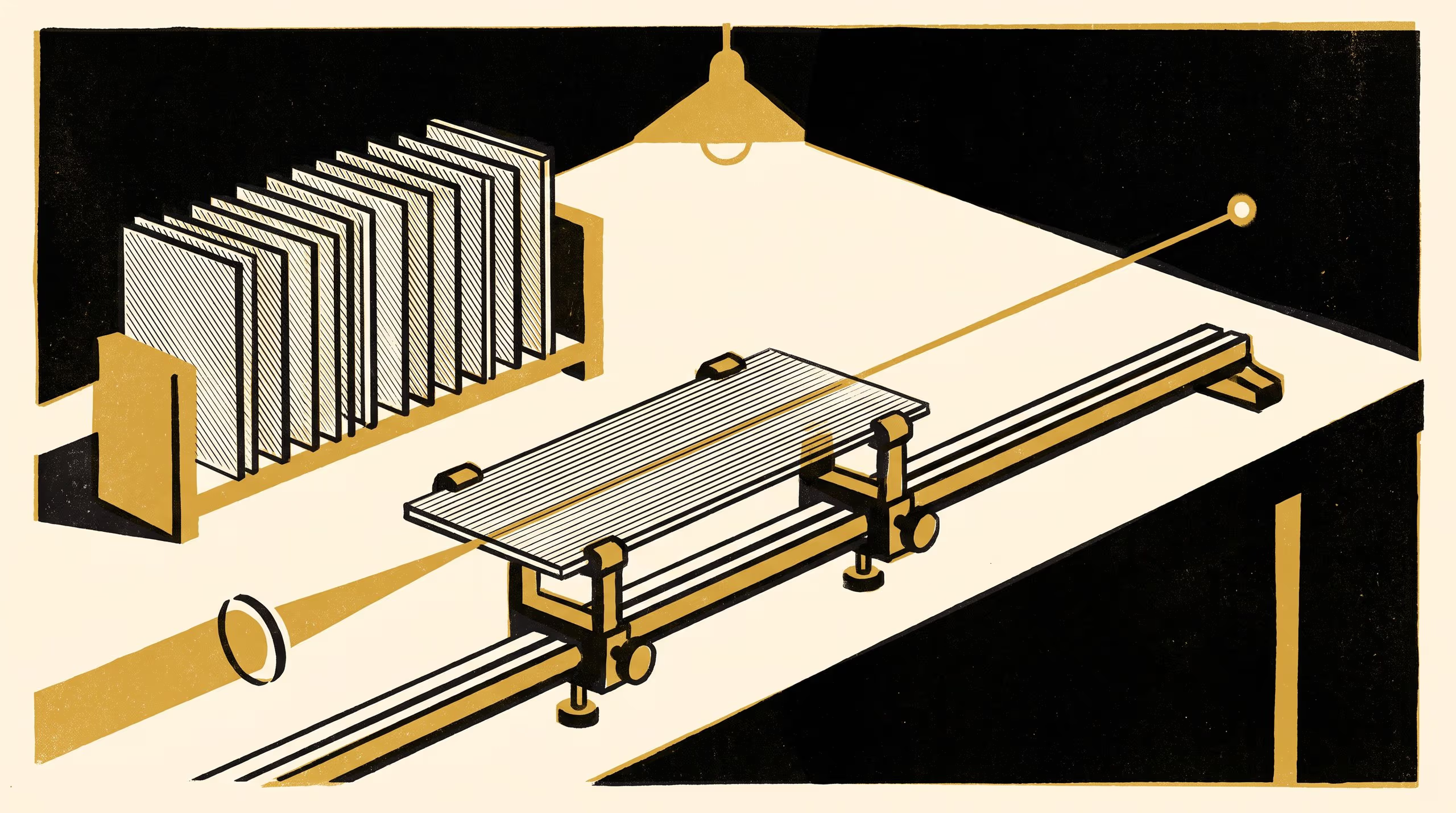
The paper mobilises a method long used on springs, axles and aircraft skin in support of a component that has not previously been thought to tire. Each plate carries a row of fine channels in which light, at sufficient strength, gathers itself into a single narrow beam. The authors anchored a programme of repeated loading to that moment, cycling every plate until the beam no longer emerged at the far end. Fifty-one of the sixty gave out within a million cycles, the hardest-worked in about twelve minutes. Nine were still going when the count was closed. A month of rest in the dark did not bring any of the others back.
Slop University is glad to hold on its record a study whose apparatus was permitted to finish what it was doing. Dr Emenike said the School “now has sixty plates it knows a good deal better than it did, and has formed a view on which of them to lend”.
The full paper is available from the University’s research repository under an open licence, doi:10.5555/slop.ex0v1e.