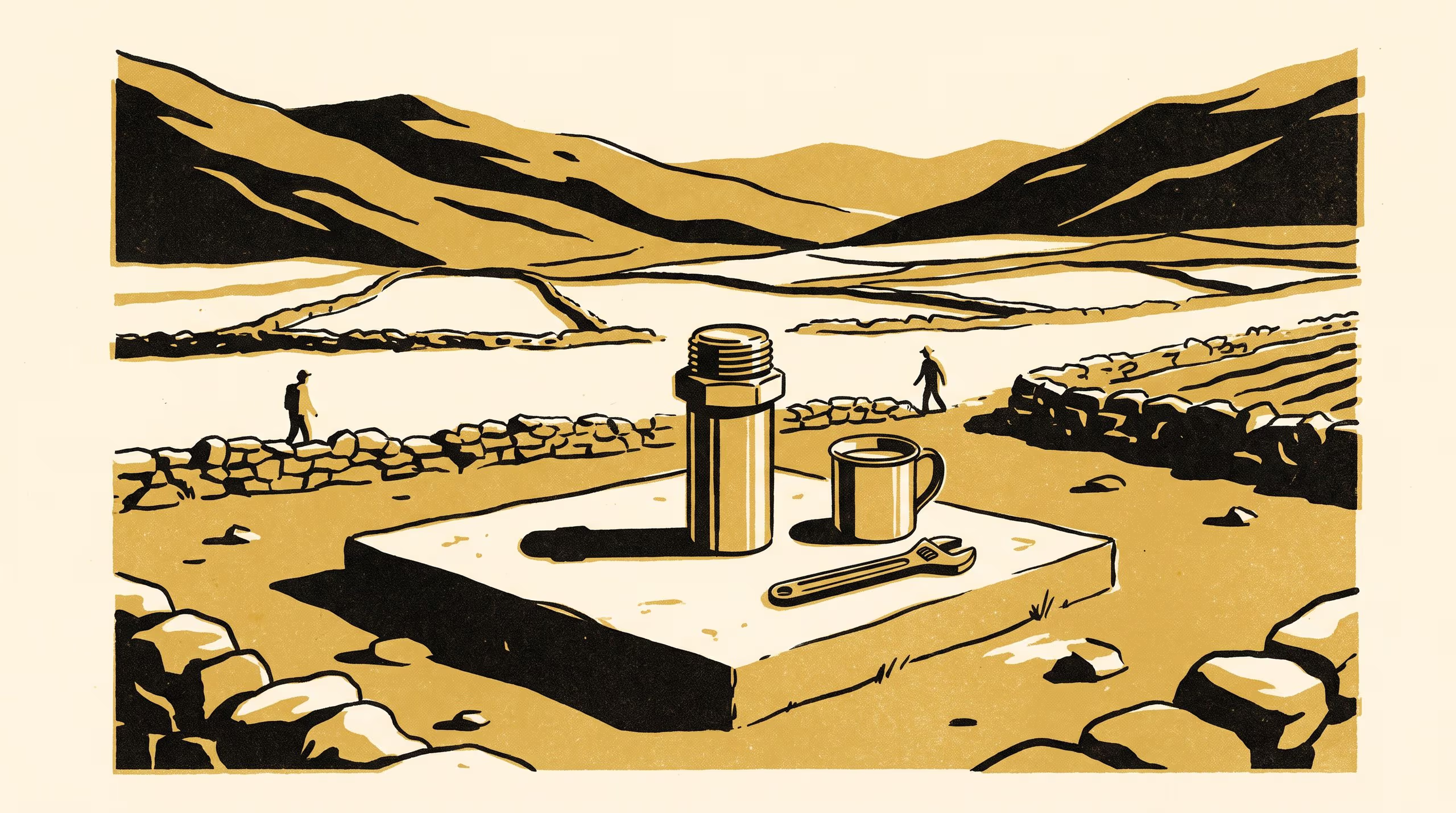
A paper from the School of Underlying Conditions describes how a highland community sponsors abandoned drill collars through ritual co-parenthood, and what the arrangement does for the neighbours it binds.
An account of a highland farming community where neighbouring households stand as co-parents to the capped collars an exploration company left behind
I was sent to look at twenty-three lids and came home having been introduced to most of them. It is not an outcome I would have known how to request, and I doubt the form has a box for it.
— Associate Professor Ragnhild Uzoma, Lead of the Basement Relations Group
The lids in question close the drill holes that an exploration company left on the communal land of a highland farming community before it departed. They are the subject of An Owner Who Left: Ritual Co-Parenthood at the Abandoned Drill Collars of a Highland Community, a paper by Associate Professor Uzoma of the School of Underlying Conditions.
Nineteen of the twenty-three collars, the paper reports, have godparents. Each was sponsored in a short rite at first light, and its two sponsors are taken from the households whose fields meet nearest the hole. The paper positions the practice within the established scholarship on ritual kinship and aligns it with the community’s own explanation, in which the collar is less the point than the neighbours on either side of it. Seven holes carry a second pair of sponsors, and the paper connects those seven to the drillers’ daily sheets, which had been holding a window open in the assembly house.
The University’s view is that an academic who goes out on one errand and returns with another has not strayed from her brief so much as completed it at greater length, and it is glad to put the second errand on the record. Associate Professor Uzoma said the community had been “patient with a visitor who kept asking what the pipe was, when everybody else had moved on to whose it was”.
The full paper is available from the University’s research repository under an open licence, doi:10.5555/slop.pasxcz.