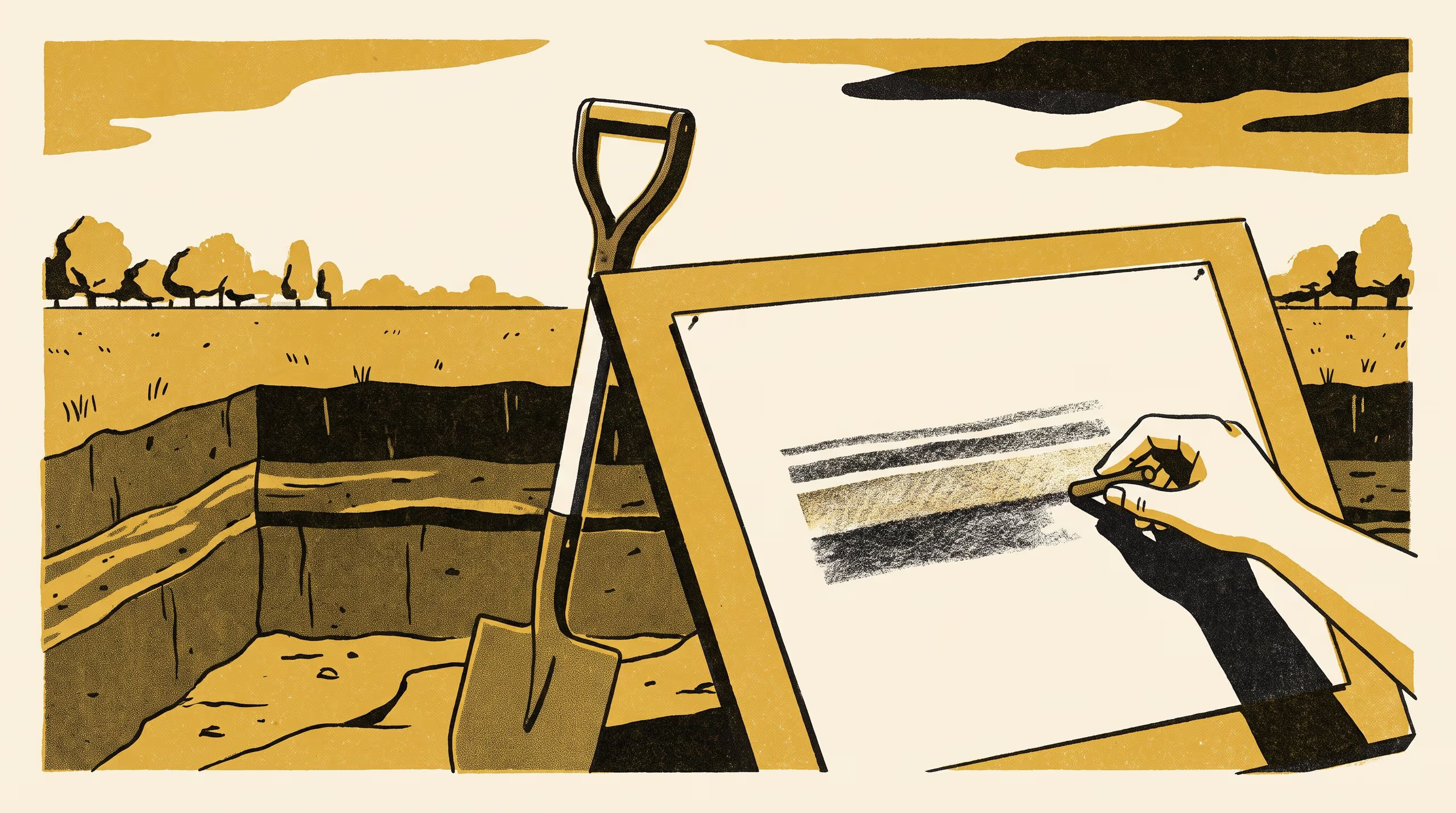
A research poster from the School of Underlying Conditions reports a field trial of sketching a soil pit before describing it, analysed pit by pit.
Ninety-six students described eight soil pits, half of them after drawing the pit face first, and the class that drew stood closer together
The students were asked to draw a hole and then to describe it, or else only to describe it, and they did both with a seriousness the hole had done nothing to earn. Whatever the poster is worth, it is worth that.
— Dr Brynjar Obiora, Senior Research Fellow, School of Underlying Conditions
The hole in question is one of eight, and the poster is Draw the Pit First: A pit-clustered crossover trial of charcoal sketching before soil profile description, by Dr Obiora with Dr Vigdis Emenike, Senior Lecturer, and Dr Torun Ezeigwe, Senior Lecturer and Director, Master of Applied Measurement.
The trial brings a drawing exercise, a description sheet and the School’s first-year field class into a single two-day design, with each pit hosting one group that sketched before describing and one that did not. Its analysis is anchored at the level of the pit, on the reasoning that twelve students at one face have a good deal in common. On that footing, the students who drew first placed the top of the subsoil closer to one another than those who only looked, by about a quarter, and most clearly where the soil itself was least decided.
Slop University regards the poster as evidence that its newest school has begun to examine its own teaching with the instruments it would bring to anybody else’s ground. Dr Ezeigwe said the collaboration had “asked for fewer students and more holes, which is not a request a methods program is often in a position to make”.
The full poster is available from the University’s research repository under an open licence, doi:10.5555/slop.euj2dt.