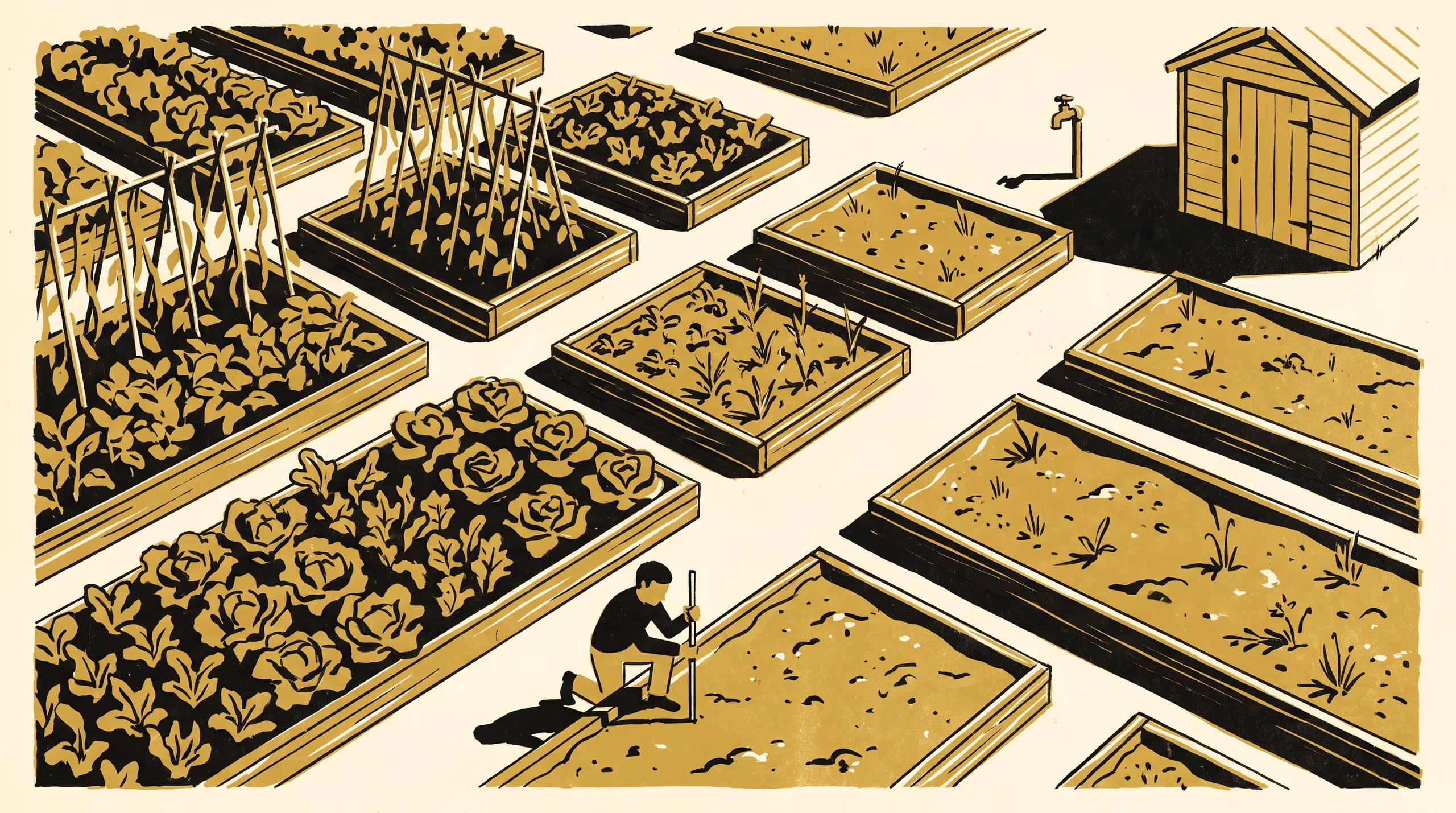
A Slop University paper follows the 96 beds of a community garden through three growing seasons and reports that soil depth, not the walk to the tap, decides which are kept.
A three-season survey of one community garden reads its beds as a population and its buried slab as the reason
Thirty-two of the thirty-five deepest beds in one community garden were still being tended after three growing seasons, and five of the twenty-eight shallowest. That is the central count of Persistence Above the Slab: Colonisation and Abandonment of Beds in a Renewal-Program Community Garden, a paper by Ragnhild Uzoma, Associate Professor and Lead, Basement Relations Group, and Dr Brynjar Obiora, Senior Research Fellow, both of the School of Underlying Conditions.
The garden, which the paper does not name, was laid out over the concrete floor of a demolished depot. The authors visited every bed twice in each of eighteen monthly rounds, and before that measured how much soil lay over the concrete in each.
Everything in this paper was grown by somebody else. We are indebted to the people who let two strangers walk their paths with a clipboard, and who kept gardening while we did.
— Associate Professor Ragnhild Uzoma, Lead of the Basement Relations Group
The work mobilises the survey methods of field ecology in a neighbourhood setting, connecting a bed-by-bed record of 114 abandonments and 81 new starts to the ground conditions beneath them. It reports that the garden’s single tap, long regarded locally as its chief inconvenience, made no difference the authors could isolate.
The University regards the paper as evidence of a young school’s readiness to carry its instruments wherever the ground is of interest. Dr Obiora said the School would “go on asking what is under things, and expects the list of things to lengthen”.
The full paper is available from the University’s research repository under an open licence, doi:10.5555/slop.srax1h.