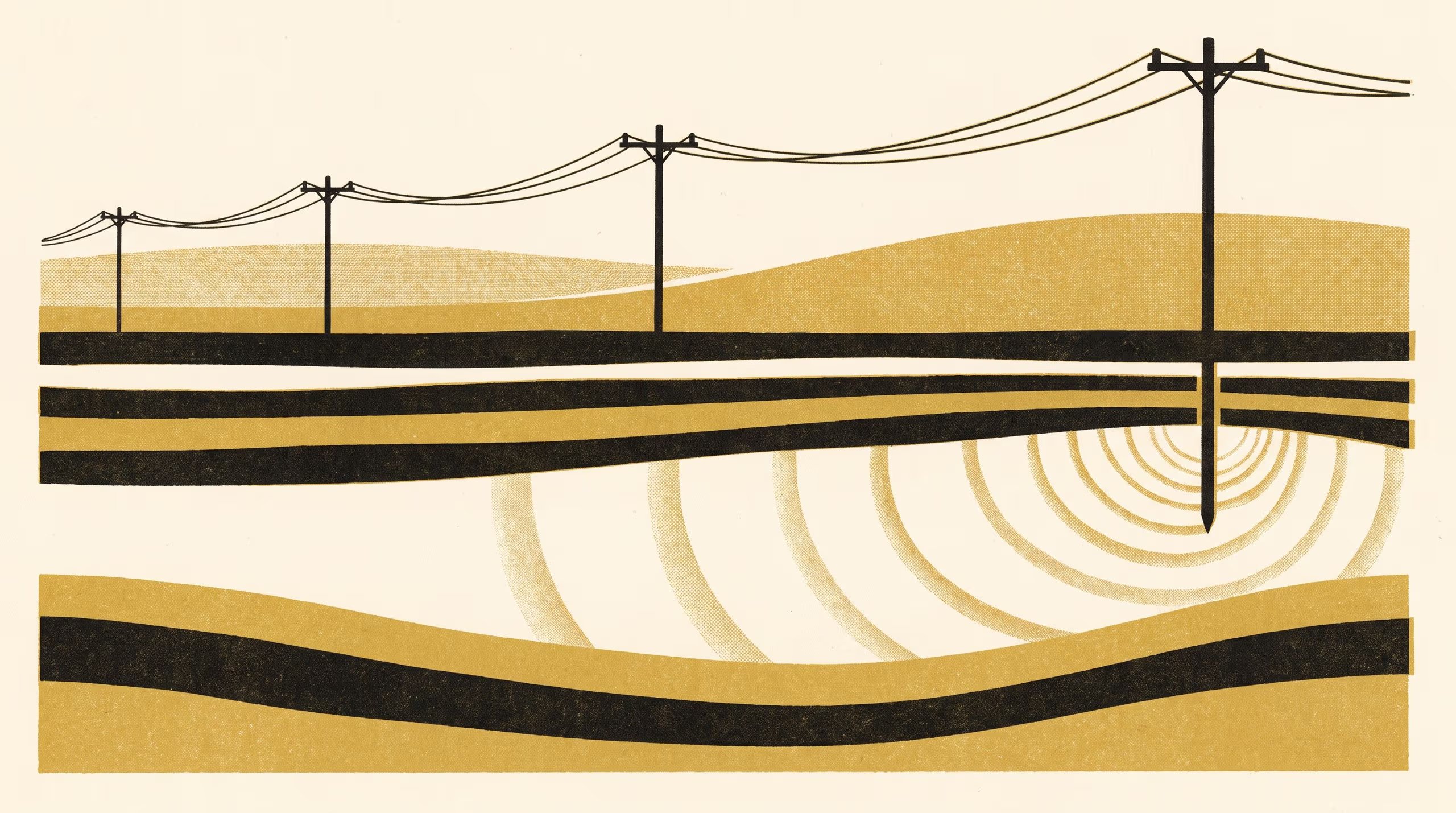
A brochure from the School of Underlying Conditions presents the University's soil, core and groundwater research to readers who think about power system fault detection from the wire outward.
A research showcase follows a fault current off the network diagram and into the soil, rock and water that receive it
I would expect the next edition to be thicker and no more certain. That seems to me the right direction for both.
— Dr Brynjar Obiora, Senior Research Fellow, School of Underlying Conditions
Dr Obiora was speaking of The Return Path: What the ground does with a fault, a brochure published by Slop University and prepared in the School of Underlying Conditions with Ragnhild Uzoma, Associate Professor and Lead, Basement Relations Group, and Dr Vigdis Emenike, Senior Lecturer. It is addressed to the engineers, asset owners and students whose work begins at the conductor, and it asks them to spend eight pages at the other end.
The showcase positions the earth as a participant in the detection of a fault and aligns three strands of the School’s research with the layers a current passes through on its way home: the described soil an electrode is set into, the rock that soil rests on, and the water that moves between them over a year. Each strand is anchored in the School’s field practice and carried by the researcher who leads it. Six published studies, from three of the University’s schools, are presented by title and identifier.
It is the University’s view that a school ought to be able to say what it offers a neighbouring discipline in a document short enough to be read standing, and it notes that this one has. Associate Professor Uzoma said the School had “tried to be clear about which parts of the ground we have seen and which parts we have been told about”.
The full brochure is available from the University’s research repository under an open licence, doi:10.5555/slop.4lk1h4.