The School of Underlying Conditions has released a display advertisement on the agreement between what its researchers expected to find and what they brought up.
A new display advertisement sets the School of Underlying Conditions' predictions beside the ground they were made about
The School of Underlying Conditions was founded to study what the surface rests on, and it has held from the start that a prediction about the ground is owed a visit to the ground. That position is now the subject of Theory and Experiment, in Agreement, a display advertisement for the University’s portrait panels convened by Dr Brynjar Obiora, Senior Research Fellow.
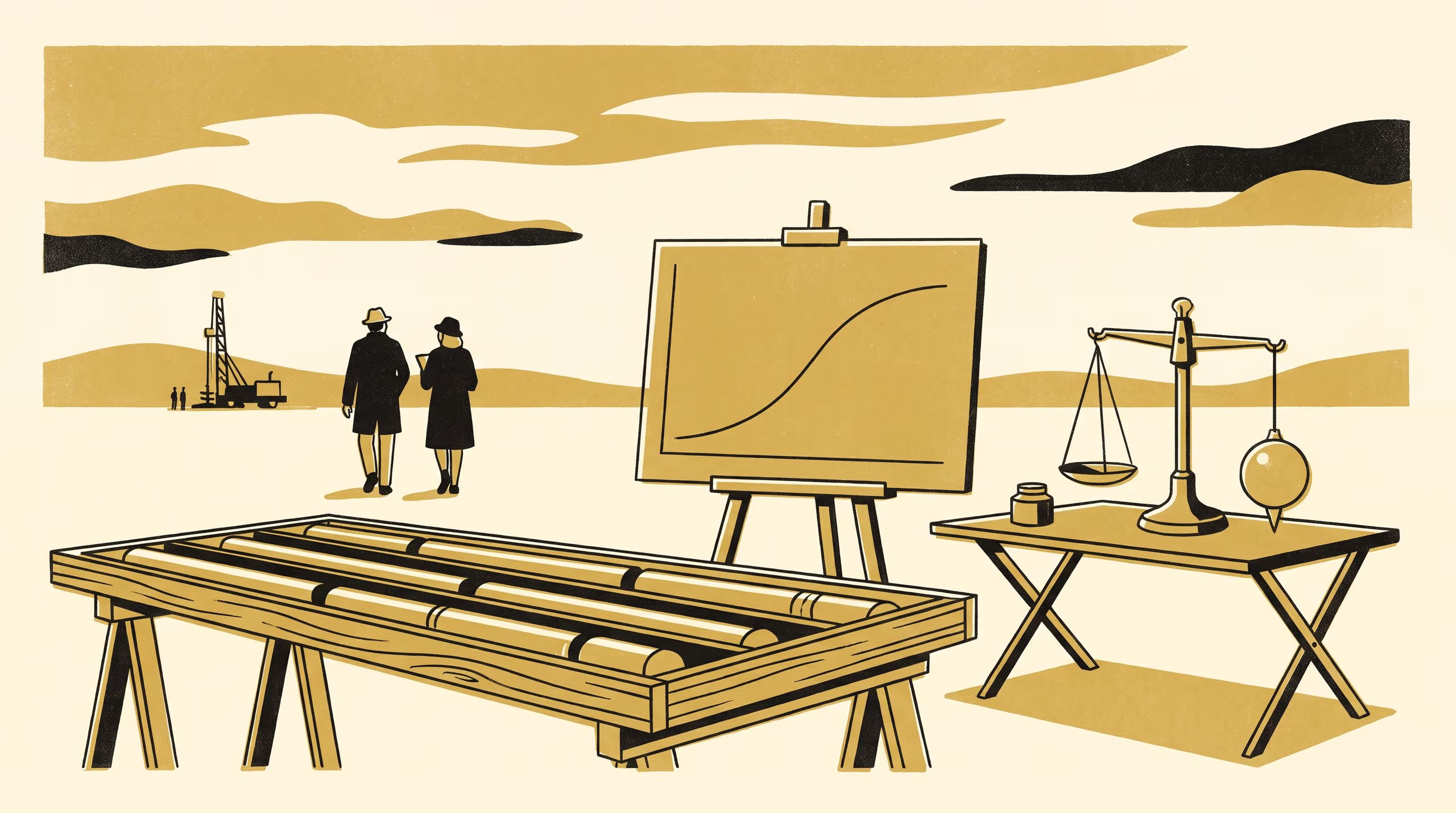
The advertisement shows a tray of drill core on trestles in open country, an easel carrying a single drawn curve, and a surveyor holding a length of the one up to the other. Beneath it, a line of copy reports how the School stands on the University’s own Indicator Commons, and an address directs the reader to the people responsible.
Most of what we expect to find down there, we do find. The rest we bring back and describe. I would not want to say which I enjoy more.
— Dr Brynjar Obiora, Senior Research Fellow, School of Underlying Conditions
Three entries in the research repository stand in the advertisement’s small print: a fluorescent probe for drill-core leachate, an account of one inland basin’s standing water levels, and a water balance of the stock dams that recharge the bores below them. Light and dark renderings have been prepared for the panels.
The University is content to have a claim of this kind made in a public place, where anyone who doubts it may stand as close as they like. Dr Obiora said the School “has always found the ground a fair-minded reader, and hopes to be read the same way”.
The full advertisement is available from the University’s research repository under an open licence, doi:10.5555/slop.1ekkmr.