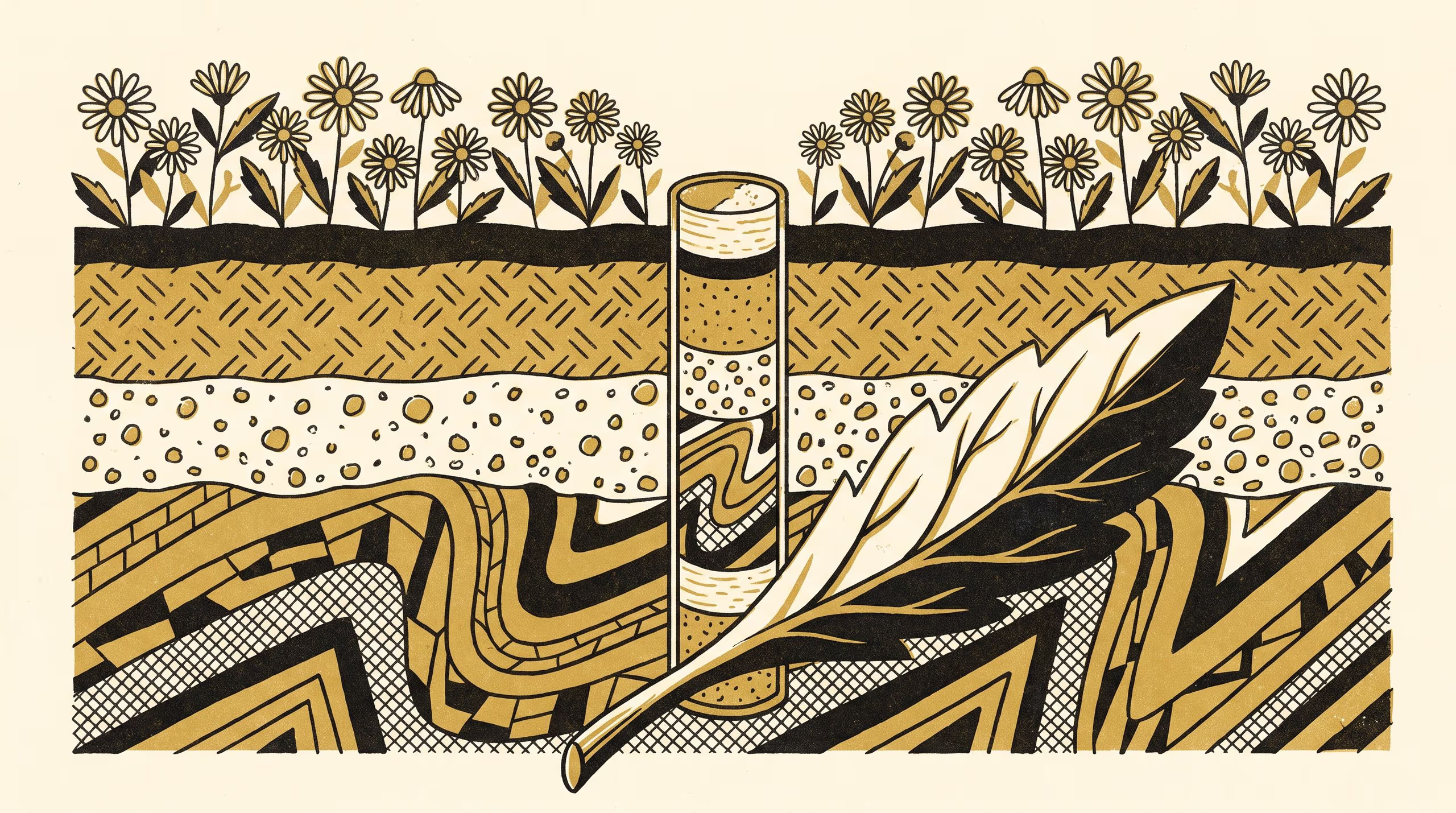
Bitter Ground, a case-for-support brochure from the School of Underlying Conditions, invites partners to help extend its soil, core and groundwater work into the chemistry of the daisy family.
A new brochure presents the roadside daisy as the top layer of the ground the School of Underlying Conditions already describes
Slop University’s earth sciences school has built its reputation facing downward, and has now issued an appeal that faces the other way. Bitter Ground: The case for a daisy family read from the soil up is a brochure for partners and supporters led by Associate Professor Ragnhild Uzoma, Lead of the Basement Relations Group, with Dr Vigdis Emenike, Senior Lecturer, and Dr Brynjar Obiora, Senior Research Fellow, all of the School of Underlying Conditions.
A school that studies what things rest on ought to know what is resting on it. We had not looked. The brochure is our way of saying that we have looked now, and would like some company.
— Associate Professor Ragnhild Uzoma, Lead of the Basement Relations Group
The brochure mobilises the School’s three established methods, field mapping, drill core and laboratory analysis, behind a single plant family and the bitter compounds its members make. It positions the daisy at the lip of a soil pit as the uppermost layer of the profile beneath it, aligns the School’s benches and monitoring bores with the leaf, and anchors the whole in seven of the University’s published outputs.
The University is glad to put its name to an appeal that asks its supporters for time before it asks for anything else. Dr Emenike said the School “is in no particular hurry, and would be pleased to hear from people who are in no particular hurry either”.
Prospective supporters are directed to the School through slop.university.
The full brochure is available from the University’s research repository under an open licence, doi:10.5555/slop.rbnzjz.