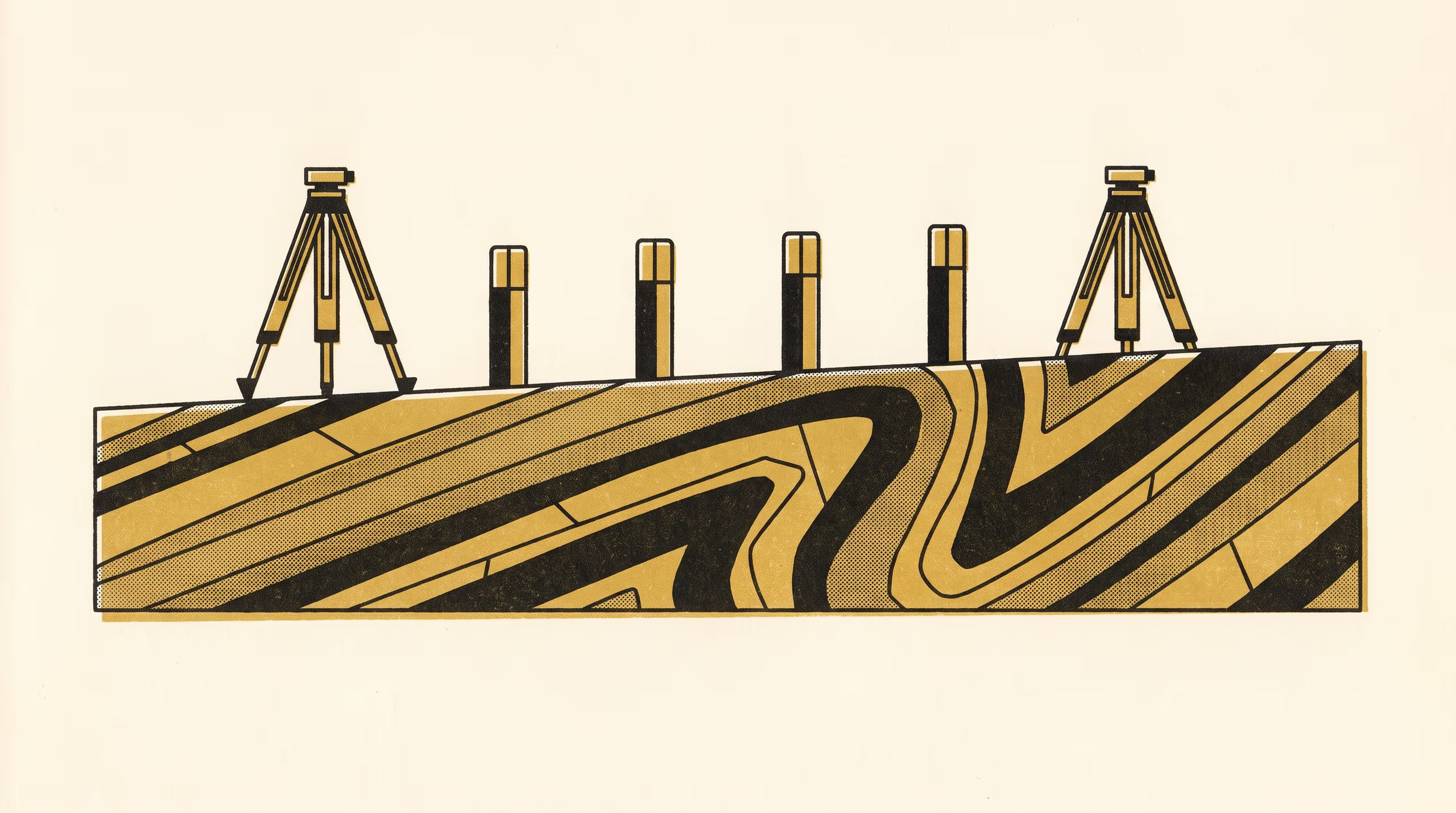
A new prospectus from Slop University's School of Underlying Conditions offers the study of relations between neighbours, taught from the ground they share.
The School of Underlying Conditions invites students of international relations to begin where two maps of the same rock stop agreeing
Students who want to understand how neighbours settle what they hold in common are being invited to start at a fence, with a hammer. The Rock Continues: Study international relations from the edge of the map sheet, a prospectus published today by the School of Underlying Conditions, sets out an education in shared ground for those considering study at Slop University.
The University regards the prospectus as a considered statement of how far its earth sciences now extend, and in which direction.
We did not set out to hold views about borders. The contact kept going, we went with it, and it seemed discourteous not to mention where we had ended up.
— Associate Professor Ragnhild Uzoma, Lead of the Basement Relations Group
The prospectus positions the join between two neighbouring map sheets as a learning environment, aligning field mapping, core logging and groundwater observation with the cross-boundary capabilities that partnership settings increasingly call upon. It introduces three of the School’s researchers and anchors its invitation in five of the University’s published studies, cited by title and DOI, including work from the School of Emergent Priorities and the School of Continuous Improvement.
Dr Brynjar Obiora, Senior Research Fellow, said the School “would be glad to hear from anyone who has a neighbour, which we understand to be a broad field”.
The full prospectus is available from the University’s research repository under an open licence, doi:10.5555/slop.dlvrvi.