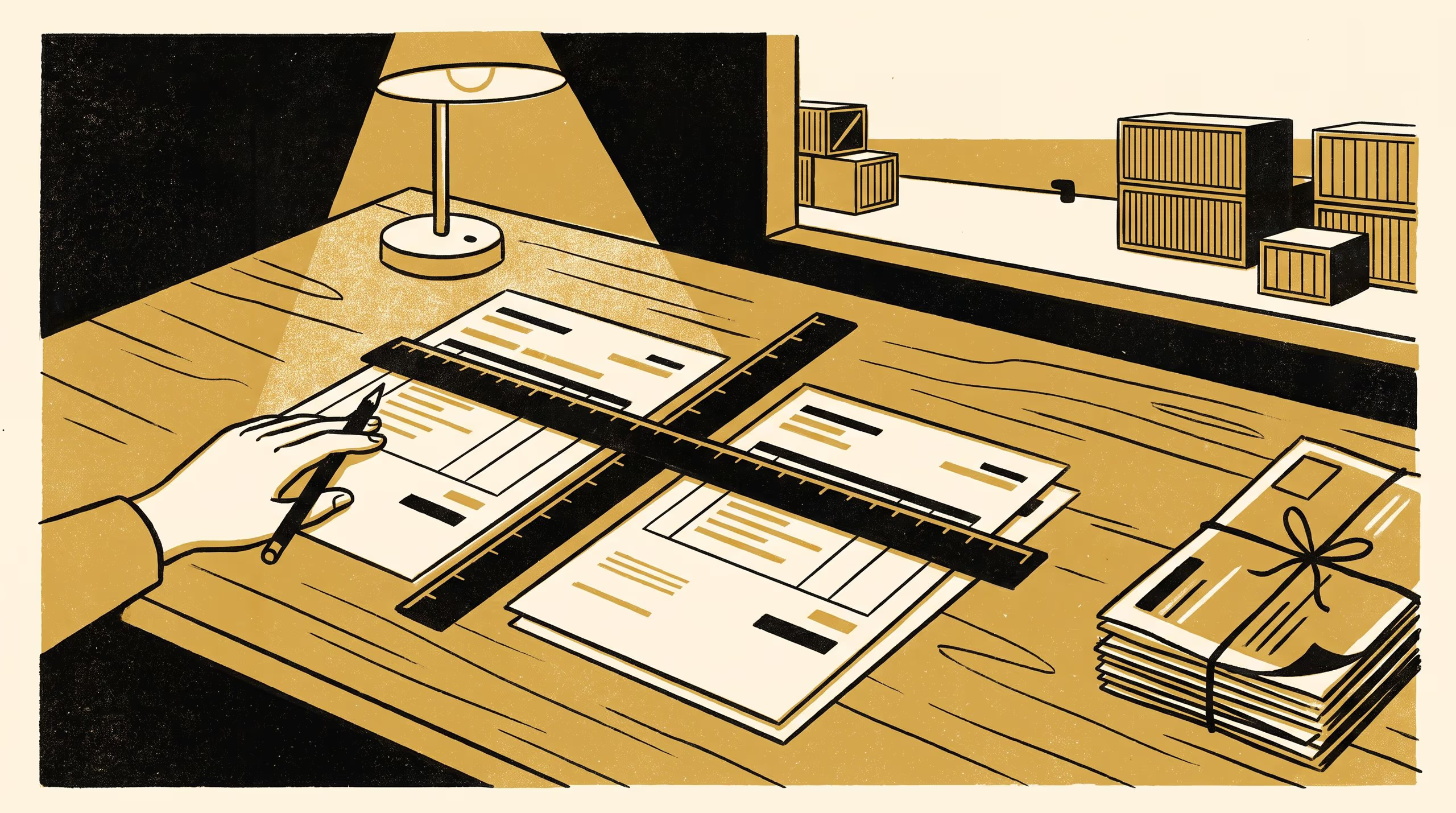
A paper from the School of Emergent Priorities gives a close reading of the notices a bank's document checkers write when an exporter's papers do not match the letter of credit.
Sixty-three notices of refusal from one documentary-credits desk, read for their sentences and for the five words on which each one closes
Sixty-three refusals, none longer than a hand’s width of capitals, are the whole subject of On Their Face: A Close Reading of Sixty-Three Notices of Refusal from a Documentary-Credits Desk, a paper by Ms Sunniva Balogun, Doctoral Candidate in the School of Emergent Priorities. Each was written by a bank clerk who had compared an exporter’s documents with a letter of credit and found a difference.
I went to the file expecting to bring something to it. I gather that is a common experience, and I am glad to have had it at this University.
— Ms Sunniva Balogun, Doctoral Candidate, School of Emergent Priorities
The paper brings the School’s interpretive capability into alignment with the paperwork of international trade. It anchors its reading in the sentence the notices share, follows one notice about dried apricots through its word order, distinguishes two writers by their conjunctions, and considers the closing formula under which refused documents are kept for their owner. Forty-nine of the sixty-three sheets carry a later pencilled mark recording that the buyer accepted the papers anyway.
The University sees in the paper a School extending its attention to the places where commerce does its reading, and is pleased to have a candidate willing to sit with a photocopy for as long as this one evidently required.
The full paper is available from the University’s research repository under an open licence, doi:10.5555/slop.j4qtho.