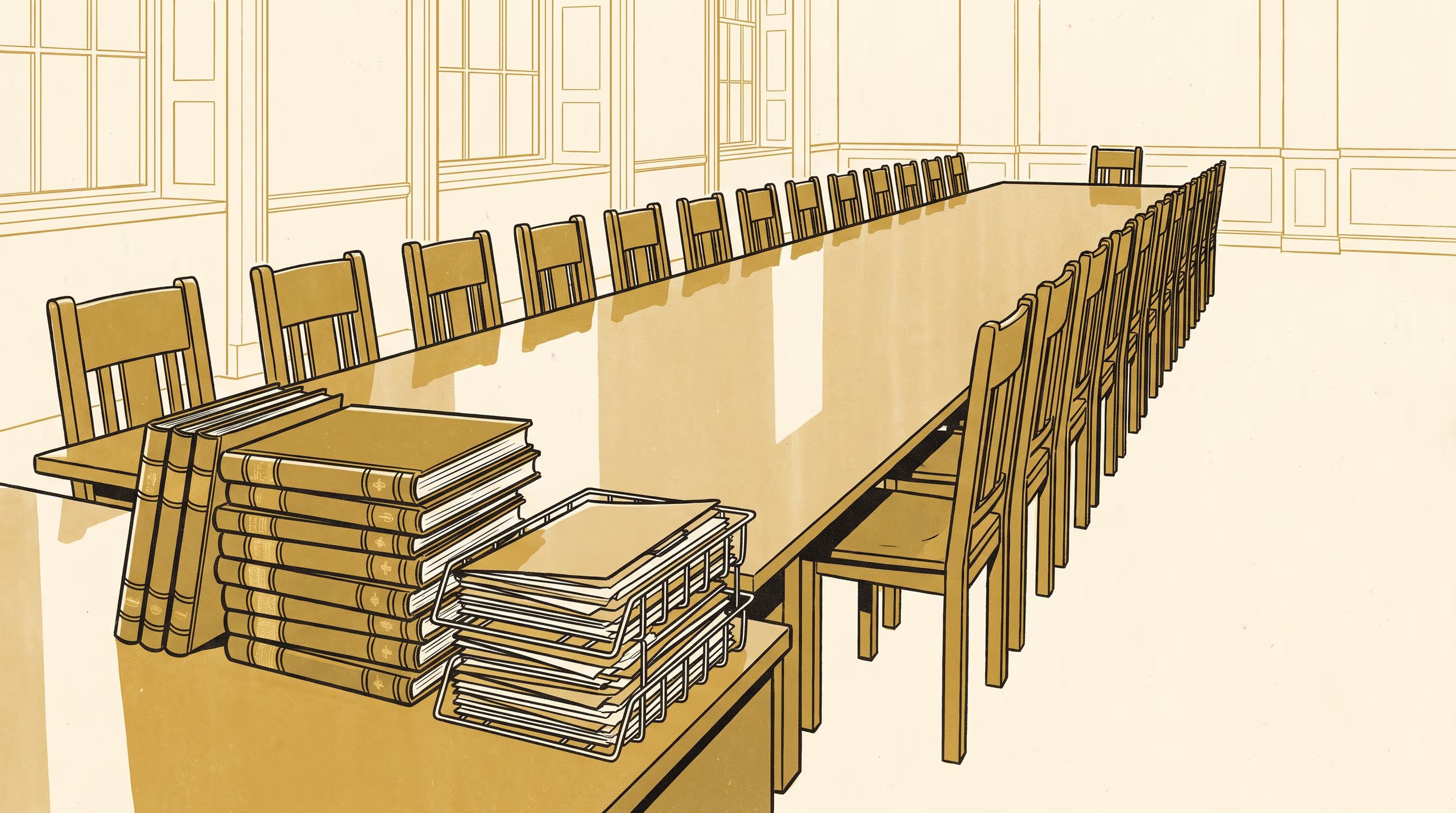
A paper from the School of Emergent Priorities reads twelve years of a faculty council's minutes to establish what becomes of the motions its student members table.
Twelve years of one faculty council's bound volumes show a chamber that refuses almost nothing and refers most of what its students move
The School of Emergent Priorities concerns itself with how a matter comes to be settled, and its newest paper visits a chamber in which very little is settled against anyone. Referred to Commission: The Disposal of Student Motions in Twelve Years of a Faculty Council’s Minutes is by Ms Ylva Onyekwere, Doctoral Candidate, and Dr Anneke Tolan, Senior Research Fellow and Deputy Convenor, Futures in Committee.
Its setting is a public university in Latin America, where students sit and vote on the councils that govern their faculties. Across 286 sessions and 3,912 motions, the paper aligns a council’s minutes with the register its commissions keep, and carries each item of student business from the floor to wherever it came to rest. The council voted down nine student motions in twelve years. It referred 604 for study, and the study was concluded while the student who had moved the item still held a seat in about one case in five.
There are twelve years of somebody’s careful hand in those volumes. I should like to think we read them at something near the pace they were written.
— Ms Ylva Onyekwere, Doctoral Candidate, School of Emergent Priorities
Slop University has long understood a reading room to be a research facility, and takes some quiet encouragement from a paper that required no other. Dr Tolan said the work “sits where the School has generally preferred to sit, a little to one side of the vote and with a clear view of the clock”.
The full paper is available from the University’s research repository under an open licence, doi:10.5555/slop.58rweq.