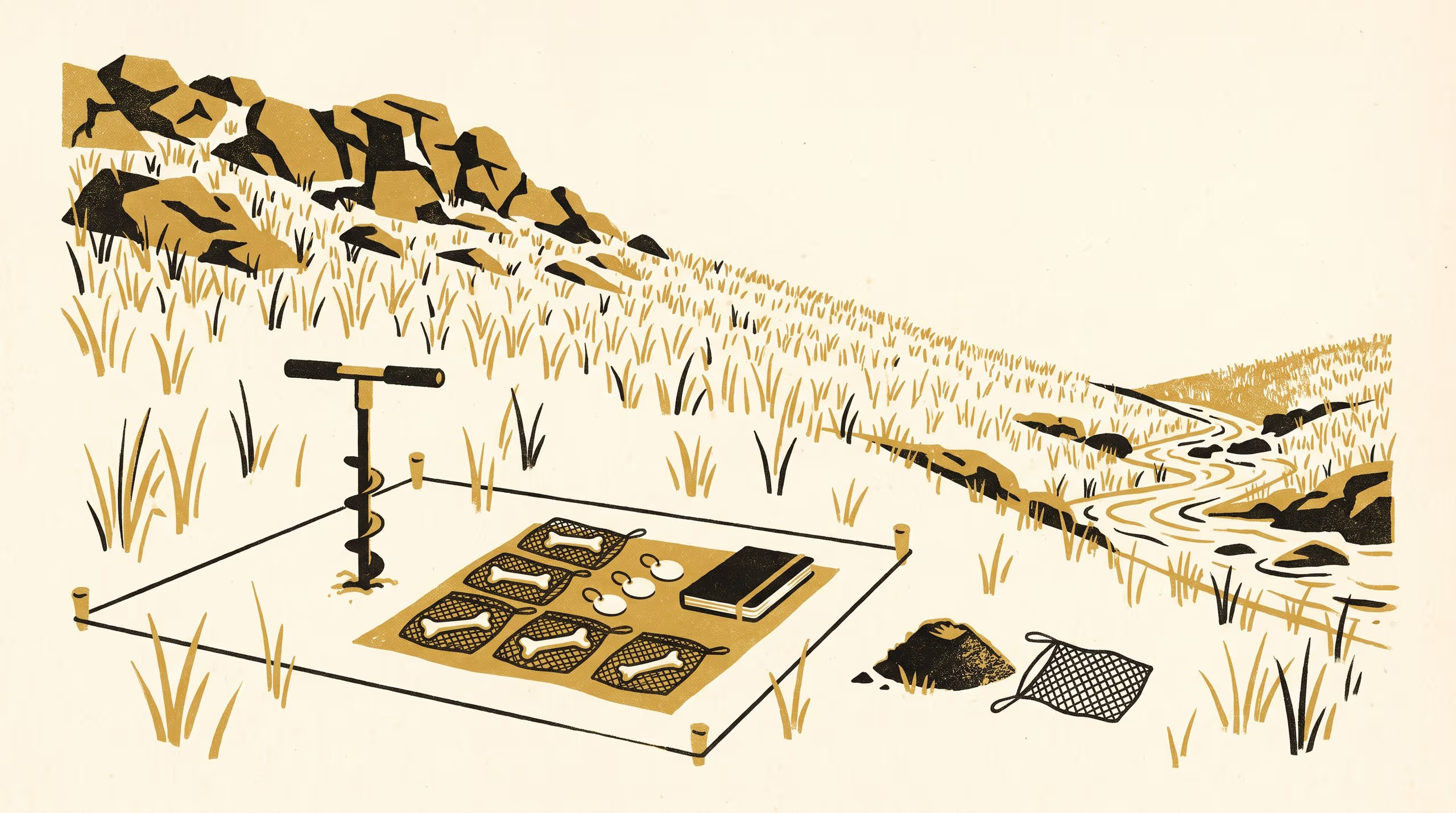
A School of Underlying Conditions paper borrows the ecologist's litterbag to follow the collagen in buried sheep bone down one hillslope for eighteen months.
Sheep bone bagged in mesh and buried down a single hillslope lost the most where the water table comes and goes, and the least where it never leaves
On one hillside, over eighteen months, the place a bone was buried mattered more than how deep it went. That is the result reported in Bone Bags on a Catena: Slope Position, Burial Depth and the Loss of Extractable Collagen from Sheep Bone over Eighteen Months, a paper by Dr Brynjar Obiora, Senior Research Fellow, and Dr Vigdis Emenike, Senior Lecturer, of the School of Underlying Conditions.
The paper carries a long-established method of field ecology across to a material it has seldom been asked to hold. The authors enclosed 160 sections of sheep bone in fine mesh, buried them at two depths and five positions between a crest and a drainage line, and brought them back in stages to see how much collagen could still be extracted. The wettest ground gave back the most. The ground that was wet only some of the time gave back the least, and 149 of the bags gave back anything at all.
The landholder asked, at the end, whether we had found what we were looking for. I said we had found most of it, and that the rest would be somewhere on the footslope. We remain grateful for the paddock and for the question.
— Dr Brynjar Obiora, Senior Research Fellow, School of Underlying Conditions
The University regards patient work of this kind as an expression of its settled confidence in the long view. Dr Emenike, who measured the water table beside every plot, said the study “has given the School a clearer sense of how much of its subject is down there, and for how long”.
A further set of bags remains in the ground for a later lift.
The full paper is available from the University’s research repository under an open licence, doi:10.5555/slop.6dfw57.