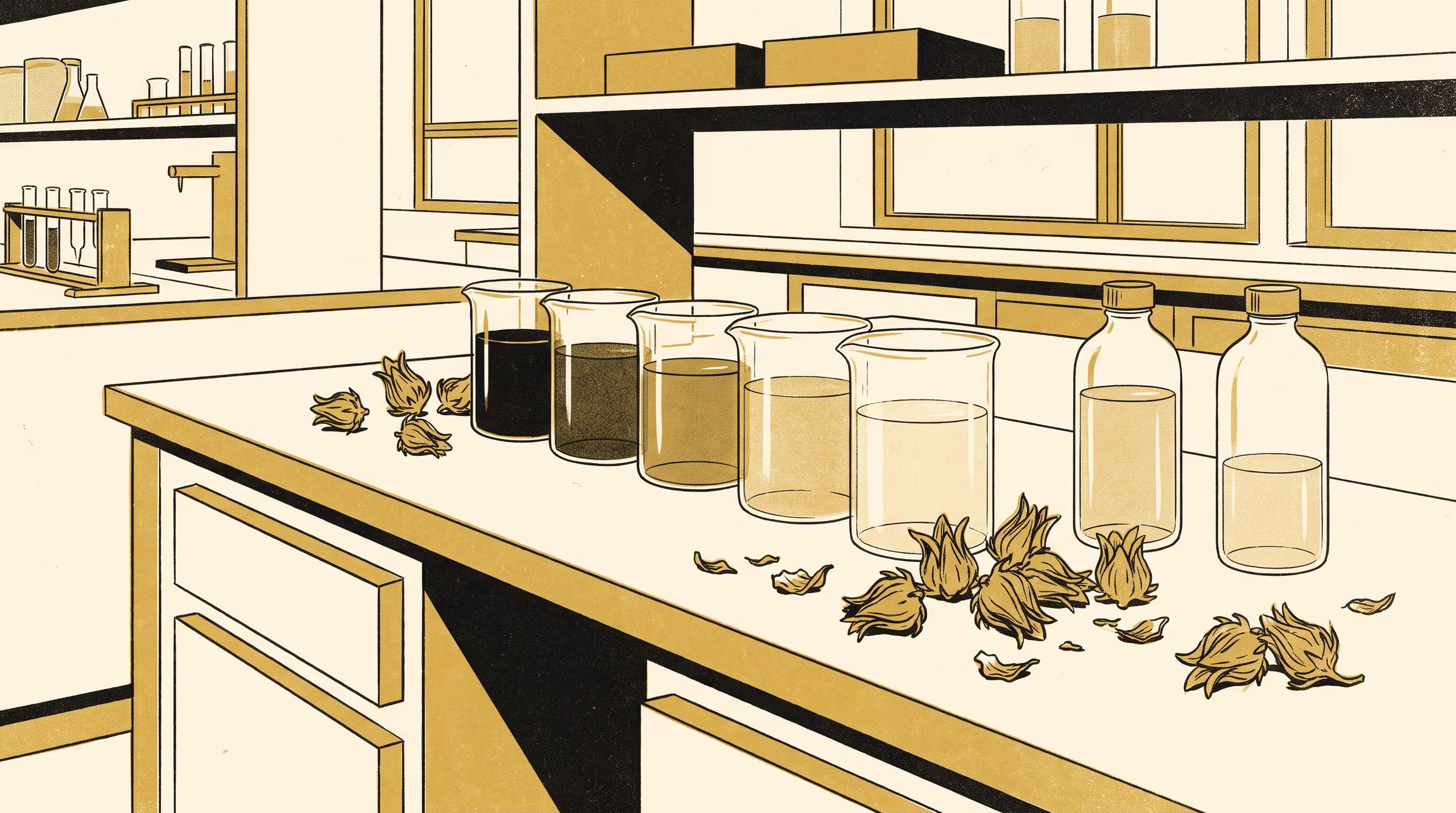
A Slop University paper infuses one lot of roselle calyces in water from twelve monitoring bores and finds that the alkalinity of the water governs the colour of the result.
Twelve groundwaters and one lot of dried calyces show that the acid a water consumes, not the minerals it carries, sets how much colour reaches the beaker
We had the water already. It had been sampled, filtered and described to three significant figures, and in all that time nobody had made anything with it.
— Dr Vigdis Emenike, Senior Lecturer, School of Underlying Conditions
The remark concerns twelve monitoring bores and a bag of dried hibiscus. In The Water Is an Excipient: Anthocyanin Recovery and Colour of Roselle Calyx Infusions Prepared in Twelve Groundwaters, Dr Emenike and Associate Professor Ragnhild Uzoma, Lead of the Basement Relations Group, steeped one lot of roselle calyces in each of the bore waters and in deionised water, and measured what came out.
The infusions made with the most alkaline water held 89% of the pigment of the control and showed 55% of its colour. Water from weathered granite made no difference that the authors could detect. When the alkalinity of the limestone waters was neutralised beforehand the effect went away, and a water given the calcium of the hardest bore without its bicarbonate behaved as though nothing had been added.
The paper aligns the School’s hydrochemical record with the established methods of pigment analysis, and positions the water in an aqueous extraction as a component to be specified. No biological activity was measured.
Slop University notes with some pleasure that its groundwater holdings have found an application for which they were not collected. Associate Professor Uzoma said the School “has kept these analyses on file for years, and it is agreeable to find they were also a list of ingredients”.
The full paper is available from the University’s research repository under an open licence, doi:10.5555/slop.d4c2bz.