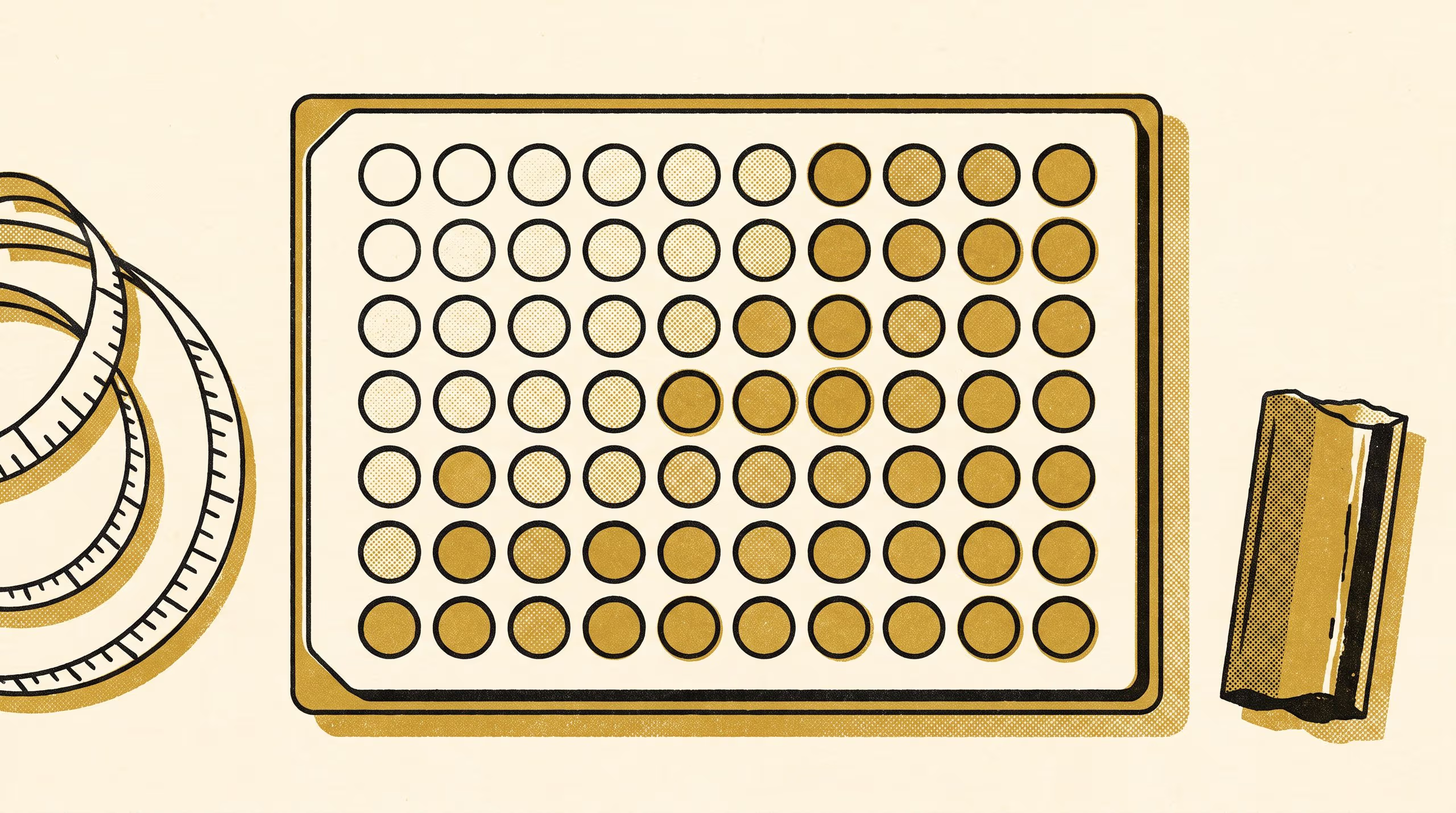
A research poster from the School of Underlying Conditions locates the chain length at which a family of laboratory-made salts stops improving against bacteria cultured from fouled monitoring bores.
Seven compounds made at the School's own bench, tested on five organisms taken from the inside of two monitoring bores
Fourteen is the answer, and the School of Underlying Conditions has gone to some trouble to be able to give it. Fourteen Carbons: A Homologous Series of Imidazolium Bromides against Five Bore-Water Isolates, a research poster by Dr Vigdis Emenike, Senior Lecturer, and Dr Brynjar Obiora, Senior Research Fellow, reports the point at which lengthening a molecule ceases to make it any better at its job.
The poster brings synthesis and screening together under one roof. The authors prepared seven closely related compounds, each two carbon atoms longer than the last, and set every one against five bacteria cultured from the film that gathers on the pipework of a fouled monitoring bore. Each added carbon strengthened the effect until the fourteenth. The sixteen-carbon compound did slightly worse, and one of the five organisms had parted company with the trend two carbons earlier.
The series stops at sixteen because that is where the page of the supplier’s catalogue stopped. We have since turned the page, and I am advised there are more.
— Dr Vigdis Emenike, Senior Lecturer, School of Underlying Conditions
The School, which was established to study what lies beneath the ground, regards the poster as evidence that its curiosity extends to what lives in the holes it has drilled there. The authors are careful to add that the work was carried out in broth, on a plate, and that no bore was treated at any stage.
Dr Obiora said the bench had been “a change of scale in the agreeable direction”, and that he had not previously held an entire field site in one hand.
The full poster is available from the University’s research repository under an open licence, doi:10.5555/slop.ero1xl.