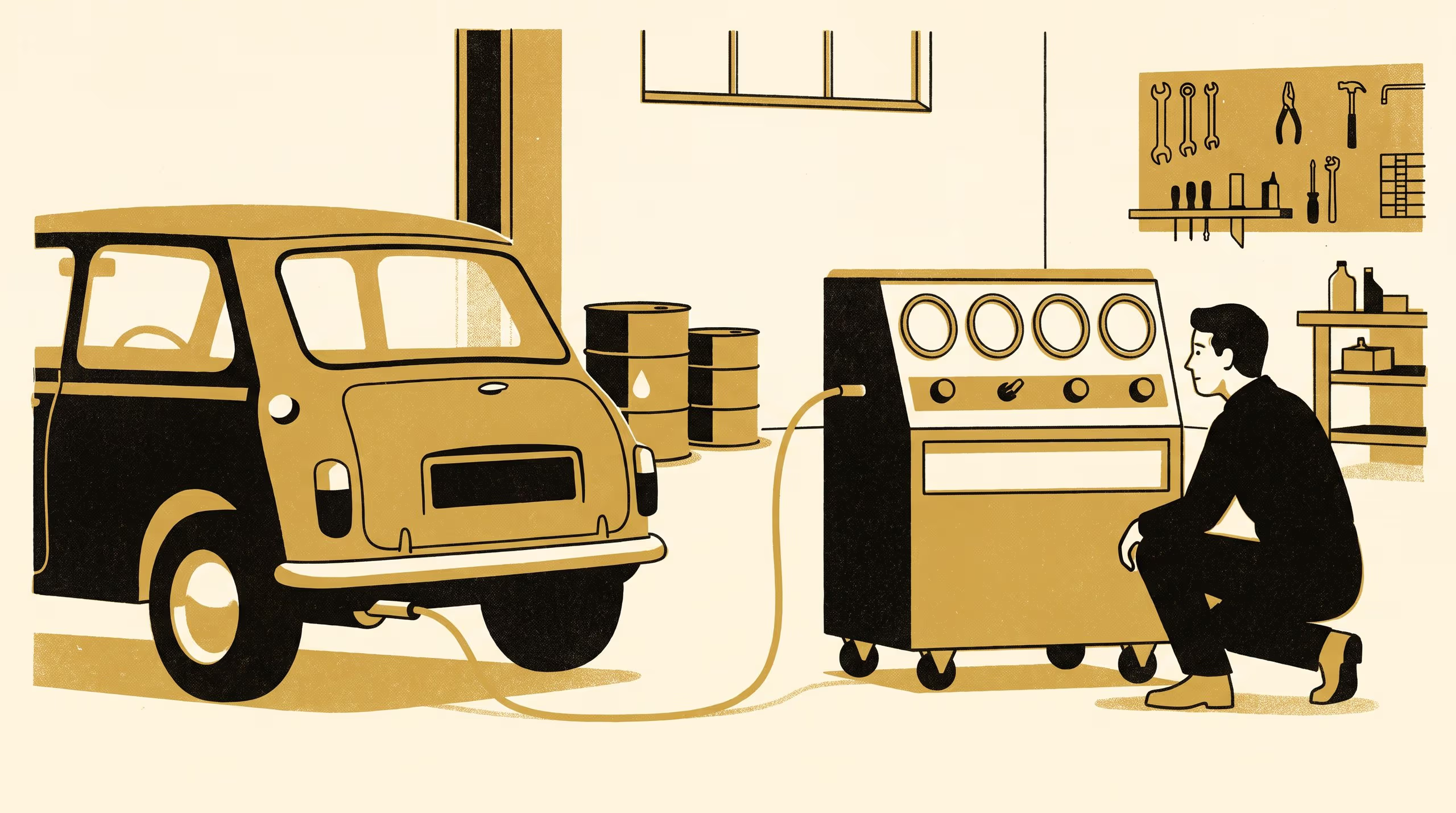
A research poster from the School of Underlying Conditions describes how sixty-four automotive apprentices came to understand an exhaust gas reading across a six-week unit.
A study of one training cohort listens to how a tailpipe printout is read, and finds the change in the reasons rather than the answers
A mistaken idea about an engine can sit quite comfortably behind a correct answer, and a new Slop University study has gone looking for it there. Reading Lambda Aloud: Apprentice conceptions of the five-gas exhaust reading across a diagnostic emissions unit is a research poster by Dr Vigdis Emenike, Senior Lecturer in the School of Underlying Conditions, with Dr Ingeborg Nwachukwu, Lecturer and Convenor, Capability Sprints, and Edda Nwafor, Doctoral Candidate.
Most of what we have came from keeping quiet while somebody else read a printout. It is a method with very little to recommend it except that it works, and I am grateful to everyone who let us sit there.
— Dr Vigdis Emenike, Senior Lecturer, School of Underlying Conditions
The poster follows 64 third-year apprentices at one training college through a unit on exhaust gas diagnosis, asking each of them the same questions before and after, and asking for the reason as well as the answer. It surfaces four ways of understanding the reading, from a verdict to an account of combustion, and maps which earlier ideas gave way. Those the workshop bench contradicted in front of the class fell by more than half. Three that the bench seldom contradicts barely moved, and the apprentices who did let one go had started reading the gases against each other.
The University counts the work as part of a widening of its teaching scholarship beyond the lecture room, and as evidence that a school of rock and water may usefully attend to air. Dr Nwachukwu said the team had “come away with a clearer sense of how much a reason weighs, and of how rarely anybody asks for one”.
The full poster is available from the University’s research repository under an open licence, doi:10.5555/slop.jius38.