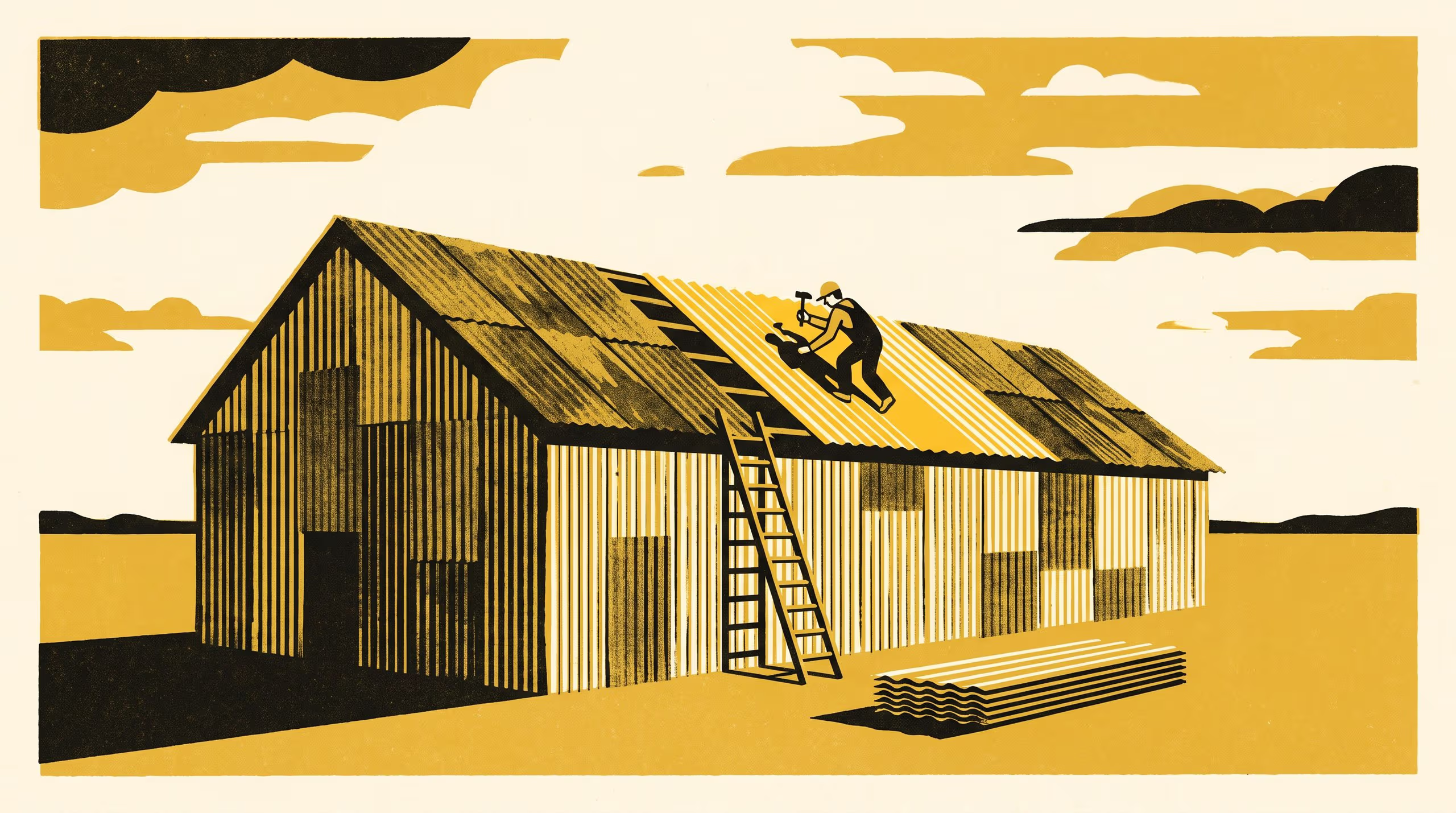
A paper from the School of Underlying Conditions and the School of Continuous Improvement asks a second-year accounting cohort where a repair ends and an asset begins, twice, under two wordings.
A twelve-step ladder of work on one farm shed shows a semester of instruction sharpening where a class draws the line without moving it
Twelve jobs on one shed roof, each a little larger than the last, were enough to show where a class of second-year accounting students parts company with itself. When the Roof Becomes a New Roof: Wording, Instruction and Where Second-Year Accounting Students Place the Capitalisation Boundary is a paper by Dr Brynjar Obiora, Senior Research Fellow in the School of Underlying Conditions, and Dr Solveig Adeyemi, Lecturer in the School of Continuous Improvement.
I have spent a career being asked where one thing stops and the next one starts. It was restful, for once, to sit at the back and watch somebody else be asked.
— Dr Brynjar Obiora, Senior Research Fellow, School of Underlying Conditions
At the paper’s centre is a graded classification instrument, anchoring a single teaching concept to a sequence of outlays that runs from three re-fixed screws to an extended shed. The 94 participating students met it before and after the unit reached the topic, half under a heading that spoke of repairs and half under one that spoke of new roofing. Instruction roughly halved the zone over which the class disagreed. It left the two headings about two steps apart, and when fourteen students were asked to reason aloud, the reason heard most often was that the roof had become a different roof.
Slop University is glad to be an institution in which a soil surveyor and a scholar of incoming reports may be found in an accounting tutorial without anyone asking what they are doing there. Dr Adeyemi said the ladder “fits on one side of one sheet, which is about the size a question ought to be”.
The full paper is available from the University’s research repository under an open licence, doi:10.5555/slop.wtw9uz.