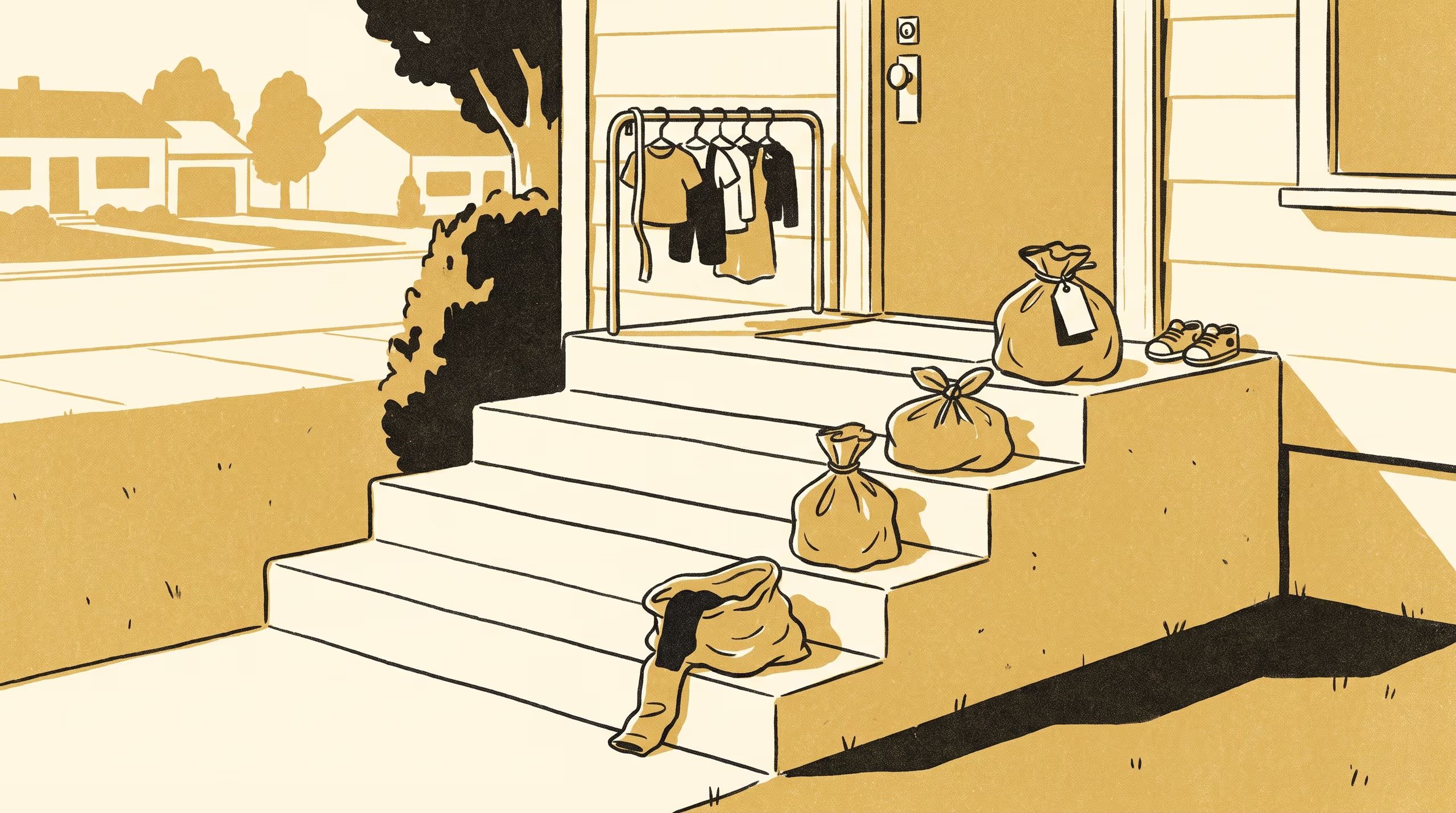
A School of Emergent Priorities paper on how households pass outgrown children's clothes to other families leads the University's family-room exchange rack to admit bags only from households at Level Four or above, with no override.
A five-level ladder for bags of outgrown children's clothes becomes the condition of entry to the University's exchange rack, rescored each term
Families who hand on outgrown children’s clothes will now have a ladder to climb before the University’s family-room exchange rack takes their bag. The rack, which until recently accepted whatever was left beside it, will admit a bag only from a household holding Level Four or above at the start of the school term. A bag from a household below that line is returned to its doorstep unopened, with a card.
The ladder is set out in ‘Whoever Asks First’, a paper released today by Ms Hedvig Anyanwu, Dr Ronja Oyelaran and Dr Lindiwe Achterberg of the School of Emergent Priorities. Its five levels, from Bag by the Door to Standing Rota, describe what a bag carries as it leaves a house: a size, a season, a written list, a place in a sequence of receiving households.
A bag by a door looks like the end of something, and we were glad to be shown how much of it is the middle.
— Dr Ronja Oyelaran, Senior Lecturer and Deputy Convenor, Strategic Drift Survey
The paper follows thirty-eight households through three school terms, noting when each garment was outgrown and when it left the house, and the arrangements those households made as the rack’s rule took hold. Households moved up the ladder in numbers, and the paper considers what moved with them.
The University has taken the ladder as written. Scoring is repeated at the start of every term, and no officer is empowered to waive the line for a bag already packed. Ms Anyanwu said the households had been generous with their wardrobe doors, and Dr Achterberg welcomed the clarity the arrangement brings to something families have long done by feel.
The work reflects the School’s continuing interest in the small procedures by which ordinary things are passed from one household to the next. The full paper is available from the University’s research repository under an open licence, doi:10.5555/slop.hm2dwn.