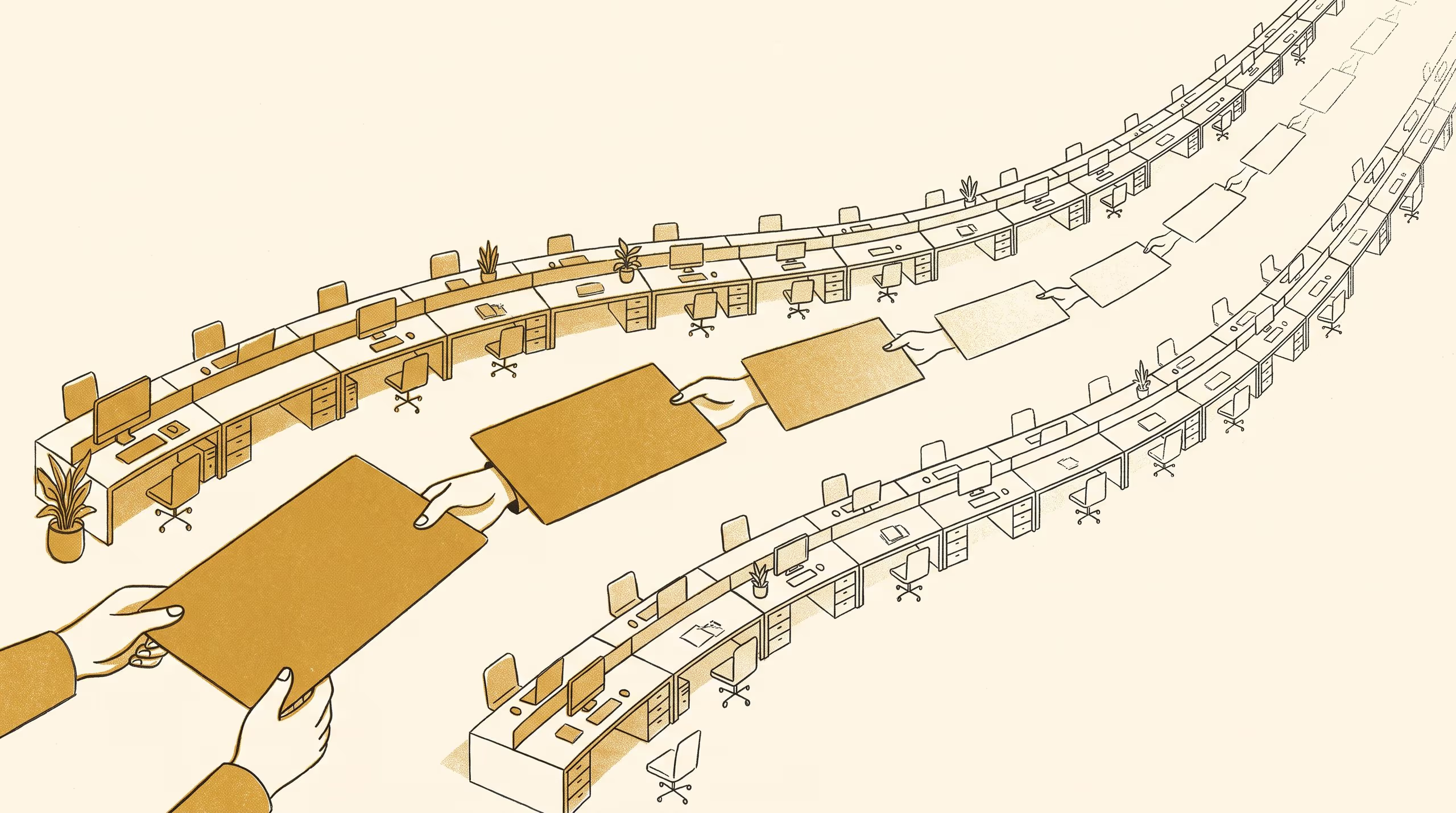
A School of Continuous Improvement poster sorts the signatures on 148 office farewell cards by position and message form, and the Indicator Commons adopts a Warmth Floor that returns any cold-ended card to its first signer.
A School of Continuous Improvement poster sorts 3,311 signatures into four cells and finds the second half of a card's circuit carries half the named detail of the first
A farewell card that reaches its last desk saying less than it said at its first will, from now on, go round again before anyone is handed it. The rule comes from “Does the Farewell Card Get Colder as It Goes Round?”, a research poster released today by the School of Continuous Improvement, and the Indicator Commons has taken it up as the Warmth Floor.
A card is the one instrument every office already owns, and what struck us was how little it asked of anyone. We found ourselves reading it the way a floor would.
— Dr Marit Osayande, Lecturer and Convenor, Living Dashboard
The poster, by Dr Renke Sabel, Dr Osayande and Dr Sten Okwuosa, follows 148 cards across 23 open-plan floors and places each signature in one of four named cells according to where it fell in the card’s circuit and whether it carried the leaver’s name. The authors set the cells alongside a pre-registered return rule and report how the cards behaved when sent a second time.
The Indicator Commons will now apply the Floor to every farewell card on a registered floor of the University, and a card will be released to its leaver only when its second half has cleared the line. Dr Sabel said the team was glad the question had turned out to have an answer a floor could carry out on a Friday afternoon.
The release reflects the School’s continuing interest in the small courtesies an institution extends without being asked, and in the order it extends them.
The full poster is available from the University’s research repository under an open licence, doi:10.5555/slop.f0cv65.