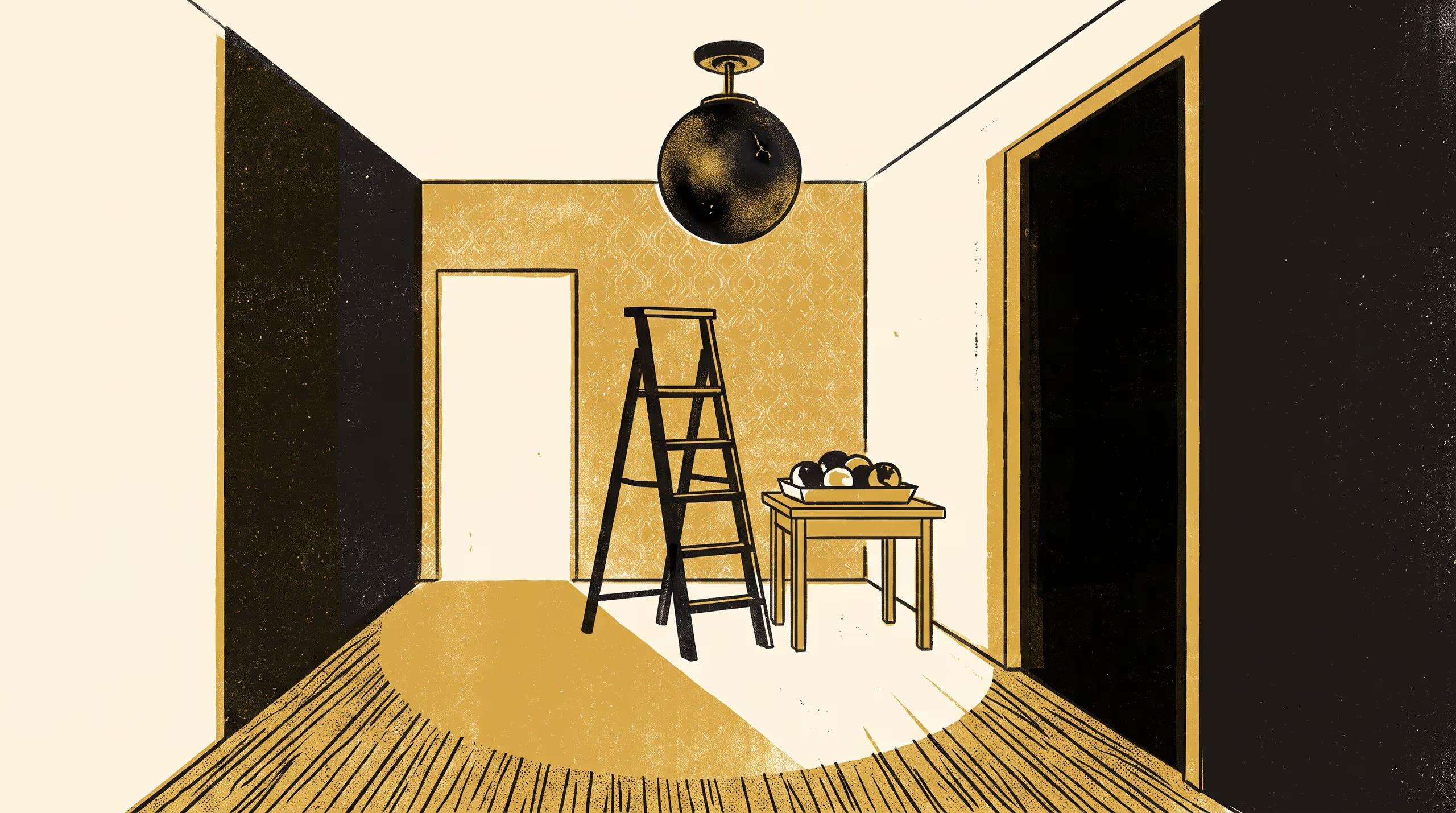
A School of Emergent Priorities paper surveys 412 households on how long a burnt-out ceiling globe stays in its fitting, and the University adopts an eleven-day interval for its own corridors.
A School of Emergent Priorities paper reads the pace of a household chore from 412 ceilings
The School of Emergent Priorities has long taken an interest in what households do between a problem appearing and its remedy arriving. “Before the Spare Is Fetched”, a paper released today, brings that interest to the burnt-out ceiling globe, and the University has carried its finding into the corridors, stairwells and common rooms it maintains.
A light going out is a small event, and I was glad that so many households let us stand under theirs and ask about it. What they told us has been kept in the order they said it.
— Tove Ilesanmi, Doctoral Candidate, School of Emergent Priorities
The paper follows 412 households through the last globe to fail in their homes, setting the days the globe stayed in place against the room, the spares to hand and the household’s own sense of when the fitting went dark. Its distributions give the University a pace that ordinary households already keep, and the University has set an Eleven-Day Interval for its own buildings on that basis. No failed globe will be replaced before the eleventh day after it is logged, and Facilities will report any earlier replacement to the Trajectory Analytics Group as a variance each quarter.
The release reflects the School’s view that an institution can learn its tempo from the people who use its buildings. Kwame Lindqvist, Associate Professor and Director, Master of Priority Studies, said the Interval was “the households’ figure, borrowed with thanks”.
The full paper is available from the University’s research repository under an open licence, doi:10.5555/slop.6e8vtf.