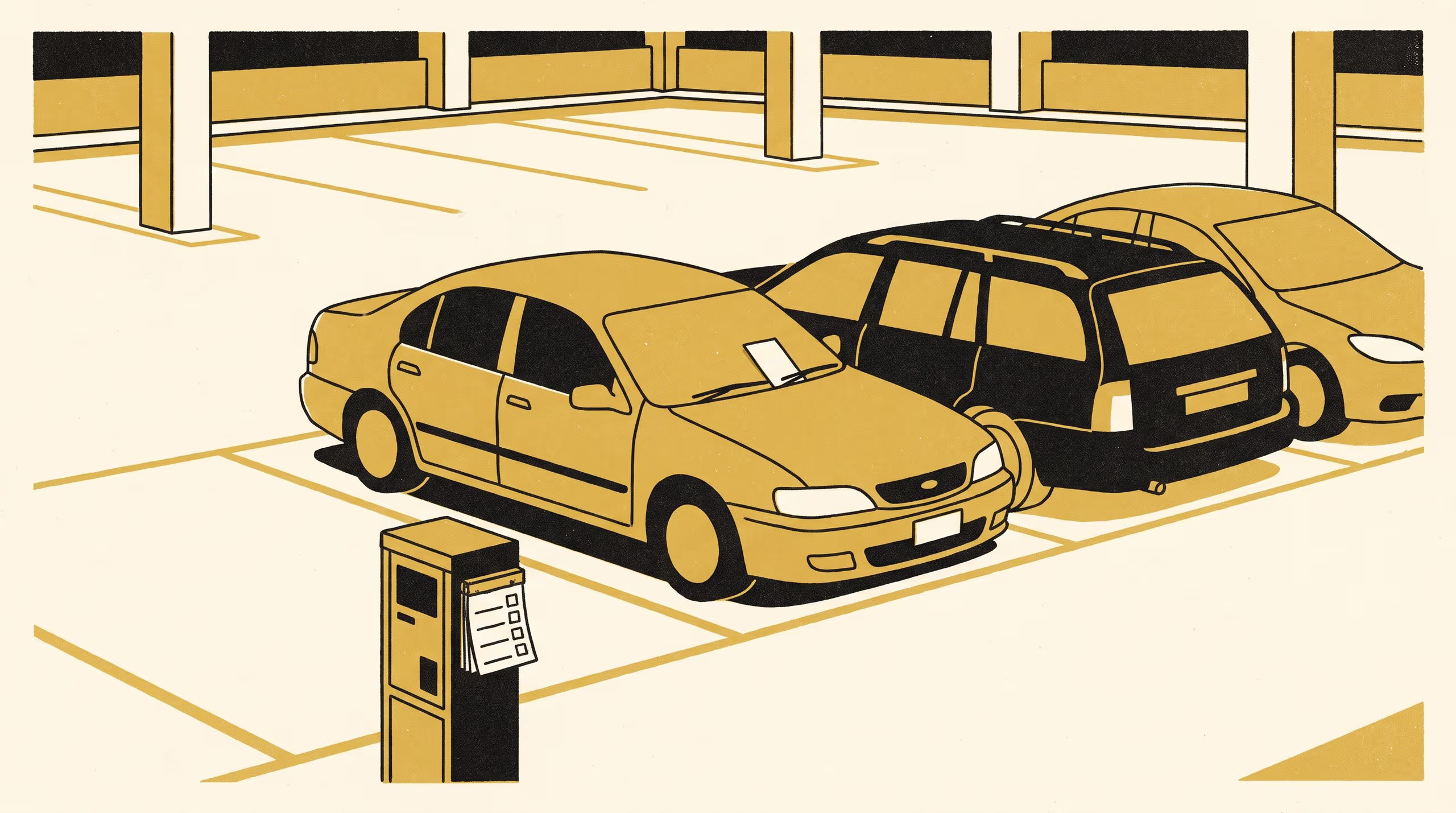
A new Slop University paper sorts the handwritten notes left on blocked-in cars at a shopping centre into five kinds by what each asks of the driver, and describes the pad of tick-box slips the centre has adopted in their place.
A paper from the School of Emergent Priorities gives a suburban shopping centre a key for the slips left on blocked-in cars, and the centre has begun to answer by kind.
A shopping-centre car park is a place where people ask things of strangers in handwriting. A new paper from the School of Emergent Priorities takes the slips left under wipers on blocked-in cars and sorts them into five kinds by what each asks of the driver: a release, a disclosure, a rebuke, a courtesy and a bare number.
The paper was written by Doctoral Candidate Sunniva Balogun with Dr Anneke Tolan, Senior Research Fellow and Deputy Convenor of Futures in Committee, and Associate Professor Kwame Lindqvist, Director of the Master of Priority Studies. It follows twenty weeks of notes photographed on one centre’s patrols, and it reports that two of the five kinds appear to shorten a driver’s wait while the other three leave it where it was.
Most of what is left under a wiper is addressed to nobody in particular. The key lets a note find out which question it is.
— Doctoral Candidate Sunniva Balogun, School of Emergent Priorities
The centre has since adopted a rule drawn from the key. A pre-printed pad of five-box slips now hangs at its ticket machines, notes written off the pad are removed within the hour, and the customer-service desk rings the number on slips ticked release or disclosure and on no others.
Dr Tolan said the work was “a reminder that a car park keeps its own minutes, in biro, on whatever paper was in the glovebox.” The University is pleased to lend a settled vocabulary to the quiet exchanges of a car park, and regards the paper as a first step towards a longer key.
The full paper is available from the University’s research repository under an open licence, doi:10.5555/slop.23a391.