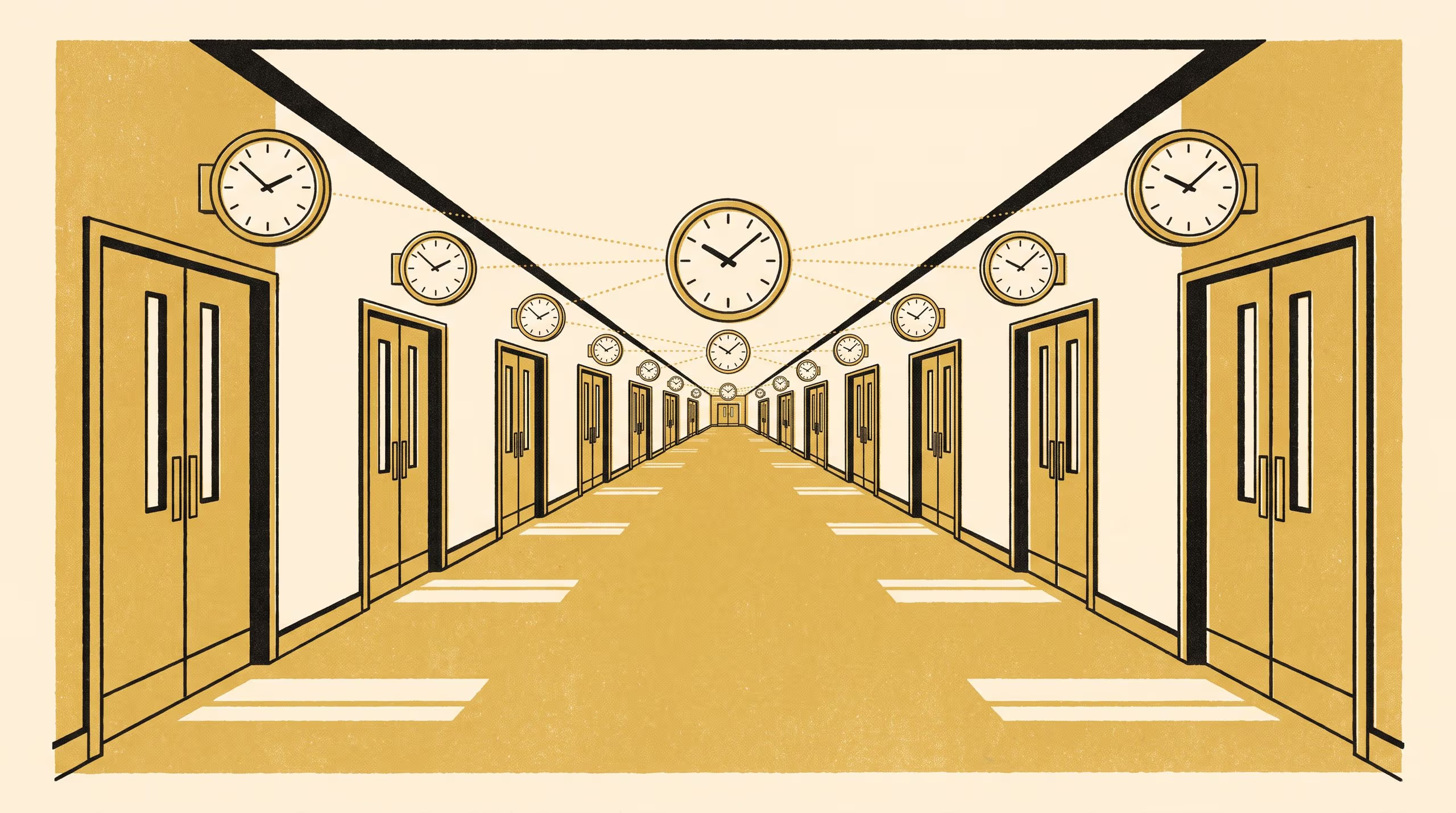
A new Slop University paper describes a system that brings a lecture-theatre corridor's wall clocks into agreement, and the Trajectory Analytics Group adopts the agreed time as the reference for lecture overrun.
A median-consensus system holds twelve wall clocks within seconds of one another, and overrun is now read against it.
Nine lecture theatres, twelve wall clocks and no shared opinion about the hour have become a corridor with one answer. The Trajectory Analytics Group in the School of Emergent Priorities has published a paper describing Concord, a system that lets each clock in a teaching corridor listen to the others and settle, a few seconds at a time, on the time most of them already share.
What we set out to give the corridor was a single answer to a question it had been answering twelve different ways.
— Dr Anouk Mensah, Postdoctoral Fellow, School of Emergent Priorities
The paper follows the system through one teaching period, in which the clocks came into step within hours of installation and stayed there. Lecturers were not asked to do anything differently. Over the same period the minutes recorded as lecture overrun fell in every theatre, while the recorded length of the lectures themselves stayed where it was.
Building on the results, the Group has adopted the corridor’s agreed time as the reference for lecture overrun from the next teaching period, a step that Professor Verity Marris, Director of the Trajectory Analytics Group, described as “a way of making sure the clocks and the people are talking about the same minute.” The Group expects to bring the approach to further corridors where it is well placed to do so.
The release marks the first occasion on which the Group’s work has been fitted to the fabric of a building rather than set down beside it.
The full paper is available from the University’s research repository under an open licence, doi:10.5555/slop.z4vb1s.