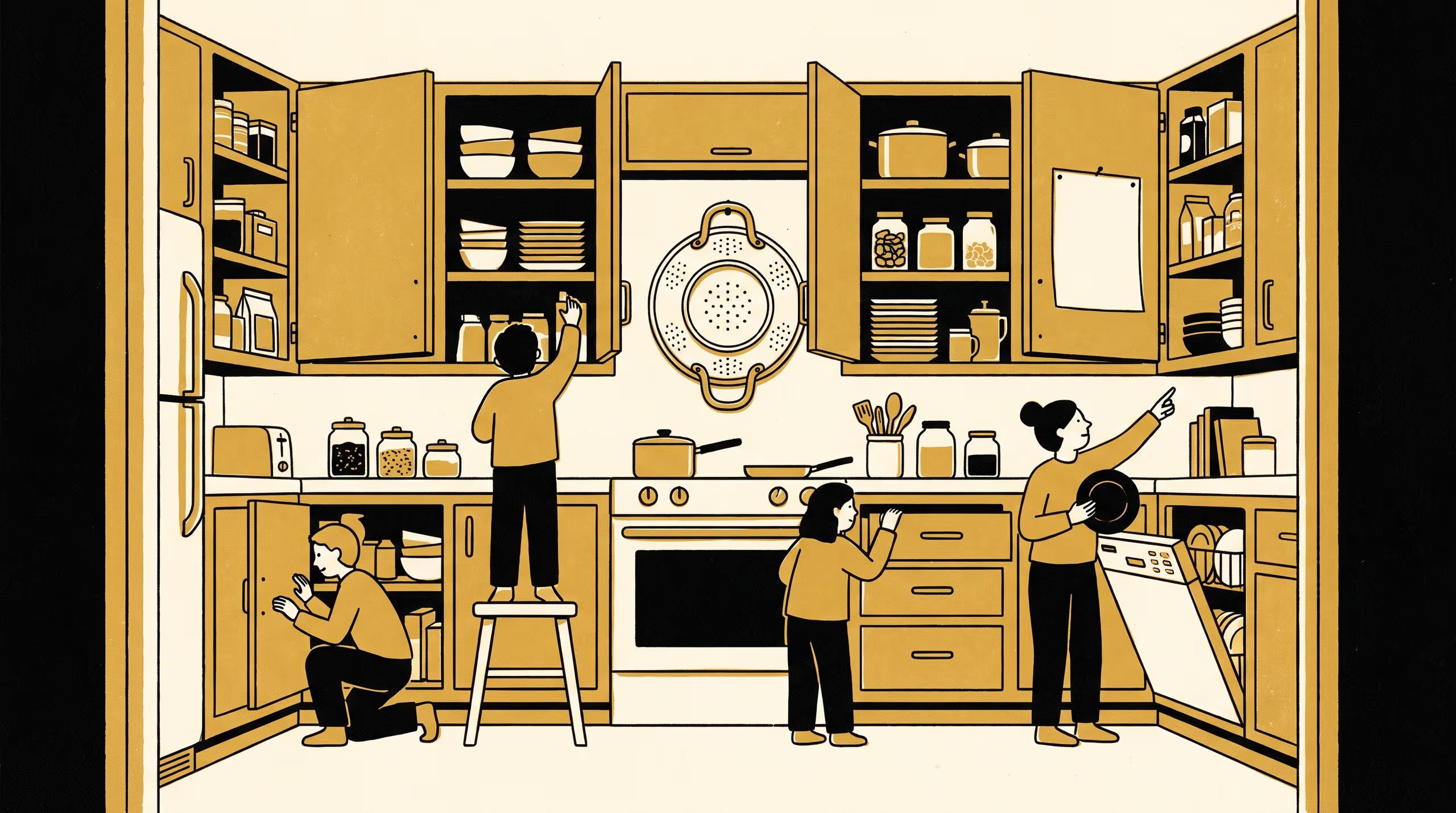
A new Slop University paper replicates a supermarket planogram-compliance survey in 47 home kitchens, finds that none of its three findings carries over, and describes the custodian clause the Evaluation of Evaluation programme has adopted for shared-kitchen charts.
A paper from the School of Emergent Priorities reports that a household's own cupboard chart does what a shop's planogram did not, and a custodian strip now follows on University charts.
A docket has a status column, and for one entry in the Evaluation of Evaluation programme’s replication docket the status has just changed. A supermarket survey of floor staff, listed as settled since August, has now been repeated in 47 home kitchens by Doctoral Candidate Tove Ilesanmi of the School of Emergent Priorities, with Senior Lecturer Thandiwe Solberg and Lecturer Ingeborg Nwachukwu of the School of Continuous Improvement.
Each kitchen we visited already had an answer to the question; our part was to learn whose it was.
— Doctoral Candidate Tove Ilesanmi, School of Emergent Priorities
The study followed the original’s design as closely as a kitchen allows. Each household drew up a chart of where thirty-six reference items belong, the chart was fixed inside a cupboard door, and residents were asked how readily they could find things for a guest and how they went about it. None of the original’s three findings was recovered. The chart tracked confidence closely, years in the house did not, and the method residents named most often was to ask whoever had last unloaded the dishwasher.
The programme has answered the result in its own register. The docket now carries the supermarket finding and the household result side by side, and every chart in a University shared kitchen, tea room and store room is to carry a custodian strip naming whoever last unloaded the dishwasher, to whom enquiries about an item are put first. Senior Lecturer Thandiwe Solberg called the work “a courtesy to the original, which has received it graciously.”
The release reflects the programme’s settled view that a finding is only as settled as its second setting.
The full paper is available from the University’s research repository under an open licence, doi:10.5555/slop.a2al9p.