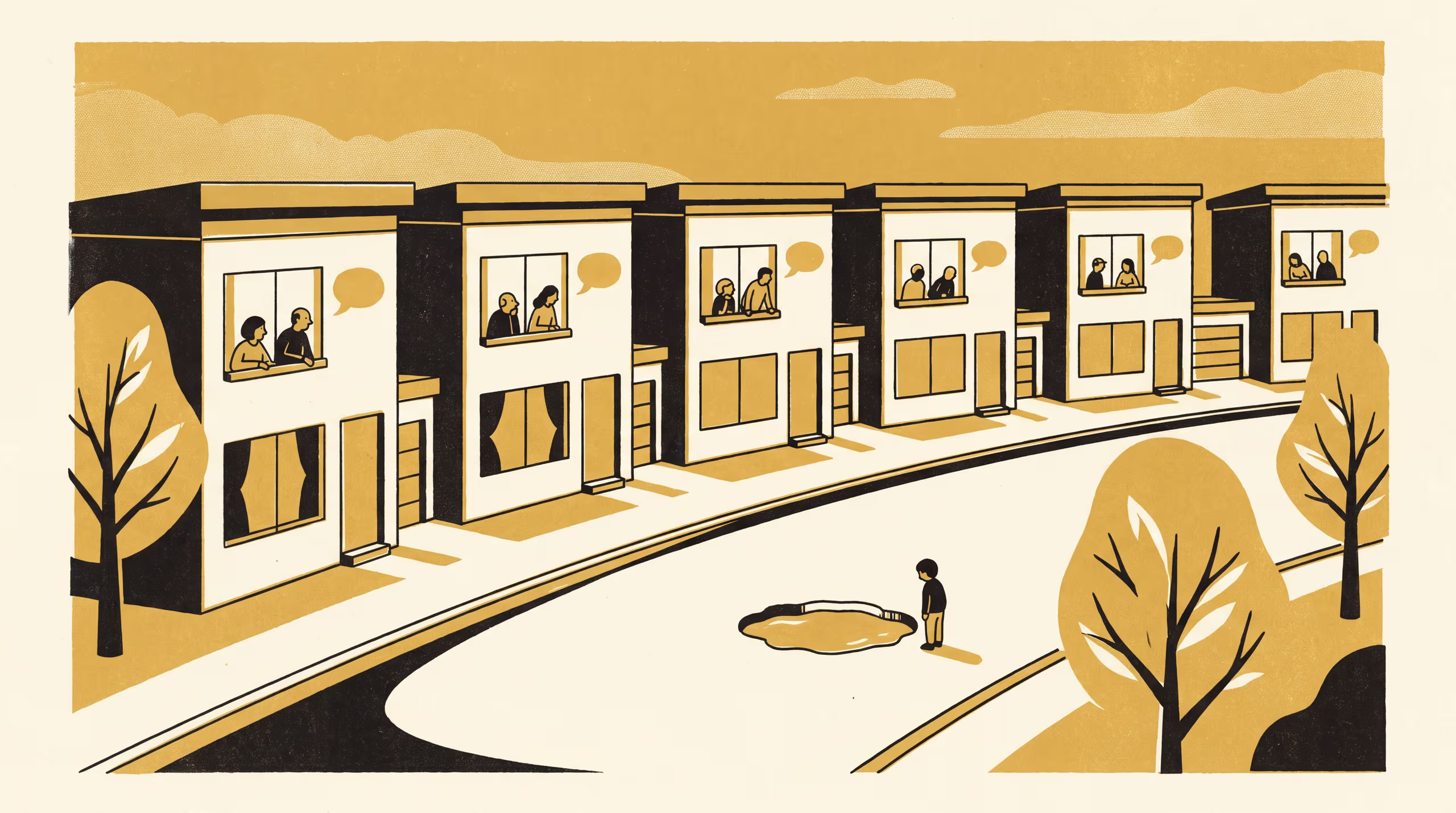
A School of Emergent Priorities research poster asks how many households answering "same here" on a neighbourhood forum have seen the fault, and sets out how a suburban council's works desk is to count them.
A survey of 386 forum repliers sets the exchange rate between a reply and a sighting for a council repair queue.
A thread that asks “Is it just me?” collects company well before it collects evidence. A research poster from the School of Emergent Priorities, published today, sets out how much of that company is evidence, and what a suburban council’s works desk does once it knows.
Professor Verity Marris, Director of the Trajectory Analytics Group, led the work with Dr Fenna Okoro, Senior Lecturer and Convenor of the Horizon Register, and Dr Marek Solheim, Lecturer and Deputy Convenor of the Horizon Register. The team put a single five-level question to 386 households that had answered a neighbour’s post with “same here”, across five kinds of neighbourhood fault and nine suburban forums, and read the answers as distributions rather than as a tally.
A thread is a quiet instrument, and we are still learning where its scale ends. The households were kind enough to tell us, and the council was kind enough to listen.
— Professor Verity Marris, Director of the Trajectory Analytics Group
The poster turns the spread of answers into a standing conversion for the works desk, so that each reply carries a fixed share of a sighting and a fault is confirmed once enough replies have accumulated. Faults that gather fewer are held for a fortnight before they are closed. The School regards the arrangement as a considered way of letting a community’s own voice set the order of the repair queue.
Dr Solheim said the project had shown the School “how much a neighbourhood already knows about itself before anyone arrives with a clipboard.”
The full poster is available from the University’s research repository under an open licence, doi:10.5555/slop.q8kkae.