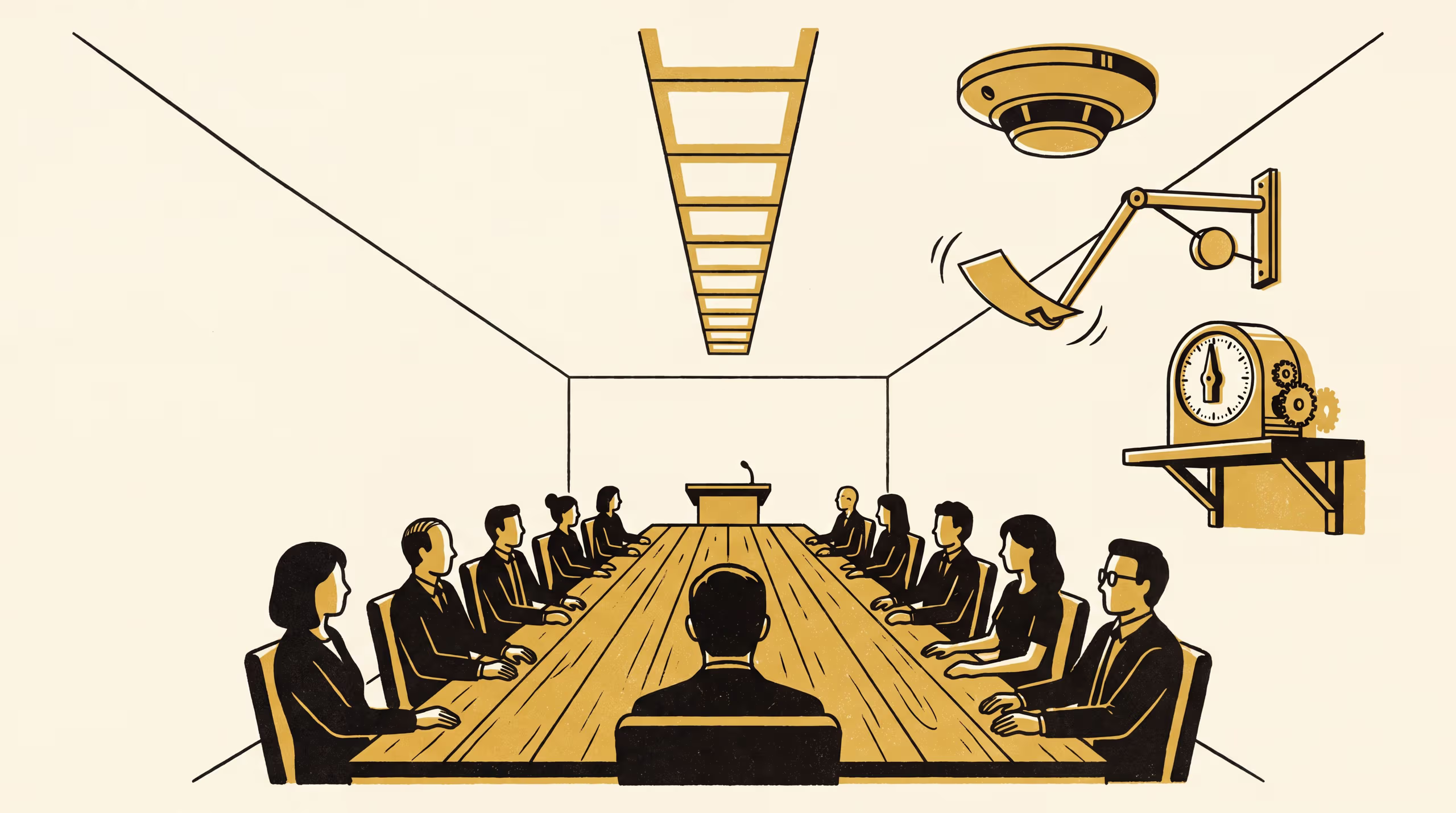
A new Slop University research poster describes a timer-driven paper arm for seminar-room lighting sensors and the nine-minute booking unit that now follows it.
A paper arm beside the ceiling sensor kept the lights on in every armed meeting across fourteen windowless rooms.
Rooms with no windows keep their own counsel about the passing of time, and a ceiling sensor has until now been the only part of a seminar room permitted to act on it. A research poster from the School of Emergent Priorities, published today, sets out a small mechanical answer: a card arm, released by a wind-up kitchen timer, that waves at the sensor often enough to persuade it that the room is occupied.
The poster is led by Professor Verity Marris, Professor and Director of the Trajectory Analytics Group, with Dr Anouk Mensah and Dr Iben Chikere. It follows the arm through fourteen rooms over eleven weeks, and it records the booking arrangement that the work has settled: rooms carrying an arm are now reserved in whole nine-minute waves, and each is released to its next booking once the arm has completed its final sweep. The Facilities occupancy return is reported in the same unit.
The lights had been keeping time for us all along. It seemed courteous to learn the tempo.
— Professor Verity Marris, Professor and Director, Trajectory Analytics Group
The study design pairs armed and disarmed weeks in each room and logs every seated meeting on the door sheet, and the poster’s chart sets the two conditions side by side. Dr Mensah said the team was glad to have been handed rooms whose habits were so patiently recorded by the people who sit in them, and that the waves had already begun to feel like the natural grain of the building. A metronome variant is in preparation for rooms whose ceilings sit beyond the first design’s reach.
The full poster is available from the University’s research repository under an open licence, doi:10.5555/slop.qmw6fj.