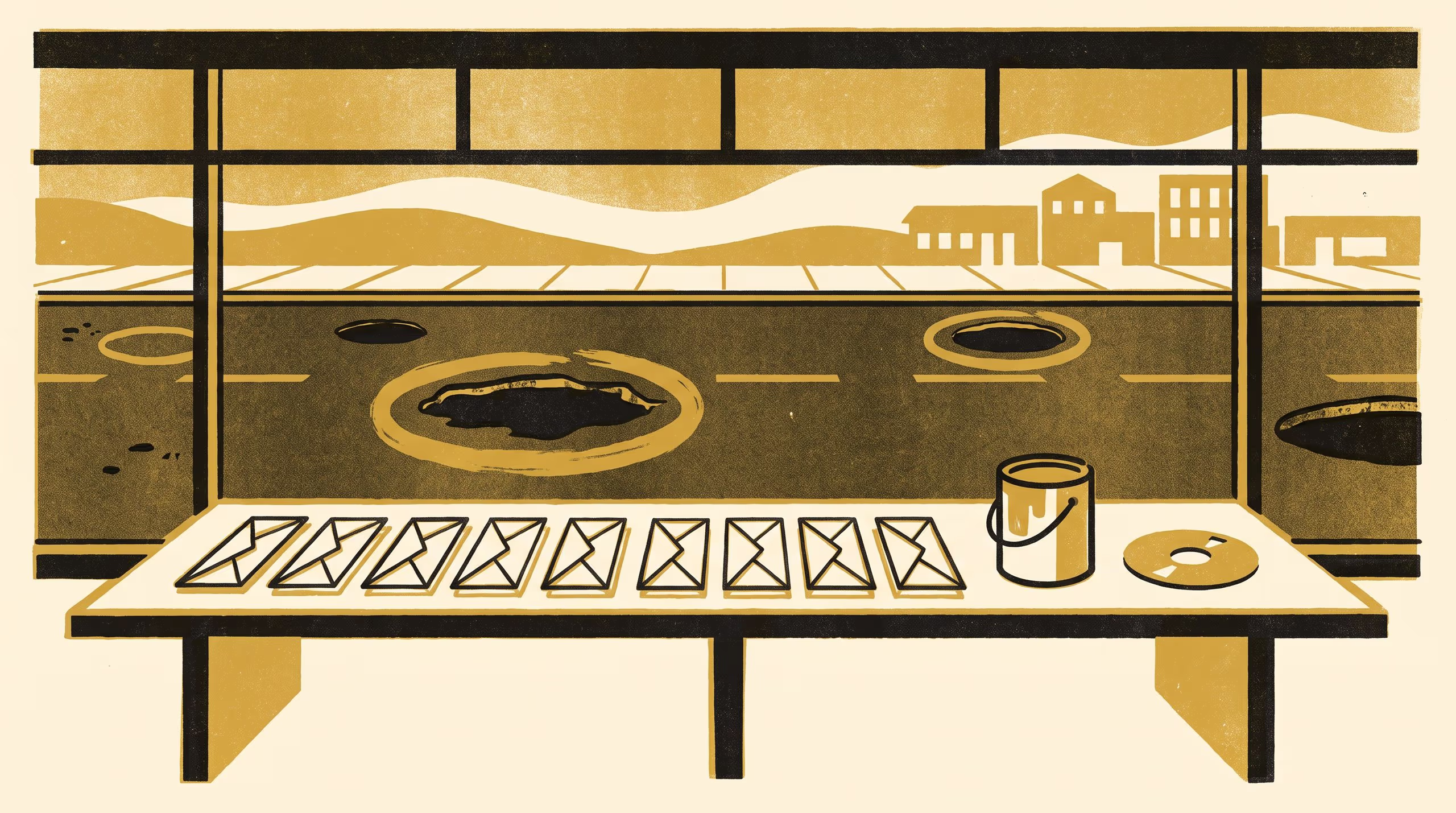
A School of Continuous Improvement poster reports that a painted ring does not shorten the wait for a pothole repair, and a shire's Road Maintenance Committee has made a matching trial the condition of any change.
A shire committee's 480-pothole trial reports equal waits for ringed and bare potholes
For as long as its minutes record, a regional shire’s Road Maintenance Committee has circled reported potholes in orange paint. A research poster from the School of Continuous Improvement, published today, sets out what the circle does to the time a pothole waits for its patch.
The poster is led by Doctoral Candidate Edda Nwafor with Lecturer Solveig Adeyemi and Postdoctoral Fellow Dr Joost Nwosu. Envelopes were opened at the Committee’s own meeting table, and the two groups of potholes were followed through the works-order system until each was closed.
A committee that agrees to draw envelopes in its own meeting has already done most of the work. The rest was keeping the tally.
— Doctoral Candidate Edda Nwafor, School of Continuous Improvement
Across 26 weeks the ringed and unringed groups reached the same median of 17 days. The Committee has recorded the result as it was found and adopted Standing Order 4, under which any change to a pothole practice is preceded by a trial of the same size, allocated the same way. The ring remains on every reported pothole in the meantime.
“A standing order is how a committee remembers what it has learned,” said Ms Adeyemi. The School regards the Committee’s willingness to be tested as a model of the stewardship it hopes to see across local works.
The full poster is available from the University’s research repository under an open licence, doi:10.5555/slop.pa539k.