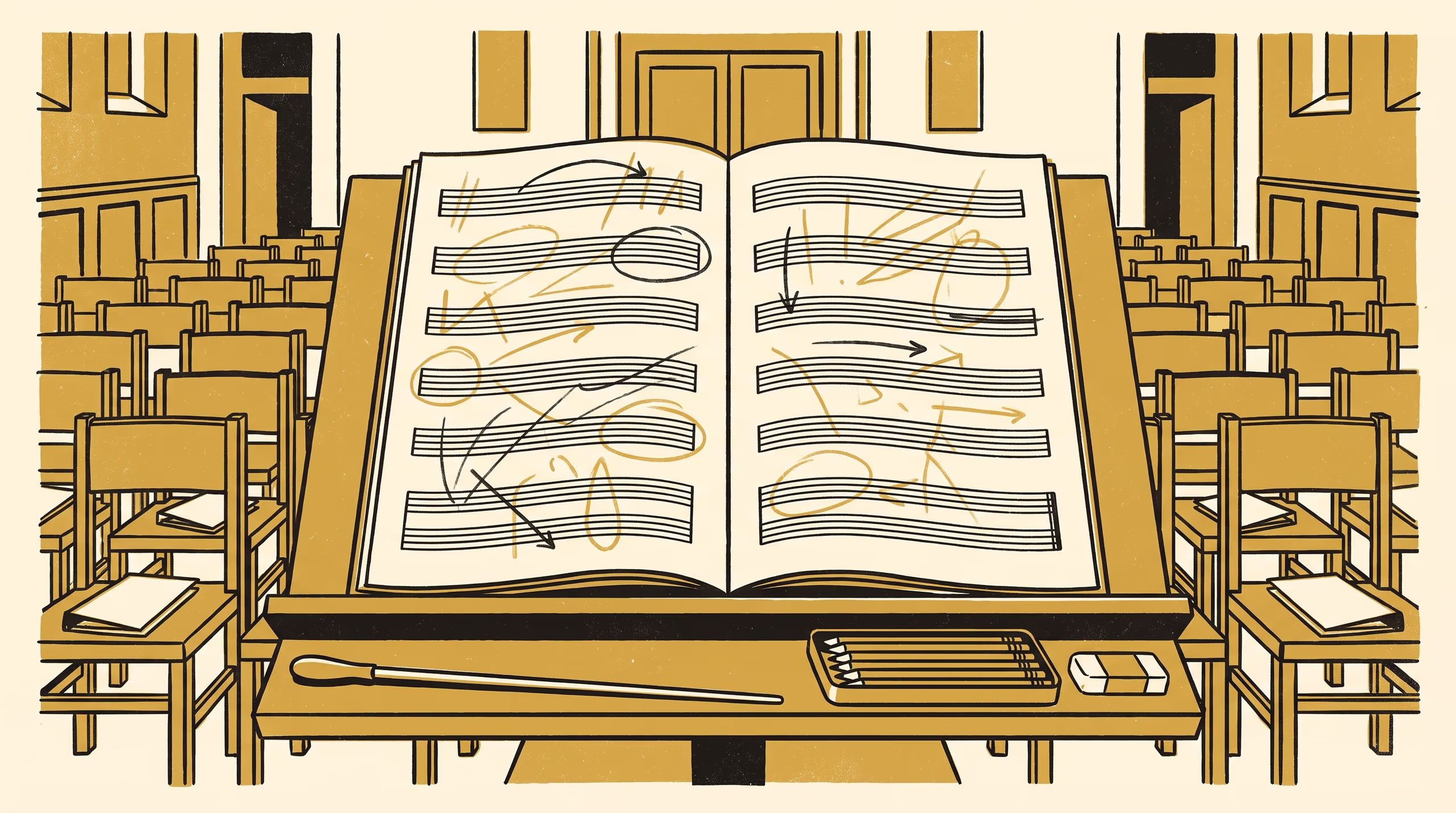
A School of Emergent Priorities poster follows a community choir's lending folder through five reissues, and the choir's committee has adopted three standing rules on the strength of what the pencil marks did.
A 212-bar study of one choir's score folder leads its committee to bar the eraser and retain every master copy
A choir’s score folder is lent, marked, returned and lent again, and for most choirs the question of what happens to the pencil in between is left to whoever holds the eraser. A research poster from the School of Emergent Priorities, published today, treats that question as a teaching case.
The poster is led by Dr Anouk Mensah, Postdoctoral Fellow, with Lecturer Iben Chikere and Lecturer Ingrid Vasseur, Convenor of Futures in Committee. It follows fourteen titles through five reissues over three seasons in one community choir, and sets out the librarian’s decision as a case for committee study, with discussion questions and a suggested meeting length.
A pencil is a short promise made by someone who has since left the choir. It has been rewarding to hear what happens when the promise is kept.
— Dr Anouk Mensah, Postdoctoral Fellow, School of Emergent Priorities
Of 212 bars where the conductor changed an instruction at rehearsal, 131 were sung to the inherited mark rather than the spoken change. The choir’s committee has since adopted three standing rules: no eraser travels with a folder, a spoken instruction takes effect once it is pencilled into the library master, and the master is sung where the two differ. Master copies are retained for the life of the choir.
“We came away with a good deal more respect for the eraser than we had when we began,” said Lecturer Iben Chikere. The School regards the work as a contribution to its agenda on how an instruction outlasts the occasion for it, and welcomes the committee’s decision to extend the rules to a second folder.
The full poster is available from the University’s research repository under an open licence, doi:10.5555/slop.ppn6i3.