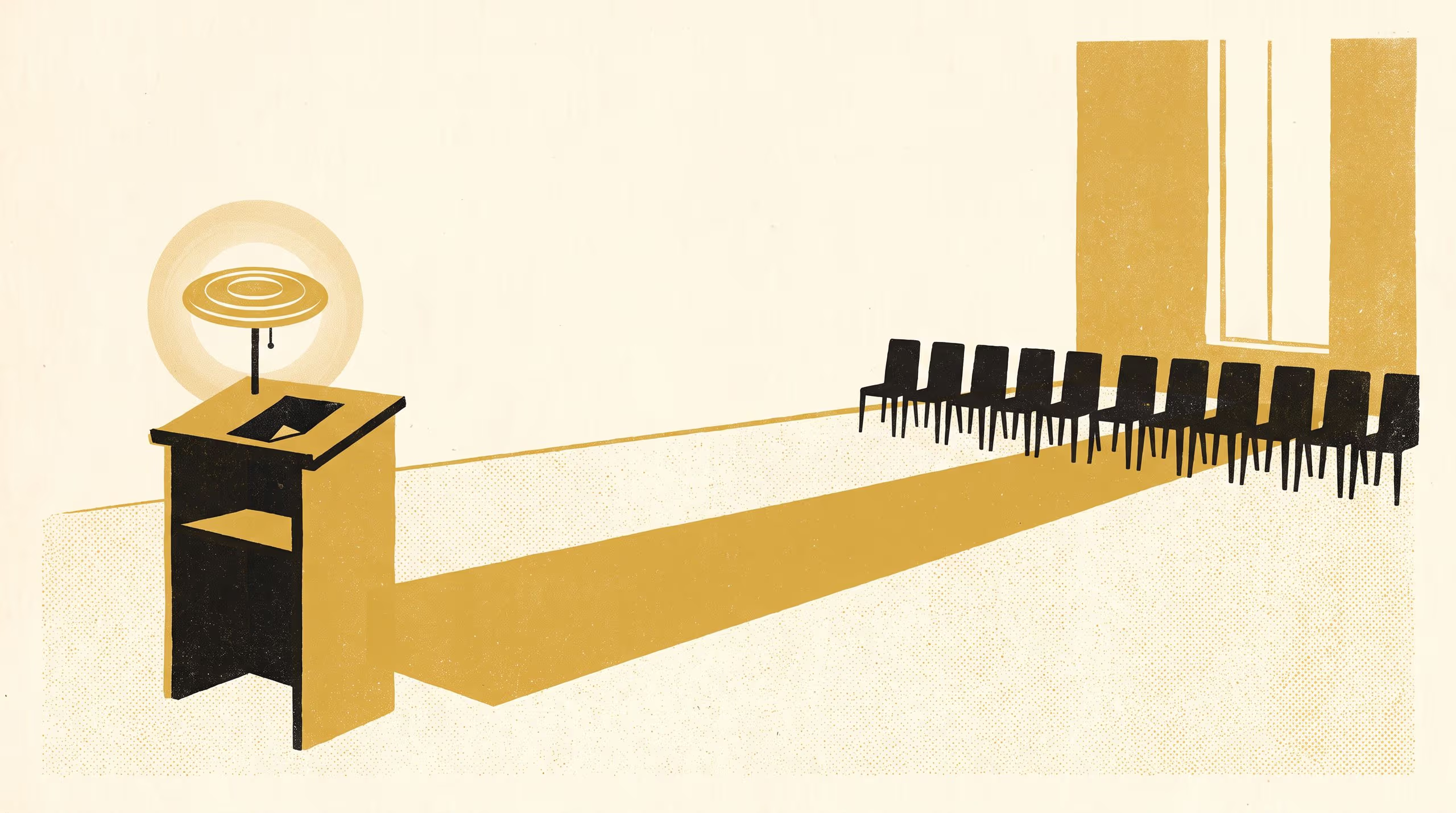
A new Slop University research poster times resident addresses at a council meeting and reports the standing order of silence that followed.
A survey of 1,420 public-question-time addresses finds the three-minute allowance filling to the bell once the silence took effect.
Public question time arrives with a lamp, a bell and three minutes, and the School of Emergent Priorities has now timed what residents do inside them. A research poster, available today, reports 1,420 addresses across four quarters of a council’s ordinary meetings, led by Doctoral Candidate Hedvig Anyanwu with Doctoral Candidates Edda Nwafor and Tove Ilesanmi.
The lamp told the speakers where the three minutes ended. It seemed only fair to ask what the room did with the rest.
— Hedvig Anyanwu, Doctoral Candidate, School of Emergent Priorities
Two observers in the public gallery timed every slot against the lamp’s colour changes, and the distributions were read across the quarters before and after the council adopted its standing order on unspent time. Under the order, the chamber sits without speaking through whatever remains of a speaker’s allowance, and the chair holds no discretion to shorten it.
The poster reports that addresses ending in the final ten seconds rose from 43.5% to 91.4% once the order took effect, and that none of the 710 addresses in the later two quarters ran under a minute. The quarterly modal length is now tabled with the agenda papers.
“A chamber that agrees to be quiet for a stranger’s spare seconds has agreed to something worth looking at,” said Doctoral Candidate Edda Nwafor.
The University is pleased to see a small piece of procedure given a whole School’s attention, and to see the work sit so readily alongside the council’s own.
The full poster is available from the University’s research repository under an open licence, doi:10.5555/slop.zcfdr2.