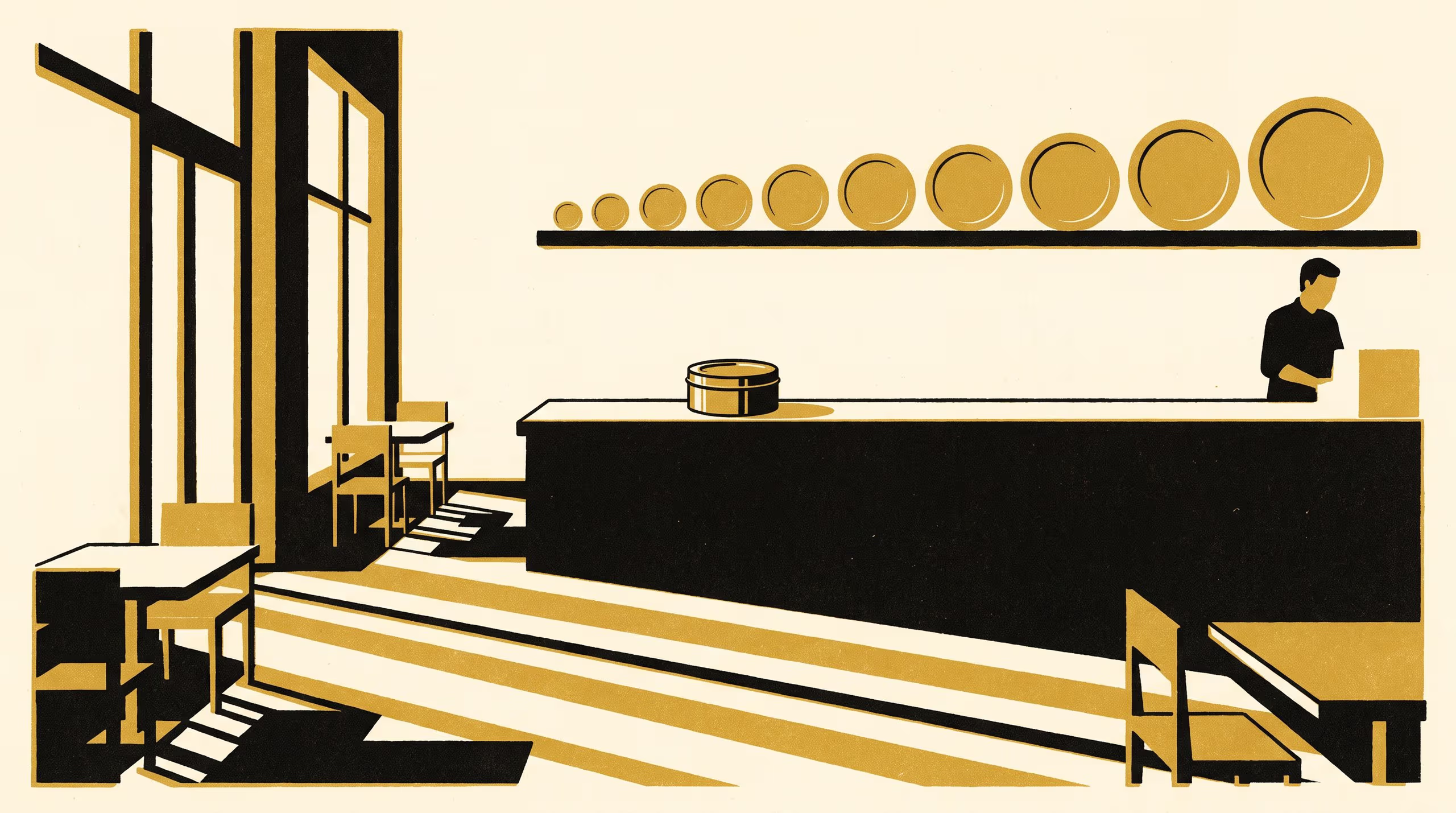
A School of Emergent Priorities brochure reports that the gathering of purchases beneath a supermarket's contactless ceiling does not reappear at a café's petty-cash tin, and that the University has scheduled a ladder of nine lid stickers in response.
A supermarket's contactless-ceiling cluster fails to reappear at a petty-cash tin's receipt-free line, and the lid sticker steps up at every shift change
The School of Emergent Priorities counts a result as unfinished until it has been asked to hold at a second counter. A contactless ceiling at a supermarket checkout drew a tight gathering of purchases beneath it; at a café’s petty-cash tin, set against the receipt-free line printed on its lid, the gathering did not appear. The University has answered with a schedule rather than a verdict. The tin’s lid sticker steps up one size at every shift change, along a ladder of nine, and the trial closes at the ninth rung whatever the tin holds in the meantime.
The brochure was led by Doctoral Candidate Tove Ilesanmi, with Dr Ingeborg Nwachukwu, Lecturer and Convenor of Capability Sprints in the School of Continuous Improvement, who led the original supermarket work, and Lecturer Dr Lindiwe Achterberg. It sets the tin and its ladder beside the published record that leads to them.
Every counter that let us stand at its till taught us something about where a line sits. We are grateful to those counters, and the ladder is our way of staying a little longer.
— Dr Ingeborg Nwachukwu, Lecturer and Convenor, Capability Sprints
Partner tins climb on the timetable of their own handovers: the outgoing shift peels the smaller sticker, the incoming shift presses on the next, and a Friday count is signed against the rung. The ladder does not consult the tin, and a cluster that appears early is logged without shortening the climb. The University regards a schedule that no result can move as the most courteous way of taking a null seriously, and Dr Achterberg describes the arrangement as the one most likely to reach its own last rung.
The full brochure is available from the University’s research repository under an open licence, doi:10.5555/slop.6kquoo.