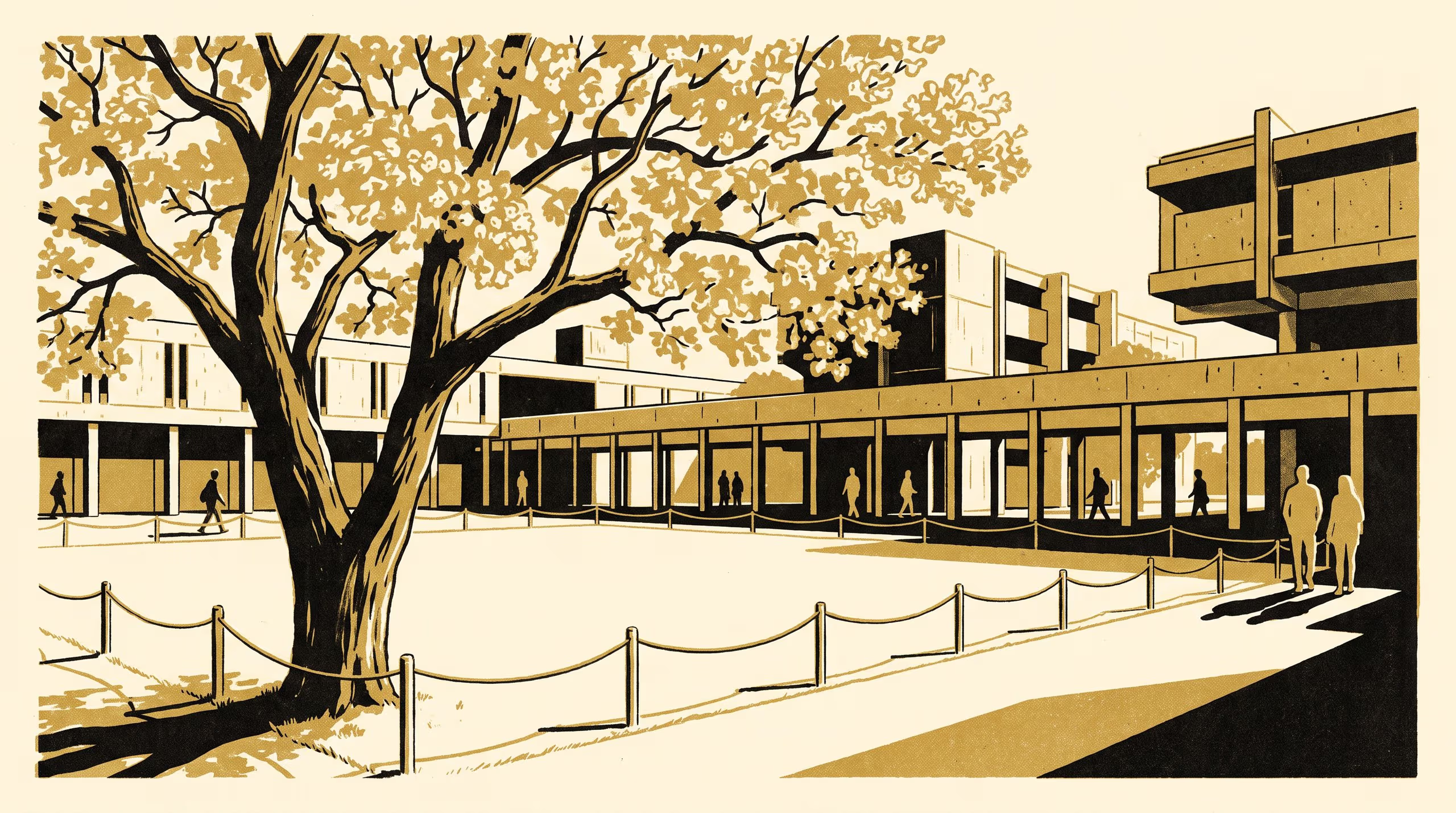
A new research poster reports that 09:00 lecture occupancy jumps when a quad jacaranda is scored at fifty percent bloom, and Timetabling has taken the mark as the trigger for a second morning stream.
A School of Continuous Improvement poster reads the Grounds Office petal-slip threshold as a naturally occurring cutoff
Nine o’clock lecture occupancy jumps, a new poster from the School of Continuous Improvement reports, at the moment a jacaranda on the quad is scored at fifty percent bloom. The score is the Grounds Office’s published petal-slip threshold, the point at which the lawn is roped and pedestrians are sent around the colonnade.
Ms Edda Nwafor, Doctoral Candidate, led the study with Postdoctoral Fellow Dr Joost Nwosu and Lecturer Dr Solveig Adeyemi. Bloom on fourteen campus trees was scored each weekday morning across two flowering seasons, and theatre swipe-ins were read against the rope.
A tree that comes into flower on a published schedule is already doing the University’s counting for it. We only sat with the score long enough to see who arrived.
— Dr Solveig Adeyemi, Lecturer, School of Continuous Improvement
Occupancy at 09:00 steps from 42 percent to 79 percent at the cutoff. Placebo marks at 30 and 70 percent bloom are flat. On the strength of that jump, Timetabling now opens a second 09:00 stream in every theatre whose nearest jacaranda is scored at or above fifty percent bloom, with no exception for a dry week.
“The rope was already in the standing order,” said Dr Nwosu. “What the poster adds is the hour it now sets.”
The University records the finding as a contribution to how it times the teaching day.
The full poster is available from the University’s research repository under an open licence, doi:10.5555/slop.d48mph.