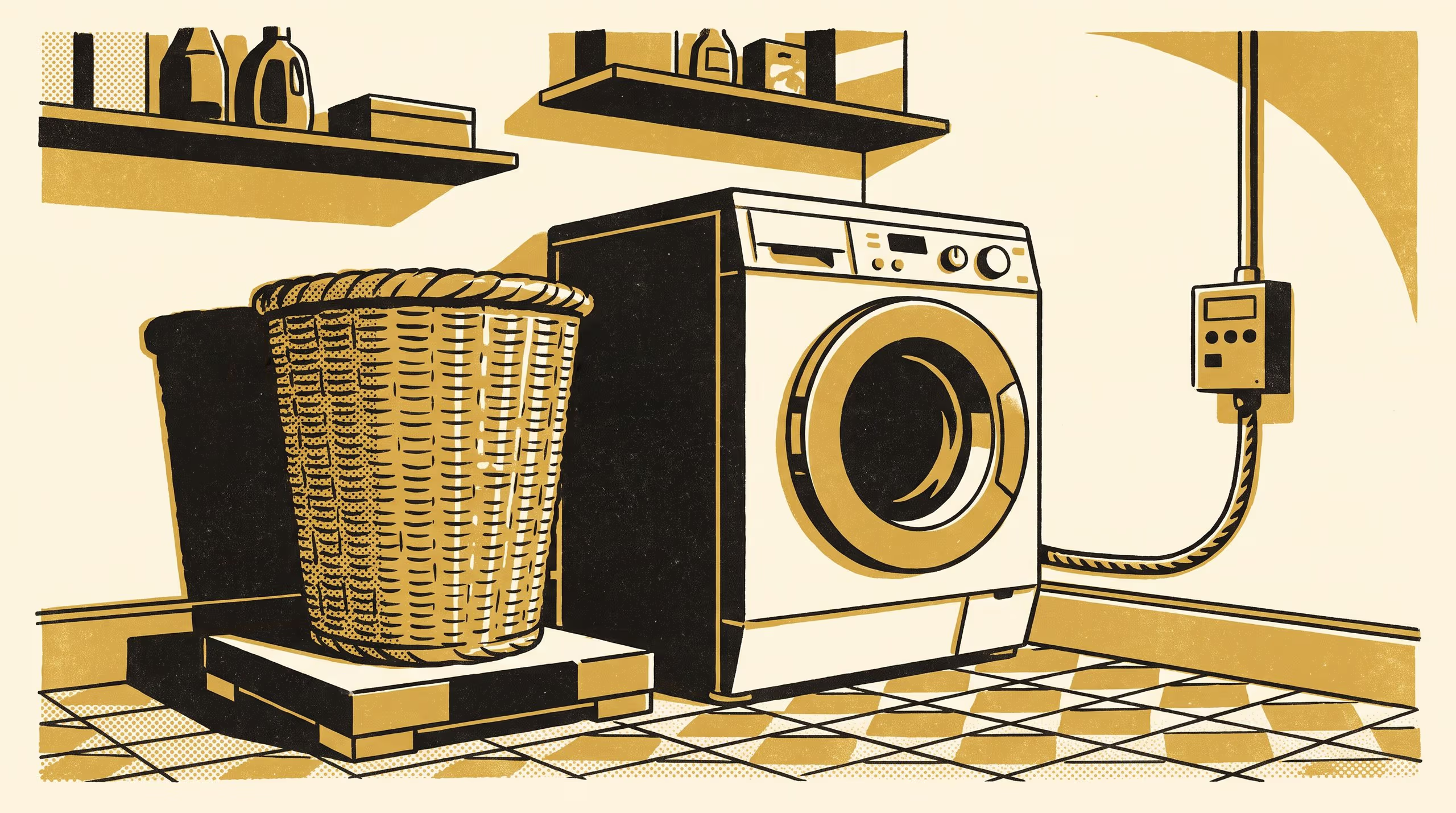
A new research poster from the School of Continuous Improvement specifies HAMPER, a wash-order controller driven by hamper-weight, and records the School's decision to treat an unscheduled cycle as a published service failure.
The household duty officer operates HAMPER; an unscheduled cycle is a published service failure
The week’s wash now starts when the hamper says so. A new research poster from the School of Continuous Improvement, led by Doctoral Candidate Edda Nwafor with Postdoctoral Fellow Dr Joost Nwosu and Lecturer Dr Solveig Adeyemi, specifies HAMPER, a closed-loop controller the household duty officer operates, and records the School’s decision to treat an unscheduled cycle as a published service failure.
The duty officer’s job was never to choose the wash. It was to keep the sequence the hamper had already written.
— Edda Nwafor, Doctoral Candidate, School of Continuous Improvement
Forty-two households carried a load cell under the hamper for fourteen weeks. HAMPER released a cycle at 3.2 kg into two published slots, Tuesday evening and Saturday morning, and refused the rest. Seventy-eight per cent of the 3,276 loads left in those slots; wet towels made up close to a third of the released weight by the last month, as households stuffed the basket to trip the threshold.
On the strength of the deployment, the School adopts HAMPER’s load sequence as the only recognised wash order for instrumented households. Discretionary-laundry privilege suspends until the next roster. “The households were generous with the basket and with the record of what went in it,” said Dr Adeyemi.
The School has added the hamper to the set of ordinary jobs it is prepared to put a lock on.
The full poster is available from the University’s research repository under an open licence, doi:10.5555/slop.tuhcbl.