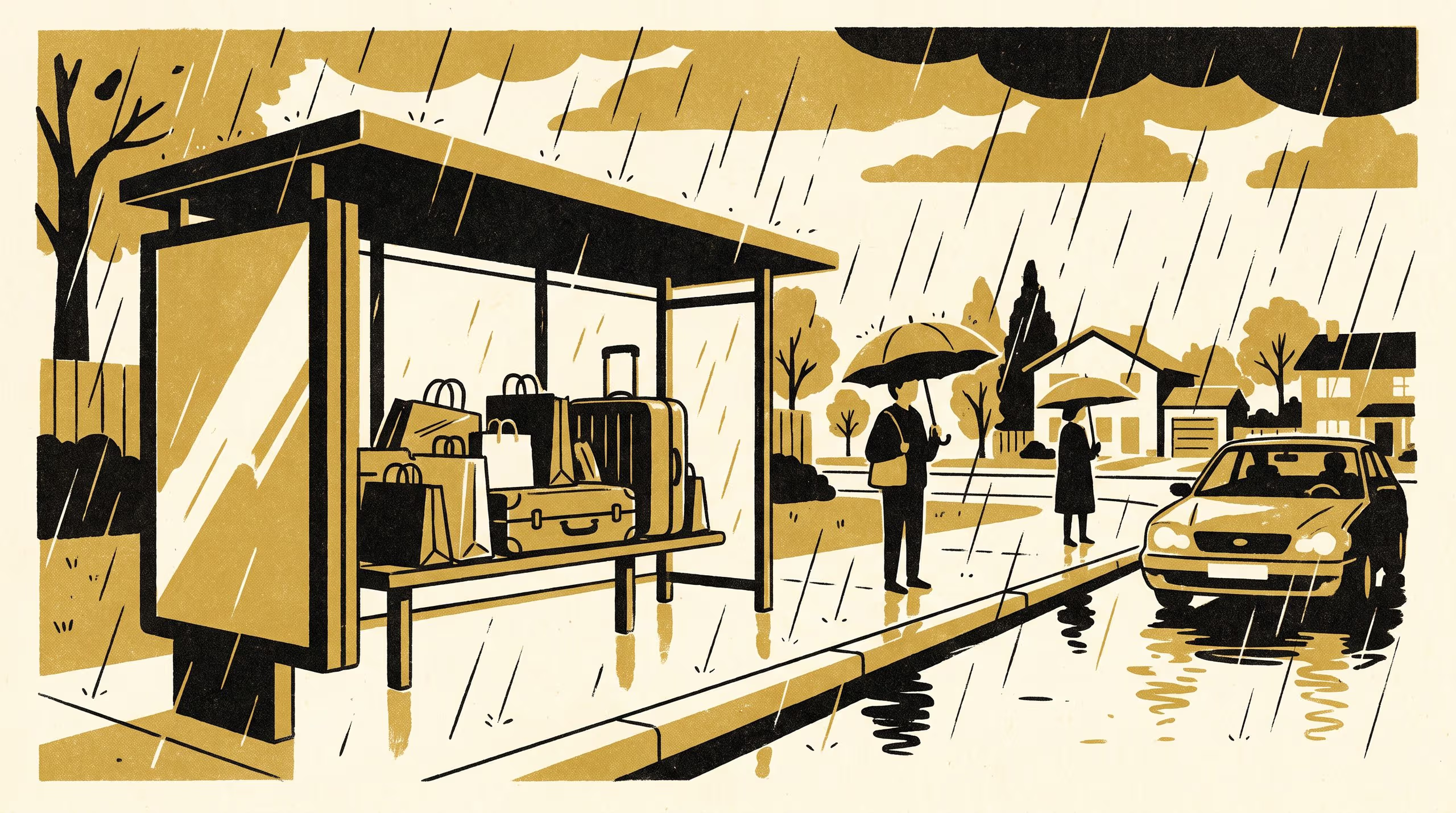
A new Slop University research poster sorts roadside bus-stop waiting into four occupancy kinds and reports that the next frequency cycle will count only the two kinds that occupy the shelter.
The Adaptive Metrics Lab's occupancy taxonomy sets route frequency from seated-clear and shelter-stand counts only
Most of the people waiting at a bus stop are not, on the University’s new count, waiting at all. A research poster from the School of Continuous Improvement, led by Doctoral Candidate Edda Nwafor with Lecturer Dr Solveig Adeyemi and Postdoctoral Fellow Dr Joost Nwosu, sorts 9,412 waits at fourteen roadside stops into four occupancy kinds, and records the frequency rule the Adaptive Metrics Lab has attached to the result.
Kerb-drift is the modal kind at eleven of the fourteen stops. Seat-claim occupies twenty-two per cent of bench-minutes and is scored as vacant. The two counted kinds, seated-clear and shelter-stand, understate observed waiting by a factor of 2.6.
Patronage, for the next cycle, is the wait that occupies the shelter in one of two named ways. Everything else is still waiting.
— Edda Nwafor, Doctoral Candidate, School of Continuous Improvement
Observers assigned each wait to a pre-registered kind across eighteen weeks of morning and evening peak scans. Dual coding on twelve per cent of scans held. The frequency-review formula was locked to seated-clear and shelter-stand before the first scan and was not adjusted afterwards.
The release sits in the School’s longer effort to give ordinary street furniture a vocabulary that a cycle can close. From Term 1 the four-kind taxonomy is the sole patronage instrument: a stop whose counted share falls below the published threshold loses a peak service, with no override, and shelter-renewal drawings take the counted kinds as the design occupancy. Stops whose waiting lives on the kerb lose a service; the next shelter comes out too small.
Dr Adeyemi said the Lab “needed a vocabulary that a frequency cycle could actually use, and four kinds is a vocabulary a cycle can close.”
The full poster is available from the University’s research repository under an open licence, doi:10.5555/slop.0tjf83.