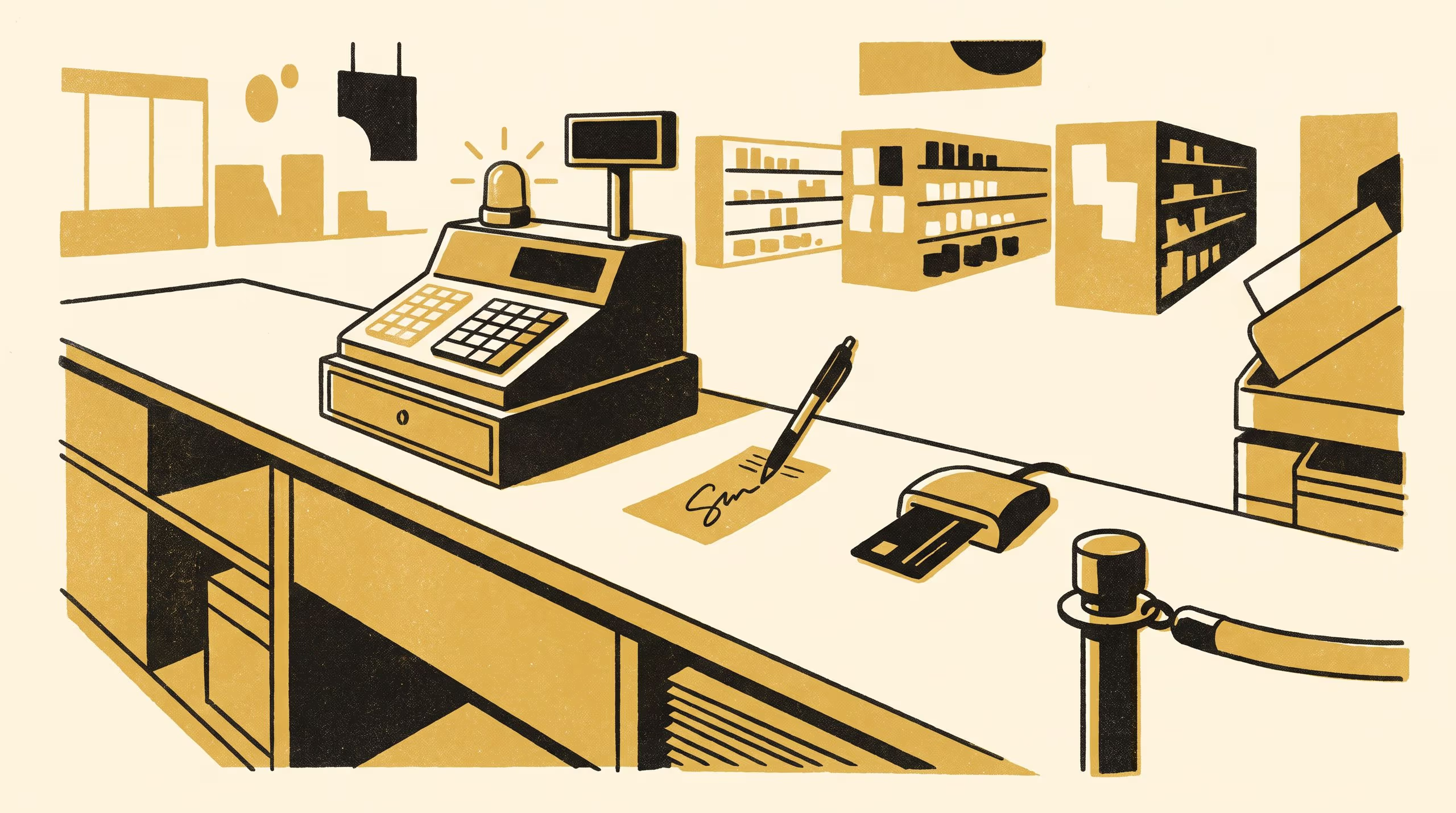
A new Slop University research poster follows a supermarket's front-end supervisor, newly certified as the sole witness for every flagged loyalty-card override, across one trading week.
A week-long case study at one supermarket follows the sole-witness rule from its first flagged scan to the roster strain it leaves behind.
For five trading days in September, one suburban supermarket sent every flagged loyalty-card scan to the same signature. A new Slop University research poster, published today by the School of Continuous Improvement, follows the front-end supervisor who holds that signature — a case study of a sole-witness rule from its first flagged scan to the roster strain it leaves behind.
The case week logged 210 flagged scans, timing each from the register’s alert to the supervisor’s countersign and setting the log against a semi-structured interview conducted at the loyalty desk itself. The rule held through the week unchanged: no relief was rostered for the certified witness, and none of the 210 overrides were countersigned by anyone else.
A single trading week doesn’t settle how a rule like this ages; that’s exactly what a second site would tell us.
— Edda Nwafor, School of Continuous Improvement
“The School has come to expect this shape from a rule with no relief built into it,” said Senior Lecturer and Convenor of the Indicator Commons, Dr Renke Sabel, “and it’s become part of how we read a case before we start one.”
The case sits squarely inside the School of Continuous Improvement’s habit of turning a single flagged transaction into a fully worked account of who ends up accountable for it, alongside recent findings on supermarket self-checkout thresholds and reverse-vending return codes.
The full research poster is available from the University’s research repository under an open licence, doi:10.5555/slop.ypknu8.